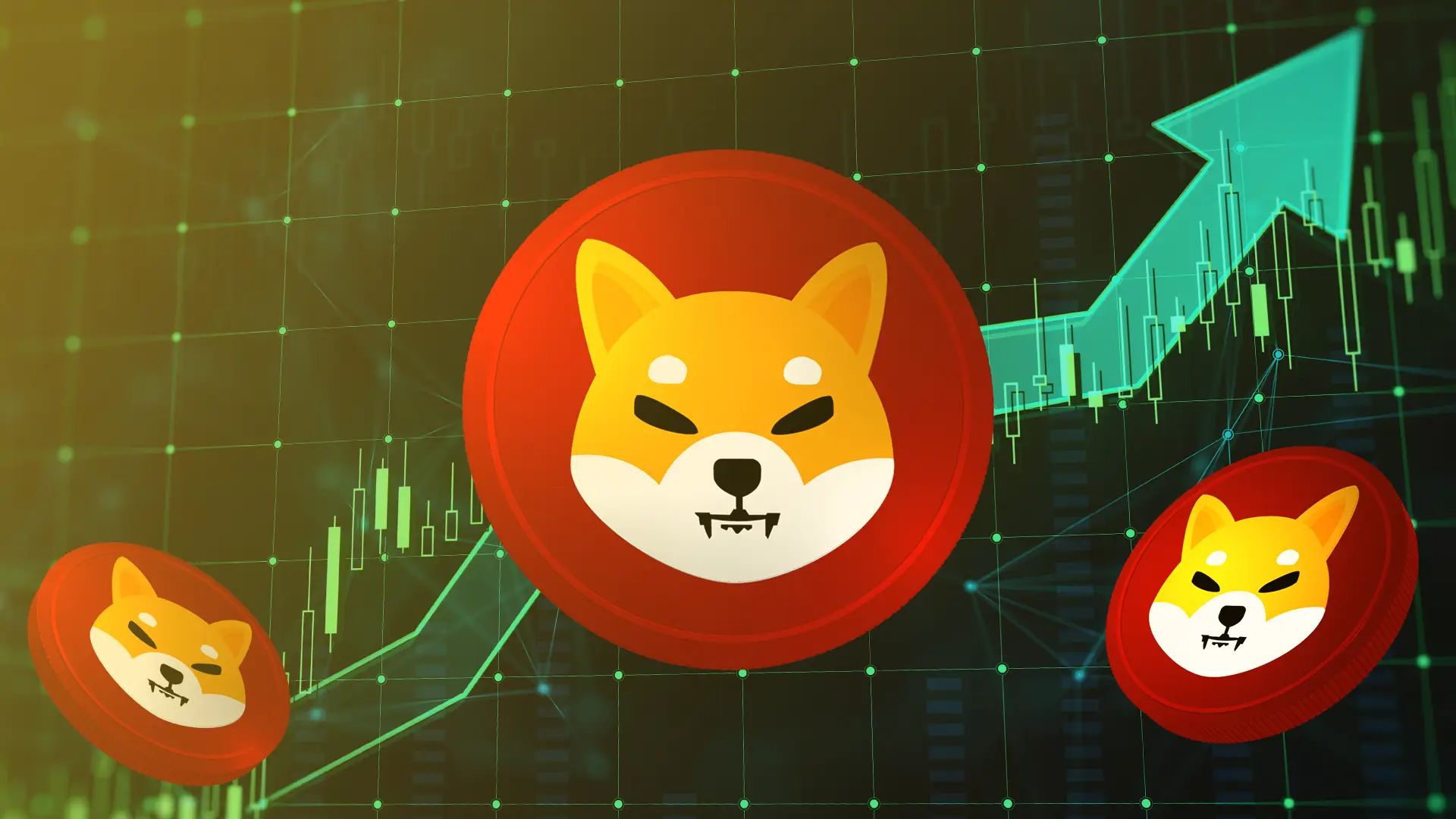
Shiba Inu’s price stabilized on Monday as the broader crypto market recovered. SHIB climbed to $0.0000085, rebounding from its year-to-date low of $0.0000075. The token now shows signs of a potential upside move, supported by several bullish chart patterns and a sharp decline in exchange supply.
Bullish Patterns Signal a Possible SHIB Reversal
On the daily chart, Shiba Inu has been trapped in a persistent downtrend for months as large holders continued to sell. However, momentum may be shifting. SHIB has developed multiple bullish indicators, including a large falling wedge formation defined by two descending, converging trendlines.
The token also appears to be shaping an inverse head-and-shoulders pattern, another powerful bullish setup in technical analysis. At the same time, a bullish divergence has emerged: indicators such as the Relative Strength Index (RSI) and Percentage Price Oscillator (PPO) have been trending higher even as price moved lower. Historically, this divergence often precedes strong upward breakouts.
If this momentum holds, SHIB’s next key upside target is the psychological level of $0.000010, roughly 20% above its current price. Still, a drop below the critical support at $0.00000753 would invalidate the bullish outlook.
SHIB Exchange Supply Drops Sharply
A major catalyst supporting Shiba Inu is the rapid decline in exchange balances. Over the past few days, the amount of SHIB held on exchanges has fallen to 287 trillion—its lowest level in months. This marks a steep drop from the monthly high of 340 trillion, meaning more than 53 trillion tokens have been moved off exchanges.
Such a reduction typically indicates that investors expect the price to strengthen, as tokens shifted off exchanges are less likely to be sold immediately.
Burn activity has also surged. In the last 24 hours, SHIB’s burn rate jumped by 1,244% to over 17 million tokens, fueled mainly by a single holder burning 13.5 million. While token burns reduce circulating supply and are often viewed as bullish, Shiba Inu’s long-term price performance has not always correlated with its significant burn history—over 410 trillion tokens have already been removed from circulation without driving sustained price appreciation.