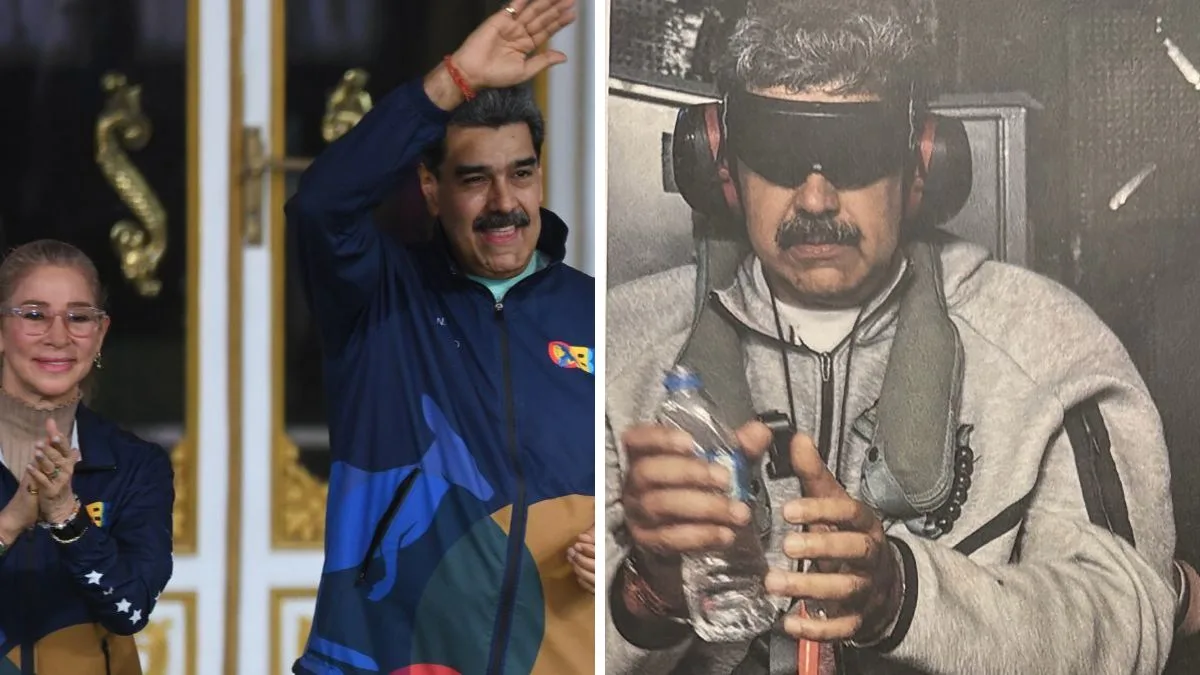
Former Venezuelan President Nicolas Maduro is scheduled to appear in a Manhattan federal court on Monday to face narco-terrorism charges, just days after his capture by U.S. forces intensified uncertainty over the future of the oil-rich South American country.
Maduro, 63, and his wife Cilia Flores are currently being held in a Brooklyn detention facility following a surprise weekend operation in Caracas carried out by the U.S. military.
Both are expected to appear at a hearing set for 12:00 p.m. EST (1700 GMT) before U.S. District Judge Alvin K. Hellerstein. It remains unclear whether either defendant has retained legal counsel or intends to enter a plea at this stage.
Long-standing allegations against Maduro
The United States has regarded Maduro as an illegitimate ruler since his declaration of victory in Venezuela’s disputed 2018 election. His arrest represents Washington’s most controversial intervention in Latin America since the U.S. invasion of Panama nearly four decades ago.
U.S. prosecutors allege that Maduro led a cartel involving senior Venezuelan political and military figures who, for decades, collaborated with drug trafficking networks and U.S.-designated terrorist organizations to smuggle massive quantities of cocaine into the United States.
Maduro was first indicted in 2020 as part of a broader narcotics investigation targeting current and former Venezuelan officials as well as Colombian guerrilla groups. A newly unsealed indictment accuses him of personally directing a state-backed cocaine trafficking operation linked to major criminal organizations, including Mexico’s Sinaloa and Zetas cartels, Colombia’s FARC, and the Venezuelan gang Tren de Aragua.
According to prosecutors from the U.S. Attorney’s Office for the Southern District of New York, Maduro enabled cocaine-driven corruption for personal gain and to benefit members of his ruling circle and family.
Charges and potential sentence
Maduro faces multiple charges, including narco-terrorism, conspiracy to import cocaine, possession of machine guns and destructive devices, and conspiracy related to those weapons. If convicted, he could face decades in prison or a life sentence on each count.
The indictment claims Maduro’s involvement in drug trafficking dates back to his election to Venezuela’s National Assembly in 2000, continued through his time as foreign minister from 2006 to 2013, and persisted after he succeeded the late President Hugo Chávez in 2013.
Prosecutors allege that while serving as foreign minister, Maduro sold diplomatic passports to known traffickers and arranged diplomatic protection for flights transporting drug proceeds from Mexico to Venezuela. Between 2004 and 2015, they say Maduro and Flores used state-backed criminal groups to traffic seized cocaine and ordered kidnappings, assaults, and killings to safeguard their operations.
As president, Maduro is accused of directing trafficking routes, using military forces to secure shipments, harboring violent criminal groups, and exploiting presidential facilities to move drugs. One cited incident alleges that shortly after taking office in 2013, Maduro ordered aides to establish new smuggling routes after French authorities uncovered an existing network.
Legal and geopolitical fallout
Legal experts note that prosecutors will need to present clear evidence linking Maduro directly to trafficking decisions, a task that could prove challenging if he insulated himself from day-to-day operations.
Maduro ruled Venezuela for more than 12 years, overseeing severe economic collapse and social unrest while resisting pressure for political change from both domestic opponents and foreign governments.
His capture followed months of escalating pressure from U.S. President Donald Trump, who authorized seizures of ships suspected of carrying sanctioned Venezuelan oil and approved strikes on vessels allegedly involved in drug smuggling.
International law experts have questioned the legality of the operation. The United Nations Security Council is set to meet to discuss the U.S. action, which U.N. Secretary-General Antonio Guterres warned could set a dangerous precedent. Russia and China, key allies of Venezuela, have also criticized Washington’s move.