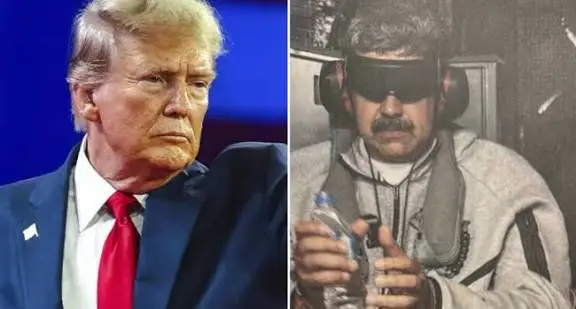
Ousted Venezuelan leader Nicolás Maduro appeared in a U.S. federal court on Monday to face drug trafficking charges, following his dramatic capture ordered by U.S. President Donald Trump — an operation that has shaken global leaders and left authorities in Caracas struggling to respond.
Maduro was expected to enter a plea during his appearance before U.S. District Judge Alvin Hellerstein. He and his wife, Cilia Flores, were transported under heavy guard from a Brooklyn detention facility to a Manhattan courthouse. Images showed the former leader restrained as he was moved between locations.
The court proceedings coincided with mounting international concern. United Nations Secretary-General Antonio Guterres raised alarms over political instability in Venezuela and questioned the legality of the U.S. military operation, which marked Washington’s most direct intervention in Latin America since the 1989 invasion of Panama.
U.S. Special Forces reportedly carried out a helicopter raid in Caracas over the weekend, breaching Maduro’s security detail and removing him from a secure location.
Drug trafficking allegations
U.S. prosecutors accuse Maduro of directing a long-running cocaine trafficking network that allegedly collaborated with criminal organizations, including Mexico’s Sinaloa and Zetas cartels, Colombia’s FARC rebels, and Venezuela’s Tren de Aragua gang.
Maduro, now 63, has consistently denied the accusations, arguing they were politically motivated and aimed at seizing control of Venezuela’s vast oil resources.
Outside the courthouse, Maduro supporters gathered in greater numbers than demonstrators opposing him, highlighting the deep divisions among Venezuelans abroad.
As global reaction intensified, the United Nations Security Council debated the legality and consequences of the U.S. action. Russia, China, and several left-leaning allies of Venezuela condemned the raid, while Caracas issued emergency directives ordering police to identify anyone who assisted U.S. forces.
Legal risks and prior indictments
If convicted, Maduro faces potential sentences ranging from decades in prison to life on each count. Court records show he will be represented by defense attorney Barry Pollack, whose previous clients include WikiLeaks founder Julian Assange.
Prosecutors allege Maduro’s involvement in narcotics trafficking dates back to his early political career in Venezuela’s National Assembly in 2000 and continued through his roles as foreign minister and president after succeeding Hugo Chávez in 2013.
U.S. authorities first indicted Maduro in New York in 2020 as part of a broader case targeting current and former Venezuelan officials. A revised indictment released over the weekend expanded the charges and added new defendants, including Flores.
Washington has regarded Maduro as an illegitimate ruler since his disputed 2018 re-election, which was widely criticized for alleged irregularities.
Legal experts have questioned whether Trump’s decision to authorize the raid violated international law, with some arguing it undermines the rules-based global order.
Oil ambitions and political fallout
In Caracas, senior officials from Maduro’s long-standing government remain in control of the country’s institutions, alternating between defiant rhetoric and tentative signals of cooperation with Washington.
Shares of U.S. oil companies rose sharply on Monday, fueled by expectations that American firms could gain access to Venezuela’s massive oil reserves. Trump has openly stated his intention to re-enter and rebuild Venezuela’s energy sector, telling reporters that the United States would reclaim resources he claims were misused by the former regime.
Venezuela holds the world’s largest proven oil reserves, estimated at over 300 billion barrels. However, years of sanctions, mismanagement, and underinvestment have reduced production to roughly 1.1 million barrels per day, far below historical levels.
After initially condemning Maduro’s capture as an illegal oil grab, Venezuela’s acting president, Delcy Rodríguez, softened her tone, calling for dialogue and cooperation with Washington. At the same time, Venezuela’s ambassador to the UN insisted the military action lacked legal justification.
Trump has warned of further strikes if Venezuela fails to cooperate on drug enforcement and energy access, while also issuing threats toward Colombia, Mexico, and Cuba.
How the U.S. plans to engage with a post-Maduro government remains unclear. The Venezuelan opposition has largely been sidelined, and despite Maduro’s removal, his allies still control key levers of power. Celebrations among opponents have been muted, with no immediate signs of the military breaking ranks, even as speculation grows that insiders may have assisted in the operation.