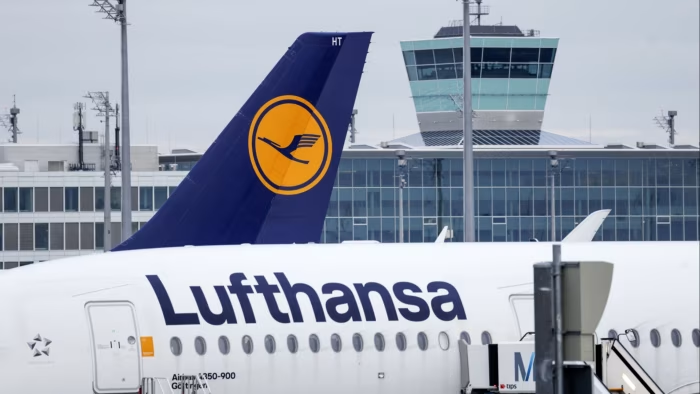
Lufthansa has pledged to turn its long-running restructuring strategy into tangible results starting in 2026, as investor skepticism persists following another uneven year under Chief Executive Carsten Spohr.
Since Spohr took over in 2014, Lufthansa’s share price has fallen by roughly one-third. While the stock saw a brief surge in 2017, it was heavily impacted by the COVID-19 pandemic and has struggled to regain momentum, leaving the airline trailing many of its European peers.
According to LSEG data, an investor who bought Lufthansa shares on the day Spohr assumed leadership would be down about 18% overall, including dividends. That equates to an average annual loss of roughly 1.7%.
Although Lufthansa shares have narrowed the gap with rivals in recent months, performance remains weaker compared with competitors that have delivered stronger financial and operational results.
Over the past six months, Lufthansa’s stock has risen 26%, compared with gains of 35% for British Airways owner IAG and nearly 45% for Air France-KLM.
Lufthansa targets margin recovery
Investor confidence continues to be weighed down by Lufthansa’s cost base and ongoing labor challenges, both of which have pressured profitability.
The group’s operating margin declined to 4.4% last year from 7.6% in 2023. Analysts currently expect a modest improvement to around 4.8% in 2025, still well below margins reported by IAG and Air France-KLM.
To address these issues, Spohr has launched a series of cost-cutting and efficiency measures. These include plans to eliminate 4,000 administrative roles over five years and accelerate the retirement of older aircraft. The company is targeting an operating margin of 8% to 10% between 2028 and 2030, a goal that has helped reassure some investors.
Complex structure and rising headwinds
Lufthansa is also seeking to simplify its organizational structure, which currently spans six hubs and nine passenger airline brands. These range from Italy’s ITA Airways to low-cost carrier Eurowings, adding operational complexity and cost.
At the same time, external challenges are mounting. Demand on key transatlantic routes has softened, while supply chain disruptions could delay deliveries of long-awaited Boeing aircraft. Labor negotiations also remain a potential obstacle, raising the risk of further cost pressures and operational disruptions.
As Lufthansa looks toward 2026, investors will be watching closely to see whether management can finally translate restructuring plans into sustained improvements in profitability and competitiveness.