Ethereum’s pioneering role remains unchallenged, continuing to serve as the bedrock of the decentralized finance (DeFi) industry with over half of the total value locked in blockchain protocols. However, this dominance has introduced significant challenges for DeFi protocols due to Ethereum’s limitations in transaction throughput and scalability.
The network has become notorious for congestion, leading to exorbitant gas fees and lengthy transaction confirmation times, which negatively impact user experience. Addressing this congestion is crucial for DeFi platforms—such as decentralized exchanges, lending and borrowing services, and yield farming algorithms—that require real-time transactions and minimal costs to function optimally.
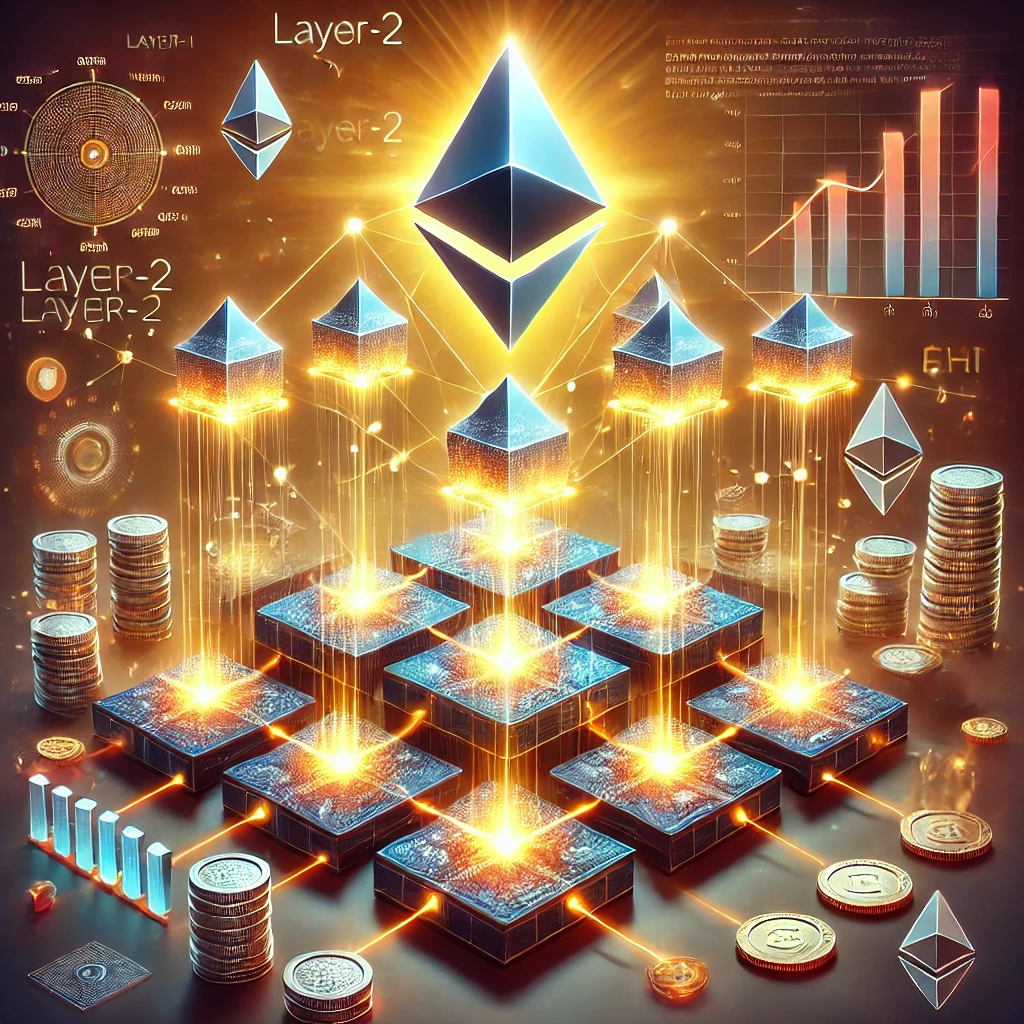
Ironically, Ethereum’s success has made it a victim of its own popularity, straining under the demands of millions of users globally. Thankfully, the DeFi sector has swiftly innovated by introducing various Layer-2 (L2) networks that operate atop Ethereum, enhancing its scalability by processing transactions off-chain.
These L2 networks employ several mechanisms, with rollups being one of the most common. Rollups process multiple transactions off-chain and bundle them into a single transaction, posting only the final state to the main Ethereum blockchain, which significantly reduces network strain.
Notable L2 solutions have demonstrated remarkable potential, enabling Ethereum to scale and support hundreds of thousands of transactions per second, thereby positioning DeFi to challenge traditional financial systems.
Polygon
As one of the earliest Layer-2 scaling solutions, Polygon is often mistakenly identified as a standalone blockchain. In reality, it is a multichain ecosystem that offers several L2 solutions designed to scale Ethereum.
Polygon utilizes zero-knowledge (ZK) rollups to facilitate rapid, private transactions with substantially lower gas fees than Ethereum’s main network. In addition to ZK-rollups, it employs a novel proof-of-stake consensus mechanism to support sidechains like Mumbai. Its native token, MATIC, is used for paying gas fees, staking to bolster network security, and participating in governance decisions.
Polygon’s ability to handle up to 65,000 transactions per second sets it apart, vastly outperforming Ethereum and many other L2 solutions. With transaction fees approximately ten times cheaper than Ethereum’s, it’s ideal for DeFi applications, blockchain gaming, and NFT marketplaces that require microtransactions. According to DefiLlama, Polygon has attracted over $1.1 billion in total value locked (TVL).
Furthermore, Polygon offers compatibility with Ethereum-based decentralized applications (dApps) through its Polygon zkEVM and also supports other prominent blockchains like Binance Smart Chain (BSC). Its high performance and flexibility have cultivated a thriving ecosystem of DeFi applications, including leading protocols like Aave, Curve, and SushiSwap, as well as NFT marketplaces like OpenSea and Rarible. Polygon fosters this growth with extensive developer tools and an active community, enabling its dApps to penetrate new markets.
Fuse Network
While Fuse Network is primarily a Layer-1 blockchain, it’s noteworthy for expanding into an L2 solution to support Ethereum and leverage its extensive DeFi ecosystem. Fuse has developed an infrastructure network for crypto and fiat payments, focusing on facilitating seamless business-to-business and business-to-consumer transactions across borders.
Building on its existing success, Fuse is launching its Ethereum-based ZK-proof L2 in late 2023. This new L2 leverages the Polygon Chain Development Kit, providing highly efficient transaction capabilities. The goal is for Fuse L2 to become the native platform for all dApps currently on the Fuse L1 chain, granting them access to Ethereum’s vast ecosystem and liquidity.
One significant advantage of using the Polygon CDK is that it allows Fuse L2 to achieve unprecedented scalability with incredibly low transaction costs, high throughput, and instant finality. This is partially enabled by integrating a zkEVM, which enhances transactions per second (TPS) and supports instant transfers through a decentralized validator set with improved security.
The adoption of ZK-proofs ensures that transactions can be validated without disclosing any details, maintaining full privacy for users while interacting across any Ethereum Virtual Machine (EVM)-compatible chain. Interoperability is facilitated by the Fuse Charge Bridge, enabling seamless liquidity flow between Fuse and Ethereum.
Fuse’s ambitious transition from an L1 to an L2 is still in its early stages but promises substantial benefits for businesses using its global payments infrastructure, allowing them to tap into a more extensive DeFi ecosystem.
Optimism
Optimism is a respected L2 solution that utilizes optimistic rollups, offering broad compatibility with the Ethereum ecosystem and relying on Ethereum’s consensus mechanism for security.
By scaling Ethereum to a peak of 4,000 TPS, Optimism processes transactions 26 times faster than the mainnet, with gas costs reduced by 90% or more. The project emphasizes decentralization, with community-led governance shaped by a growing number of DeFi protocols, decentralized autonomous organizations (DAOs), and NFT marketplaces. It is also developer-friendly, providing familiar tools for dApp builders.
Optimism’s native token, OP, is used for transaction fees, network governance, and staking. While concerns exist regarding its reliance on Ethereum—which carries inherent risks and necessitates monitoring of its decentralization process—the project is supported by a dedicated team of developers and an enthusiastic community. With over $680 million in TVL, Optimism’s ongoing development positions it as a key player in DeFi’s future growth.
Base
A newcomer in the L2 landscape, Base is developed by the prominent crypto exchange Coinbase with the aim of enhancing Ethereum’s DeFi capabilities by increasing transaction speeds and reducing costs.
Built on the OP stack and leveraging optimistic rollups like Optimism, Base can achieve up to 2,000 TPS, enabling near-instantaneous transactions with gas fees reduced by up to 95% compared to Ethereum. It also benefits from Ethereum’s security model to process transactions off-chain, ensuring user funds remain safe.
Base is developer-friendly, offering numerous tools for building and deploying dApps efficiently. A significant advantage is its association with Coinbase, allowing Base dApps to access millions of users.
Despite being in its early stages, Base has already accumulated an impressive $2.7 billion in TVL, making it an L2 solution to watch. By building on a robust foundation, Base could play a crucial role in helping Ethereum scale to meet mainstream demand as DeFi’s popularity continues to rise.
Coti
Originally a Layer-2 solution for Cardano, Coti is evolving into a privacy-centric scaling solution for Ethereum. This shift aims to support more affordable transactions that leverage Ethereum’s security and interoperability while ensuring maximum privacy for users.
The COTI token powers the network, used for transaction fees, staking, governance, merchant processing, and establishing user trust scores within the broader Coti ecosystem. As part of its transition, COTI is migrating from Cardano to Ethereum.
Coti is also moving from its Directed Acyclic Graph technology to an EVM-compatible architecture. Despite this change, it retains its key privacy feature—garbled circuits—which ensures full confidentiality of transaction data.
Coti claims to support up to 100,000 TPS, an impressive throughput enabled by ZK-proofs. It also has extensive reach due to its support for the Inter-Blockchain Communication (IBC) protocol, enabling compatibility with the Cosmos ecosystem and EVM-based chains. However, developers should note that Coti’s transition requires careful adaptation and thorough testing, which explains its relatively low TVL of approximately $28.98 million.
Layer-2s: The Future of DeFi
Layer-2 networks are rapidly becoming the foundation of the DeFi ecosystem across multiple blockchains. They enhance the scalability of Layer-1 networks and facilitate seamless interoperability, creating a more interconnected DeFi landscape with enhanced privacy for users.
L2 networks represent a significant shift in the financial industry, enabling protocols to converge into a larger, more expansive ecosystem. By strengthening DeFi’s infrastructure, L2 solutions are critical for scaling to support mass adoption and unlocking new opportunities for growth.