Japanese equities surged to fresh all-time highs on Monday, while super-long government bonds stabilized after an initial selloff, signaling investor confidence in Prime Minister Sanae Takaichi’s pledge to pursue a “responsible, proactive” fiscal strategy.
The yen initially slid to a record low against the Swiss franc before sharply reversing course after Japanese officials warned of possible currency intervention, calming markets.
Takaichi’s Liberal Democratic Party secured a decisive victory in Sunday’s snap election, winning 316 of the 465 seats in the lower house. The landslide result gives her a strong mandate to advance fiscal stimulus and tax relief measures.
Despite plans for increased spending, Takaichi has repeatedly emphasized that her policies will not jeopardize Japan’s public finances — a key reassurance for investors, given the country’s position as the most heavily indebted developed economy.
“The election outcome reduces political uncertainty and reinforces the broader ‘Japan is Back’ narrative,” said Masahiko Loo, senior fixed-income strategist at State Street. He added that investor interest is expanding beyond early beneficiaries of the so-called “Takaichi trade,” such as exporters, financials, cyclicals and defense stocks.
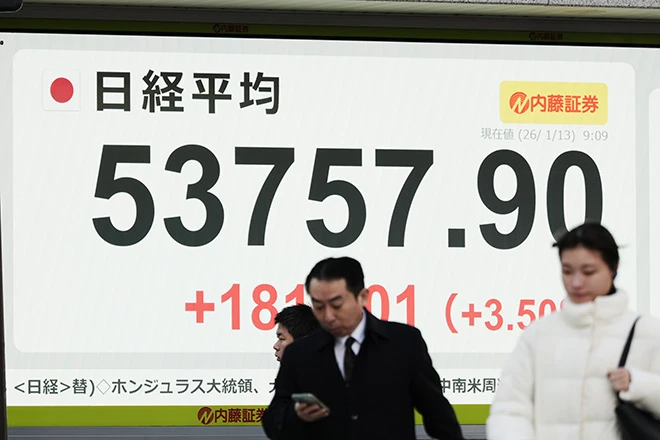
The Nikkei 225 jumped 3.9% to close at a record 56,363.94, while the broader Topix index rose 2.3% to an all-time closing high of 3,783.57.
Expectations of a long-lasting administration
“What’s becoming clear is not just stability, but the likelihood of a long-term administration,” said Shingo Ide, chief equity strategist at NLI Research Institute.
However, Ide cautioned that the pace of gains may slow. “If the Nikkei were to surge straight to 60,000, that would be excessive. A period of consolidation around current levels seems more likely,” he said.
In bond markets, 30-year Japanese government bond yields initially spiked 6.5 basis points to 3.615% before quickly retracing most of the move. Yields later settled just 1 basis point higher at 3.56%.
“The market reaction suggests Takaichi has convinced investors she will be decisive without being fiscally reckless,” said Zuhair Khan, senior portfolio manager at UBP, while noting that longer-term credibility still needs to be tested.
A bond market selloff last October, following Takaichi’s rise to LDP leadership, prompted her to adopt the current “responsible, proactive” framework, which was formally outlined in her first policy speech and embedded in the party’s manifesto.
Analysts noted that the LDP’s dominant victory may actually be positive for bond investors, as it removes the need to negotiate with opposition parties calling for even more aggressive tax cuts and fiscal expansion.
Yields on shorter-dated bonds rose, reflecting expectations of earlier interest rate hikes by the Bank of Japan. The two-year yield climbed to its highest level since 1996, while five-, 10- and 20-year yields also advanced.
Market participants said the yield curve flattened as traders priced in faster economic growth, firmer inflation and a more confident central bank stance.
Yen rebounds as intervention risk resurfaces
The yen initially weakened sharply, touching record lows against the Swiss franc and falling against the dollar and euro. However, it rebounded after Japan’s top currency official Atsushi Mimura said authorities were monitoring markets “with a high sense of urgency,” a phrase widely interpreted as a warning of possible intervention.
The yen later strengthened to around 156.4 per dollar, recovering much of its earlier losses.
“The risk of intervention has always been present once the yen weakens too far,” said Kumiko Ishikawa, senior analyst at Sony Financial Group, noting that last week’s declines had already made further downside difficult.