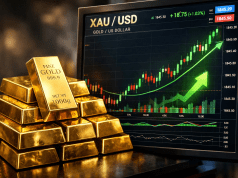
Gold and Silver Rise After Soft US Retail Sales Data
Gold and silver prices moved higher in Asian trading on Wednesday after weaker-than-expected U.S. retail sales data fueled speculation that the world’s largest economy may be slowing. Investors are now turning their attention to upcoming nonfarm payrolls data for clearer signals on the Federal Reserve’s next policy move.
Despite posting gains this week, precious metals remain volatile. Gold prices have struggled to regain momentum after falling sharply from record highs reached in late January. Recent weakness in the U.S. dollar and softer economic indicators have provided only limited support.
At the same time, uncertainty surrounding geopolitical tensions in the Middle East has failed to significantly boost safe-haven demand for gold.
Spot gold climbed 0.6% to $5,052.11 per ounce, while April gold futures rose 0.9% to $5,076.40 per ounce. However, spot prices remain roughly $600 below recent all-time highs.
Silver and platinum also advanced. Spot silver gained 1.7% to $82.1375 per ounce, and spot platinum increased 2.1% to $2,130.63 per ounce.
Dollar Weakness Supports Precious Metals
Precious metals edged higher after U.S. retail sales data for December came in below expectations, signaling a potential cooling in consumer spending. Analysts at ANZ noted that gold’s recent rally had stalled due to concerns the metal had risen “too far, too fast.”
With speculative positions largely cleared from the market, traders are now looking for a fresh catalyst. The weaker economic data encouraged some renewed buying interest in gold.
The softer retail sales report suggested broader consumer spending may be slowing amid persistent inflation and labor market pressures. If this trend continues, it could weaken the overall economic outlook and increase expectations for further interest rate cuts.
U.S. Treasury yields declined on this view, while the dollar extended losses earlier in the week. The dollar index slipped 0.2% during Asian trade, adding to downward momentum.
Payrolls and CPI Data in Focus
Investors are closely watching the upcoming U.S. nonfarm payrolls report for clearer insight into labor market conditions. Signs of sustained weakness could strengthen expectations for additional rate cuts.
Lower interest rates typically benefit gold and other non-yielding assets, as they reduce the opportunity cost of holding them.
Markets remain cautious, however, following President Donald Trump’s nomination of Kevin Warsh as the next Federal Reserve chair. Warsh is viewed as less dovish on monetary policy, a perception that previously triggered heavy selling in metal markets.
Beyond the jobs report, attention will also shift to U.S. consumer price index (CPI) data due later this week. Labor market strength and inflation trends remain the Federal Reserve’s primary factors when deciding on interest rate adjustments.