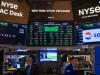
Stocks Decline While Dollar Holds Firm After U.S. Inflation Data
U.S. stock markets moved lower on Wednesday while the U.S. dollar remained relatively strong, after new data showed inflation increased as expected in February. Despite the inflation report, investors were primarily focused on oil prices and the potential economic impact of the U.S.-Israel conflict with Iran.
U.S. Inflation Matches Forecasts
According to the U.S. Department of Labor, the Consumer Price Index (CPI) rose 0.3% in February, slightly higher than the 0.2% increase recorded in January and in line with economists’ expectations.
On an annual basis, inflation reached 2.4% in the twelve months to February, also matching forecasts. Meanwhile, core CPI, which excludes volatile food and energy prices, increased 2.5% year-over-year, remaining consistent with market projections.
However, the report does not yet reflect the sharp increase in gasoline prices that occurred after the outbreak of conflict in the Middle East nearly two weeks earlier.
Wall Street Indices Move Lower
Major U.S. stock indices ended the session in negative territory. The Dow Jones Industrial Average declined about 0.9%, while the S&P 500 dropped 0.3%. The technology-heavy Nasdaq Composite fell 0.1%.
Market participants are increasingly concerned that higher energy prices could push inflation upward, potentially forcing central banks to raise interest rates again instead of cutting them.
Brian Jacobsen, chief economist at Annex Wealth Management, said the conflict in the Middle East could reverse earlier expectations of declining inflation.
“February’s inflation data was moving in the right direction, but the conflict in the Middle East may change the outlook. Instead of falling energy prices, we may see renewed inflation pressures,” he said.
He also warned that food prices could rise as disruptions in fertilizer markets add pressure to agricultural costs.
Oil Prices Remain Volatile
Oil markets experienced another volatile trading session, although price swings were less dramatic than earlier in the week.
The International Energy Agency (IEA) is reportedly preparing to release 400 million barrels of oil from strategic reserves, the largest coordinated release in its history, in an effort to stabilize prices. Countries including Japan and Germany have already announced plans to begin releasing part of their reserves.
Meanwhile, Brent crude oil futures climbed roughly 4% to around $91 per barrel, after earlier rising as much as 6% to nearly $93 per barrel.
Global Markets React to Energy Uncertainty
The MSCI All-World Index declined 0.3%, while European equities also moved lower. The STOXX 600 index fell 0.77%, reflecting growing investor caution.
In contrast, Asia-Pacific markets outside Japan posted modest gains, with the regional MSCI index rising 1%.
Investors remain concerned that the Middle East conflict could disrupt global energy trade and trigger another oil price shock.
Strait of Hormuz Remains Key Risk
A major concern for global markets is the situation around the Strait of Hormuz, a crucial passage through which about 20% of global oil supply flows.
Shipping traffic through the strait has been severely disrupted since the outbreak of the U.S.-Israel conflict with Iran. Several vessels have reportedly been struck by projectiles, while Iran’s military leadership warned that oil prices could surge to $200 per barrel if tensions escalate further.
Central Banks Monitor Inflation Risks
Christine Lagarde stated that the European Central Bank is prepared to act if necessary to prevent a repeat of the 2022 energy-driven inflation shock.
Several ECB policymakers currently favor a wait-and-see approach before adjusting interest rates.
Currency Markets and Bond Yields
Currency markets also reacted to the developments. The euro declined around 0.3% to $1.157, while the British pound remained mostly unchanged near $1.341.
The Japanese yen weakened further, pushing the U.S. dollar up 0.4% against the currency to 158.68.
Rising Bond Yields Raise Market Concerns
U.S. government bonds continued to sell off, pushing the yield on the benchmark 10-year U.S. Treasury note up 6.4 basis points to 4.136%.
The recent rise in bond yields has intensified concerns that certain areas of financial markets may be overheating, including the fast-growing private credit sector and large-scale investments tied to artificial intelligence projects.
Investors were reminded of potential vulnerabilities after reports indicated that JPMorgan Chase had marked down the value of some loans held by private-credit funds and tightened lending conditions to the sector.
These concerns have already triggered investor withdrawals from some private credit funds, including BlackRock’s $26 billion HPS Corporate Lending Fund.