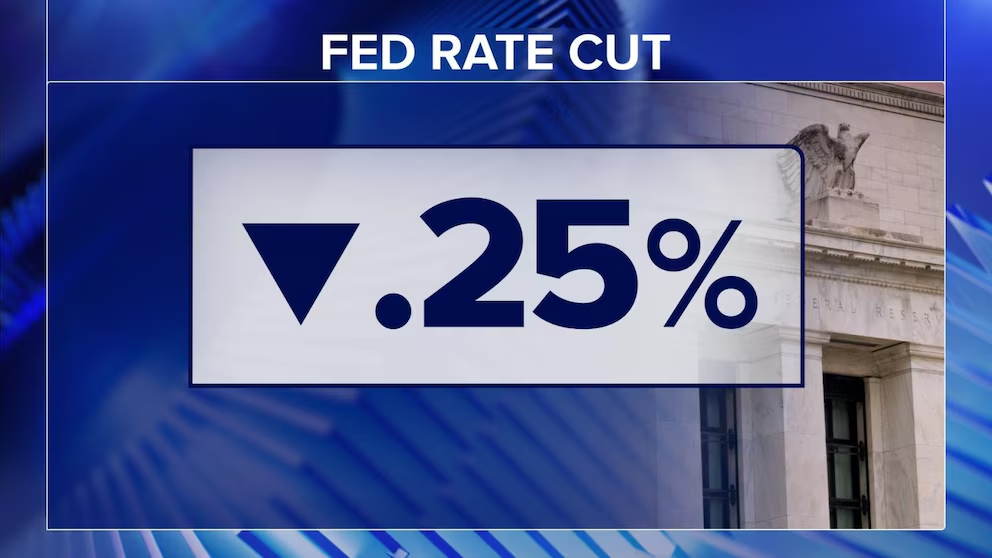
The Federal Reserve cut interest rates by 25 basis points on Wednesday, marking its third rate reduction this year. Despite the move, the Fed kept its longer-term outlook for future cuts unchanged, even as divisions among policymakers make the path ahead less clear.
In its statement, the Fed said it will continue monitoring incoming economic data to determine the appropriate stance of monetary policy.
The Federal Open Market Committee (FOMC) lowered the benchmark rate to a target range of 3.5% to 3.75%. The vote revealed deep internal disagreement, with two members preferring a pause and one arguing for a larger 50-point cut.
The Fed’s rate projections also remain steady. Policymakers still expect interest rates to fall to 3.4% in 2026 and to 3.1% in 2027, both unchanged from the previous forecast.
Expectations for a third cut had dimmed in the weeks leading up to the meeting as disagreements among Fed members intensified. But momentum shifted after New York Fed President John Williams, a close ally of Chair Jerome Powell, signaled support for further easing in December.
The divide within the committee stems from differing interpretations of current economic conditions. Officials in favor of cutting rates point to a cooling labor market that may require additional support. Meanwhile, more hawkish members remain worried that progress toward the 2% inflation target has stalled. The lack of fresh data due to the government shutdown has made it harder for policymakers to reach consensus.
This “data fog” resulted in minimal changes to the Fed’s updated economic projections. The core Personal Consumption Expenditures (PCE) inflation forecast for 2025 was revised slightly lower to 3%, down from 3.1%. Inflation estimates for 2026 were trimmed to 2.5%, while the 2027 forecast stays at 2.1%. The Fed still expects inflation to reach the 2% target in 2028.
Labor market projections were mostly unchanged as well. Fed members still expect unemployment to sit at 4.5% in 2025 and 4.4% in 2026. For 2027, the unemployment rate is now forecast at 4.2%, a small improvement from the previous 4.3% estimate.