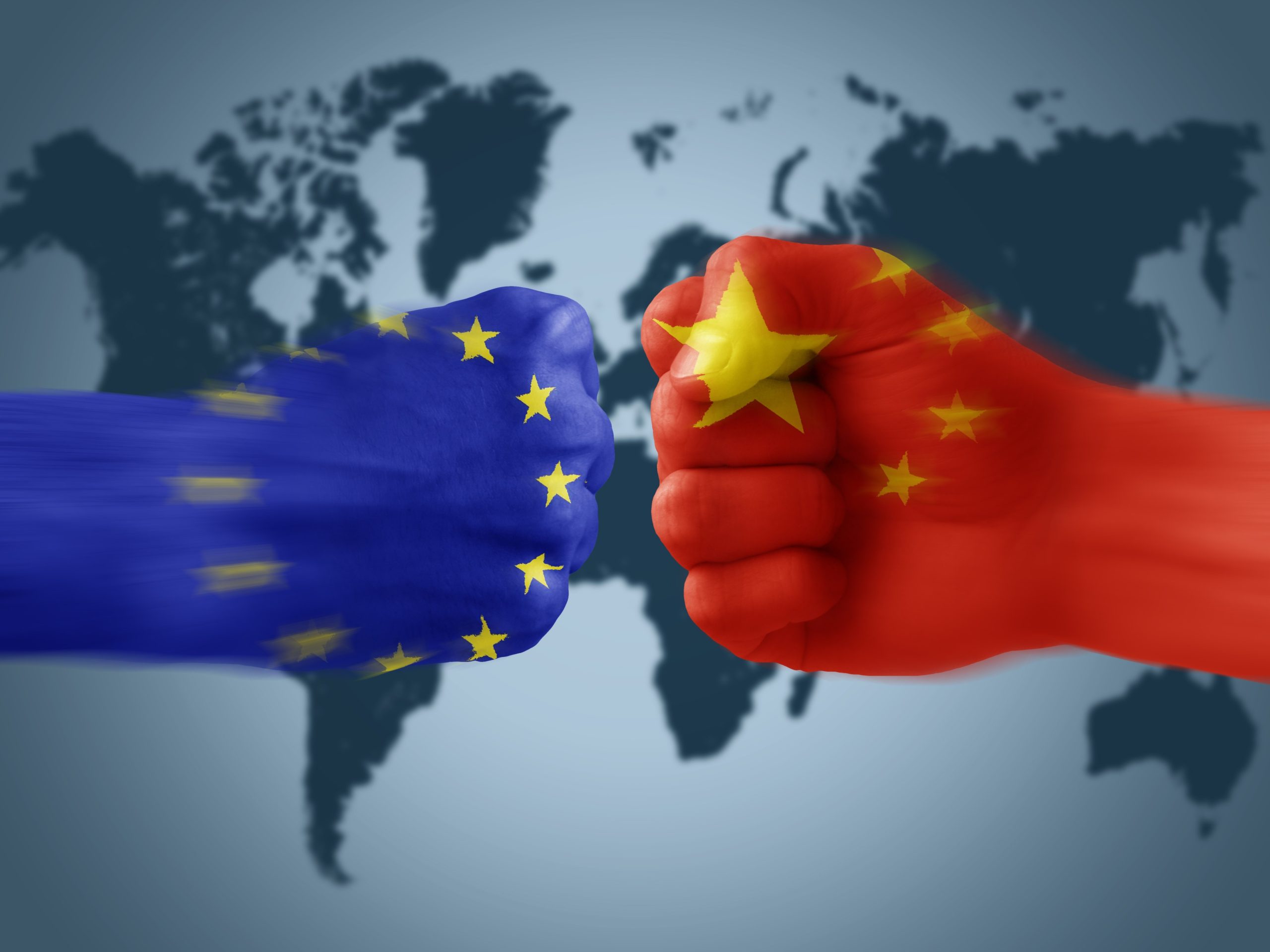
Europe is facing growing competitive pressure from China, as Beijing accelerates an export-driven growth strategy that Goldman Sachs says is reshaping the landscape for several core European industries.
Goldman’s economists recently raised their GDP forecasts for China for 2025–27. They warned that stronger Chinese export growth is likely to come “at the expense of other high-tech producers like Europe.” As a result, they now expect a larger structural drag on European growth, cutting Germany’s average forecast by 0.2 percentage points over the next four years.
Despite these economic challenges, Goldman strategists argue that equity markets tell a different story. The DAX index has gained 19% this year, extending the strength seen in 2024, even as German industrial production continues to weaken.
According to the strategists, led by Sharon Bell, investors are not ignoring China’s rising influence. Instead, the composition of the DAX provides some insulation, as several heavyweight sectors are less exposed to direct Chinese price competition.
Goldman’s research highlights that the sectors most sensitive to falling Chinese producer prices include Chemicals, Autos, and Basic Resources, where margins have the strongest correlations with China’s PPI.
The bank expects China’s deflationary pressures to persist through at least 2027, keeping price competition elevated. However, some sectors—such as consumer and services industries—have historically benefited from lower China-driven input costs.
Europe’s extensive international footprint also shapes how these pressures spread. Since 2008, all revenue growth for European companies has come from markets outside Europe, with China making up a significant share. Yet this exposure has become a risk. Companies with greater dependence on China have underperformed since 2022, with Goldman noting sharp declines in earnings-per-share estimates across its China-exposed basket.
Valuations have also weakened. EPS for these firms is now more than 20% below pre-pandemic levels.
Competitive pressure is most visible in the Autos and Chemicals sectors, and Goldman remains underweight both. Chinese automakers have increased their market share in Europe by four percentage points since 2024. European brands have also lost ground in China, particularly in electric vehicles.
Investment trends widen the divide further. Chinese companies continue to increase spending on R&D and capital investment across most tradable goods sectors. By contrast, Europe’s growth-investment share of cash flow remains near 20%—roughly half the level seen in China and the United States.
Still, the pressure is not uniform. Major portions of the European market—including Financials, Telecoms, Utilities, Real Estate, Retail, and business services—show little direct vulnerability to Chinese competition.
Europe’s policy response is also evolving. Tariffs, security regulations, and industrial measures—such as the Carbon Border Adjustment Mechanism set to begin in 2026—are playing an increasing role.
Goldman sees ongoing opportunities in domestically focused sectors, including Banks, Retailers, Defense, Telecoms, and companies benefiting from fiscal infrastructure spending.
The bank also conducted a broad transcript analysis to understand how companies describe China’s influence. Firms across the STOXX 600 mentioned China nearly 10,000 times since early 2024, though only about 60 referenced direct competitive pressure.
Overall, Europe is not uniformly exposed, but it is increasingly “fighting the China dragon” in sectors where Chinese overcapacity, heavy investment, and aggressive pricing converge, the strategists said.