Eurozone government bonds dropped sharply on Monday, sending yields to their highest level in about a year as escalating tensions in the Middle East pushed oil prices higher and intensified inflation concerns across financial markets.
Germany’s 10-year government bond yield, widely seen as the benchmark for the euro area, climbed 5.9 basis points to 2.922%, marking its highest level in roughly twelve months. The rise reflects growing investor worries that persistent geopolitical tensions could keep inflation pressures elevated.
Short-term borrowing costs also surged. The yield on Germany’s two-year bond, which is particularly sensitive to interest rate expectations, jumped 15.1 basis points to 2.459%. This level was last recorded in August 2024 and signals shifting market expectations regarding future central bank policy.
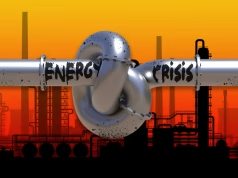
The conflict involving the United States, Israel, and Iran has heightened concerns about potential disruptions to global oil supply. Traders are particularly focused on the Strait of Hormuz, one of the world’s most important energy shipping routes, where fears of supply interruptions have driven crude oil prices to their highest levels since 2022.
Political developments in Iran have added to market uncertainty. On Monday, Tehran announced that Mojtaba Khamenei would succeed his father, Ali Khamenei, as supreme leader. The move, seen as a defiant signal toward U.S. President Donald Trump, suggests that hardline leadership will remain firmly in control of the country.
Although escalating geopolitical tensions typically boost demand for safe-haven assets, government bonds have not benefited from that dynamic. Instead, investors are increasingly concerned that higher energy prices could reignite inflation and complicate the outlook for central banks.
If oil prices remain elevated, policymakers may be forced to maintain restrictive monetary policies or delay interest rate cuts. Such expectations have pushed bond prices lower, since bond prices move inversely to yields.