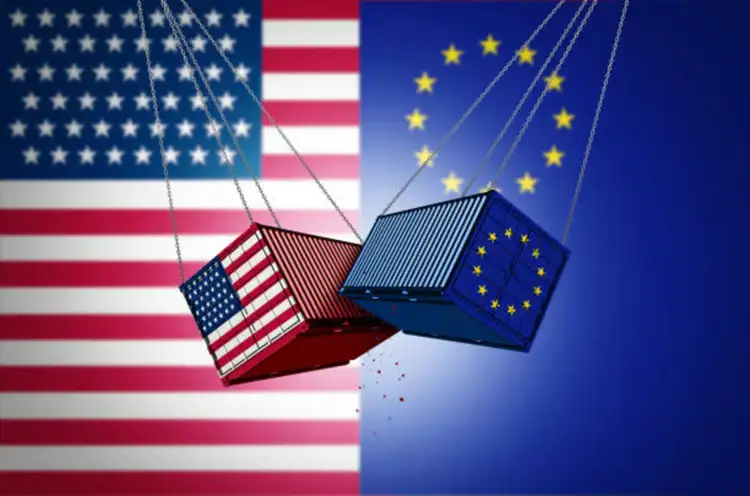
The European Commission stated on Monday that it intends to push firmly this week for the United States to ease or remove tariffs, even after President Donald Trump announced plans to double duties on steel and aluminum imports to 50%.
European Trade Commissioner Maros Sefcovic is scheduled to meet with U.S. Trade Representative Jamieson Greer during an OECD summit in Paris on Wednesday. Meanwhile, EU technical negotiators are engaging in parallel discussions with their U.S. counterparts in Washington.
White House Press Secretary Karoline Leavitt told reporters that the EU is “negotiating in good faith,” and the Trump administration remains “hopeful and optimistic” about reaching an agreement with Brussels.
The Commission, responsible for EU trade policy across its 27 member states, emphasized that resolving the trade dispute is a top priority.
“We are not looking to escalate tariffs. Our goal is to reduce or eliminate them,” a Commission spokesperson said at a Monday press briefing. “That continues to be our position, and we will strongly advocate for it both in technical and political meetings this week.”
The EU has expressed strong opposition to Trump’s plan to double tariffs on steel, calling it economically destabilizing for both sides of the Atlantic.
Olof Gill, the Commission’s trade spokesperson, said on X that the move “adds further economic uncertainty” and noted that both the EU and U.S. had agreed to accelerate negotiations.
EU officials did not immediately respond to reports—first published by Reuters—that the Trump administration had asked trade partners to submit their best offers by Wednesday.
Currently, the EU is subject to 25% U.S. tariffs on steel and autos, and is facing potential reciprocal tariffs of up to 20% on most EU goods, though these have been temporarily held at 10% during a 90-day suspension period ending in July.
In response, the EU had prepared counter-tariffs on $24 billion (€21 billion) worth of U.S. goods, though they remain suspended. Brussels is also considering broader retaliatory measures on up to €95 billion in U.S. exports, particularly in response to car-related duties.
The European Commission warned that if no resolution is reached, these countermeasures will automatically take effect on July 14, or sooner if warranted by developments.