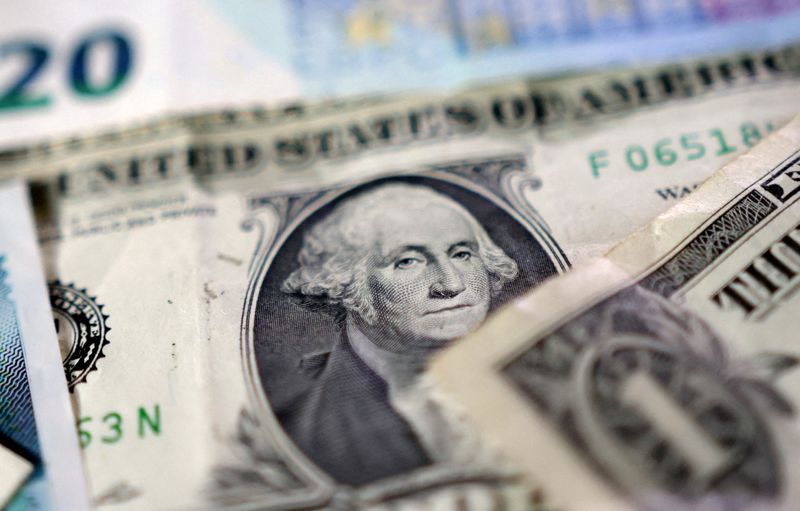
The U.S. dollar remained close to a 10-month high on Monday, as investors prepared for a busy week of central bank meetings while geopolitical tensions in the Middle East continued to influence global markets. The ongoing U.S.-Israel conflict involving Iran has added uncertainty to financial markets, keeping traders cautious at the start of the week.
Several major central banks are scheduled to announce policy decisions in the coming days. At least eight institutions—including the U.S. Federal Reserve, European Central Bank, Bank of England, and Bank of Japan—will hold interest rate meetings. These will be their first policy decisions since the conflict in the Middle East escalated.
Market attention will focus on how policymakers evaluate the economic impact of rising oil prices, particularly their potential effects on inflation and economic growth.
Carol Kong, currency strategist at Commonwealth Bank of Australia, said the war could create mixed economic pressures. While it may slow global economic growth, it could also push inflation higher due to rising energy costs. As a result, central bank responses will likely depend on whether inflation in each economy is currently above or below their policy targets.
Ahead of the key policy meetings, the dollar gave back some of last week’s gains. The euro rebounded slightly from a 7½-month low, rising 0.14% to $1.1433. Meanwhile, the British pound increased 0.17% to $1.3245, although it remained close to the 3½-month low reached on Friday after posting a weekly loss of about 1.5%.
The U.S. Dollar Index edged lower to 100.20 but continued to trade near the 10-month peak reached last week.
Geopolitical developments remain a major factor for markets. U.S. President Donald Trump said on Sunday that Washington is urging other countries to help protect the Strait of Hormuz, one of the world’s most critical oil and gas shipping routes. He added that the United States is discussing joint efforts with several nations to secure the waterway.
In a separate interview, Trump warned that NATO could face serious challenges if allied nations do not assist in maintaining safe passage through the Strait of Hormuz.
Although oil prices eased slightly after hopes of improved energy supply security, global markets remain volatile. Investors are still uncertain about how long the Middle East conflict—now entering its third week—could last.
Jorry Noeddekaer, head of global emerging markets and Asia at Polar Capital, said that despite the geopolitical tensions, the war is unlikely to significantly alter the current trajectory of global monetary policy unless the conflict escalates further.
Meanwhile, the Australian dollar strengthened by 0.55% to $0.7019, supported by expectations that the Reserve Bank of Australia (RBA) could raise interest rates at its policy meeting on Tuesday. Markets are currently pricing in about a 74% probability of a 25-basis-point rate hike.
Analysts at Commonwealth Bank believe additional tightening could follow. According to Kong, inflation in Australia was already elevated before the Middle East conflict began, and the latest surge in energy prices may increase inflation risks even further.
The Japanese yen remained under pressure, trading near the 160-per-dollar level and last standing at 159.44. Japan’s heavy dependence on energy imports from the Middle East has made its currency particularly sensitive to the ongoing conflict.
Naomi Fink, chief global strategist at Amova Asset Management, noted that rising energy costs and weaker currency conditions could complicate monetary policy decisions for the Bank of Japan. Higher import costs, combined with logistics disruptions and yen weakness, may force policymakers to make difficult trade-offs in the months ahead.
Elsewhere in currency markets, the New Zealand dollar rose 0.47% to $0.5803, while the offshore Chinese yuan strengthened slightly to 6.9002 per dollar.
On the diplomatic front, senior U.S. and Chinese economic officials reportedly held constructive talks in Paris on Sunday. Discussions focused on potential areas of cooperation, including agriculture, critical minerals, and managed trade arrangements that could later be reviewed by U.S. President Donald Trump and Chinese President Xi Jinping in Beijing.