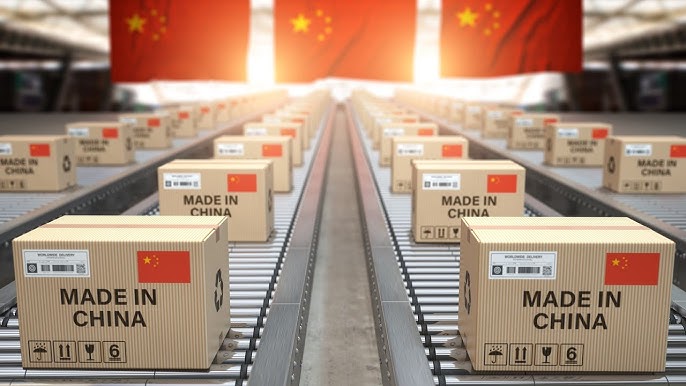
China’s exports unexpectedly declined in October, marking the sharpest downturn since February, as new tariffs from the United States weakened demand. The drop came after several months of frontloading orders to beat President Donald Trump’s trade measures — a stark reminder of China’s heavy reliance on U.S. consumers despite efforts to diversify its export markets.
Since Trump’s return to the White House last November, Beijing has been working to expand trade ties with Southeast Asia and the European Union in anticipation of renewed trade tensions. However, no market comes close to matching the United States, which buys over $400 billion worth of Chinese goods each year. Economists estimate that lost U.S. demand has shaved about 2 percentage points off China’s export growth — roughly 0.3% of GDP.
China’s Exports Fall as Tariffs Weigh on Demand
Official customs data released on Friday showed that exports fell 1.1% in October, reversing an 8.3% increase in September and missing a forecast of 3.0% growth in a Reuters poll. The decline represents China’s worst export performance since February.
According to Capital Economics, the weakness was broad-based, with a significant slowdown in shipments to non-U.S. markets. Exports to the U.S. dropped 25.17% year-on-year, while exports to the European Union rose only 0.9% and those to Southeast Asia grew 11.0%. Analysts noted that some Chinese producers are routing shipments through Vietnam and other transit hubs to avoid higher U.S. tariffs.
The October figures were also affected by a strong base from last year, when factories had rushed to ship goods ahead of Trump’s potential re-election. Analysts now believe the “frontloading” phase is ending, making it harder for China to sustain export momentum in late 2025 and early 2026.
Global Slowdown and Trade Tensions
Economists warn that China’s export growth faces broader headwinds as the global economy cools. The country’s Purchasing Managers’ Index (PMI) fell to a six-month low, reflecting a steep drop in new export orders.
Woei Chen Ho of UOB Singapore said the recent trade truce between President Trump and Chinese President Xi Jinping may stabilize the short-term outlook, but both sides are expected to continue reducing trade dependence. Meanwhile, U.S.-bound Chinese goods still face average tariffs of around 45%, well above the 35% level that many economists say erodes manufacturers’ profit margins.
Despite recent progress in diplomatic talks — including Trump’s meeting with Xi in South Korea to extend the truce by another year — tensions remain high. The renewed tariffs followed Beijing’s decision to expand export controls on rare earth metals, sparking further friction between the two economies.
Imports Slow as Domestic Demand Weakens
China’s trade surplus narrowed slightly to $90.07 billion in October, missing expectations of $95.6 billion. Imports grew just 1.0%, the slowest pace in five months, signaling weak domestic consumption.
Officials have pledged to significantly boost household spending as part of the 2026–2030 economic plan outlined by the Communist Party. Economists expect more aggressive fiscal stimulus in early 2026 to offset soft external demand.
China’s imports of soybeans, crude oil, and iron ore increased from a year earlier, driven by favorable global prices and frontloaded purchases from South America. However, copper imports fell as high prices and a prolonged property downturn dampened construction demand.