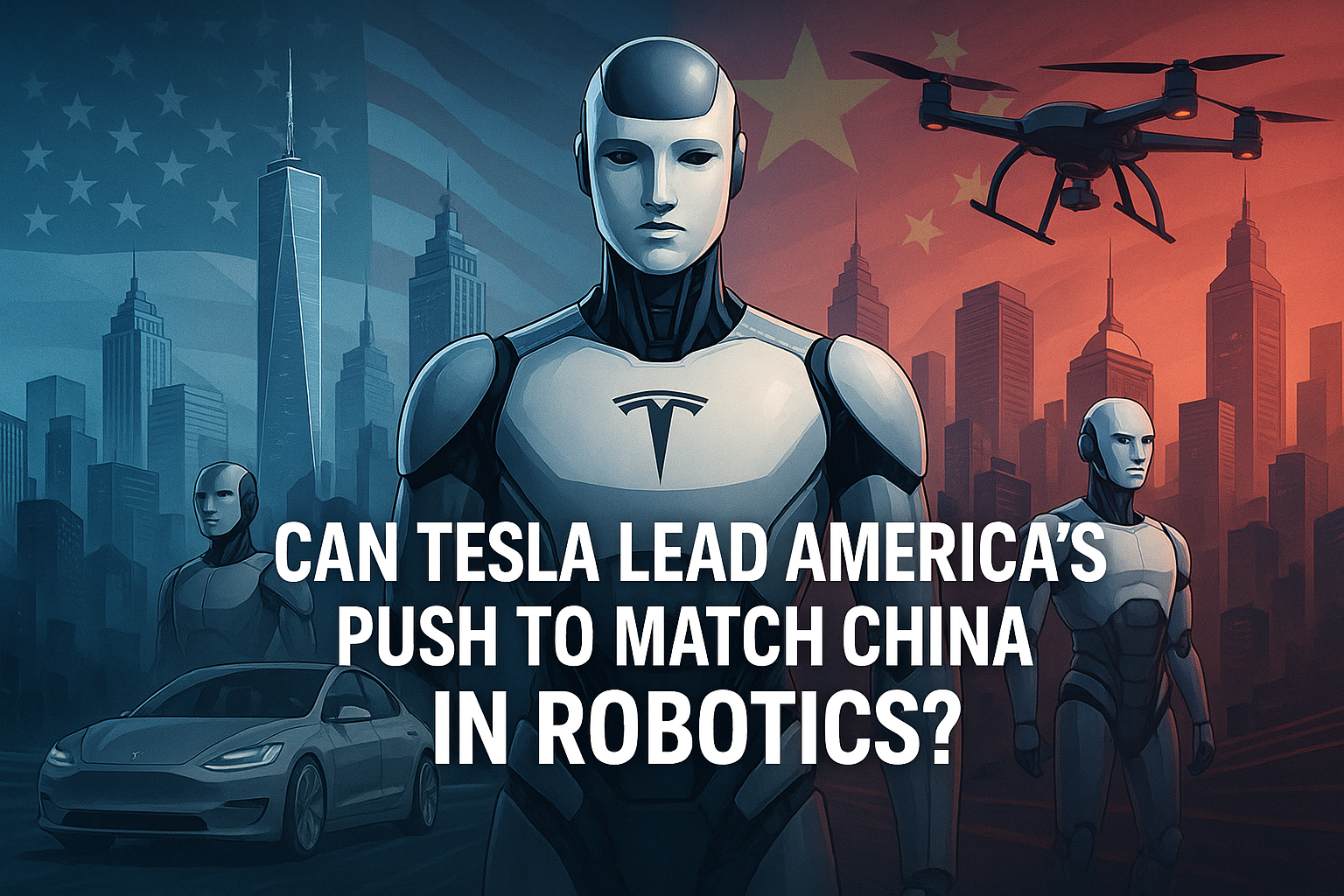
Tesla (NASDAQ: TSLA) may play a crucial role in helping the U.S. catch up to China in the development of autonomous technologies—a competition that Morgan Stanley describes as vital to both national security and geopolitics.
In a recent report, the bank points out that China currently leads in the area of “embodied AI,” which includes autonomous vehicles, drones, and humanoid robots, thanks mainly to its strong hardware manufacturing capabilities.
“China produces more drones in a single day than the U.S. does in an entire year,” the analysts noted, emphasizing that AI is significantly boosting efficiency. With advancements in AI, one operator could manage 100 drones at once, creating swarms of autonomous systems with potential defense and industrial uses.
Although the U.S. government is becoming more aware of the urgency, there are still policy gaps. Transportation Secretary Sean Duffy recently highlighted that “America is locked in a high-stakes innovation race with China” and called for unified national standards for autonomous vehicles to replace inconsistent state-level rules.
Morgan Stanley identifies Tesla as the American company best equipped to lead this effort. The firm cites Tesla’s strength across six key areas—Data, Robotics, Energy, AI, Manufacturing, and Space—summarized as “DREAMS.”
Tesla currently has about 7 million cars on the road and aims to exceed 100 million by 2035, while also advancing its robotics and battery technology.
Manufacturing may be Tesla’s greatest asset, according to the report. Elon Musk views manufacturing as the foundation of Tesla’s competitive edge.
“To gather data, you need probes; then you improve the probes to collect better data, and the cycle continues,” said Morgan Stanley’s Adam Jonas and his team.
Tesla’s vehicles are not just cars—they serve as platforms to develop and fine-tune AI for broader applications.
Jonas added, “The car is to Tesla what the book was to Amazon (NASDAQ: AMZN).”
Tesla’s upcoming launch of fully autonomous vehicles in Austin, expected by the end of June, could mark a significant milestone. Unlike California, Texas appears more open to such initiatives.
As the U.S. works to revive its “Apollo spirit” and close the innovation gap, the report ends with a bold question: “If Tesla doesn’t help bridge the gap, who will?”