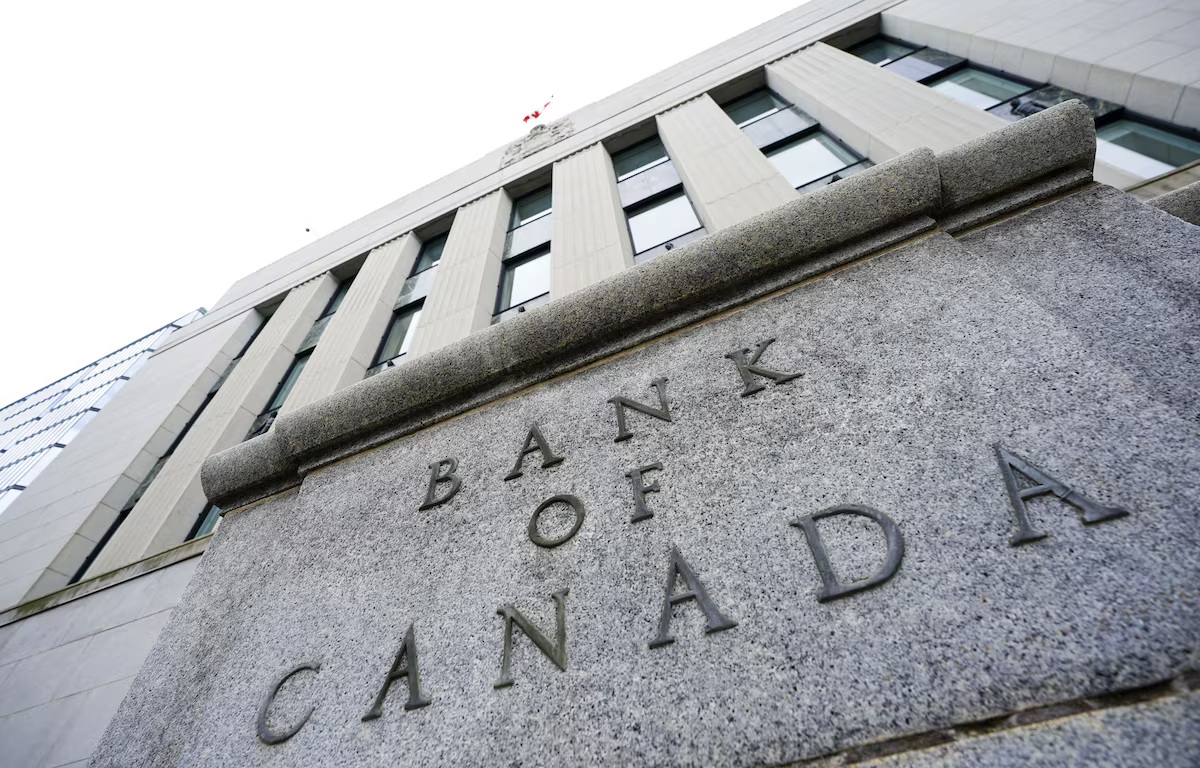
The Bank of Canada is expected to maintain its benchmark interest rate at 2.75% on July 30 for a third straight meeting, driven by a recent uptick in inflation and a drop in unemployment, according to a Reuters survey of economists. Despite the pause, most analysts still anticipate at least two additional rate cuts before the end of 2025.
Since June 2024, the Bank has lowered interest rates by a total of 225 basis points, but has held steady since March, as policymakers await clarity on a wave of trade tensions stemming from U.S. tariff threats.
This uncertainty is significant, as over 80% of Canadian exports are sent to the United States. So far, steep U.S. import tariffs on products like steel, aluminum, and cars have negatively impacted Canadian consumer and business sentiment.
Further market anxiety was triggered by a recent warning from U.S. President Donald Trump, who proposed a blanket 35% tariff on goods outside the current North American free trade deal.
This ongoing trade ambiguity, combined with mixed economic indicators, is expected to keep the BoC from making any rate changes in the near term, according to all 28 economists surveyed between July 21–25.
“Given the stronger-than-expected data and escalating trade risks, we believe the Bank will hold for now,” said James Knightley, ING’s chief international economist. “However, with downside risks to growth, we expect two more cuts rather than just one before year-end.”
Among those polled, nearly two-thirds (18 out of 28) expect a 25-basis-point cut in September, bringing the rate down to 2.50%. While projections for the end of 2025 varied, 17 economists anticipate at least two more reductions this year, including five who foresee three.
Canada’s economy, after shrinking by 0.1% in April following 2.2% annualized growth in Q1, is projected to contract by 0.5% in Q2. The median forecast sees stagnation in Q3, followed by a 0.8% rebound in Q4. Overall, annual growth is expected to average 1.3% for both 2025 and 2026.
Almost half of the economists surveyed (10 of 21) predict Canada will slip into a technical recession—two straight quarters of negative growth—sometime this year.
Businesses continue to act cautiously, holding back on hiring and capital spending, according to a recent BoC survey. Housing demand, a key pillar of the Canadian economy, also remains subdued despite falling home prices and borrowing costs.
“Rates aren’t yet low enough to spur housing demand, and businesses are hesitant to invest until there’s more certainty around the future of the Canada-U.S.-Mexico trade agreement,” said Avery Shenfeld, CIBC Capital Markets’ chief economist.
“Unless trade negotiations produce a significantly better outcome than expected, we see the BoC lowering rates two more times this year.”
Inflation in Canada rose to 1.9% last month and is projected to hover around 2%—the midpoint of the BoC’s 1–3% target range—through 2027. However, core inflation pressures are expected to stay persistently high, according to median projections from the poll.