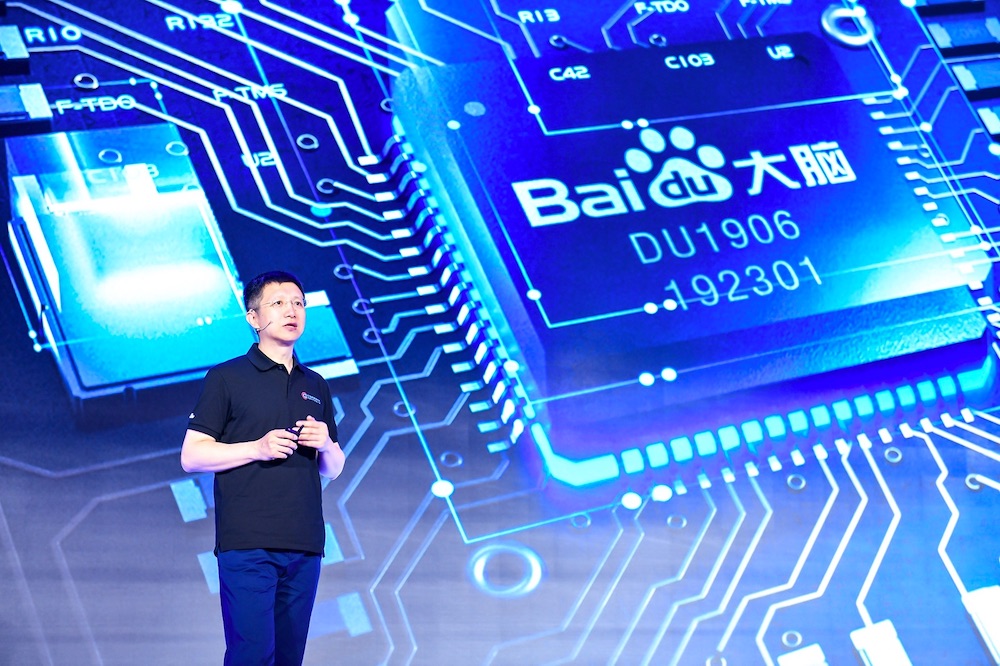
Baidu introduced two new artificial intelligence semiconductors on Thursday, saying the chips aim to give Chinese companies stronger, cheaper, and domestically controlled computing power.
Growing tensions between the United States and China have led to strict limits on exports of advanced U.S. AI chips to Chinese firms. As a result, many companies in China are now building their own processors or turning to local suppliers.
At the Baidu World technology conference, the company announced that the M100 chip, designed for AI inference, will launch in early 2026. The M300, which can handle both training and inference tasks, is scheduled for release in early 2027.
AI training builds models by analyzing large datasets, while inference uses those models to generate predictions and respond to user requests.
Baidu, which has been working on its own chips since 2011, also revealed two new supernode products. These systems use high-performance networking to connect multiple chips, helping reduce performance limits of individual processors.
Huawei already offers a similar system called CloudMatrix 384. It combines 384 Ascend 910C chips and is considered by analysts to be more powerful than Nvidia’s GB200 NVL72, one of the most advanced systems from the U.S. chipmaker. Huawei also said in September that more advanced supernode products are in development.
Baidu’s Tianchi 256 will combine 256 P800 chips and will be available in the first half of next year. A larger version using 512 chips is planned for the second half of the year.
The company also presented an updated version of its Ernie large language model. Baidu said the new model performs strongly in text processing as well as image and video analysis.