Asian Stocks Mixed as Japan Tech Slumps, While China Gains on AI Optimism
Asian markets were mostly weaker on Monday, with Japanese tech stocks facing heavy profit-taking, while Chinese equities remained well supported by optimism around home-grown AI development.
Trading volumes were thin due to a U.S. holiday, leaving Wall Street and European futures to post only modest gains after a decline on Friday.
The U.S. dollar and bonds came under mild pressure ahead of a packed week of economic data, including manufacturing and services surveys, plus the all-important August payrolls report due Friday. Median forecasts point to a 75,000 job gain, though estimates range widely from zero to +110,000 after July’s weaker-than-expected results. Analysts also note that August payrolls have historically undershot forecasts, raising the likelihood of a softer outcome.
A weaker jobs report would likely cement expectations for a Federal Reserve rate cut at its September 17 meeting, which futures markets currently see as a 90% probability. JPMorgan’s Chief U.S. Economist Michael Feroli said only a strong upside surprise in hiring could prevent the Fed from easing policy.
Despite lingering economic uncertainty, expectations of lower borrowing costs have supported Wall Street near record highs, although September remains historically the worst month for the S&P 500 over the past 35 years.
Futures trading was subdued, with S&P 500 and Nasdaq futures down 0.1%, while EUROSTOXX 50 futures added 0.1%, FTSE futures were flat, and DAX futures gained 0.1%.
Asia Market Moves
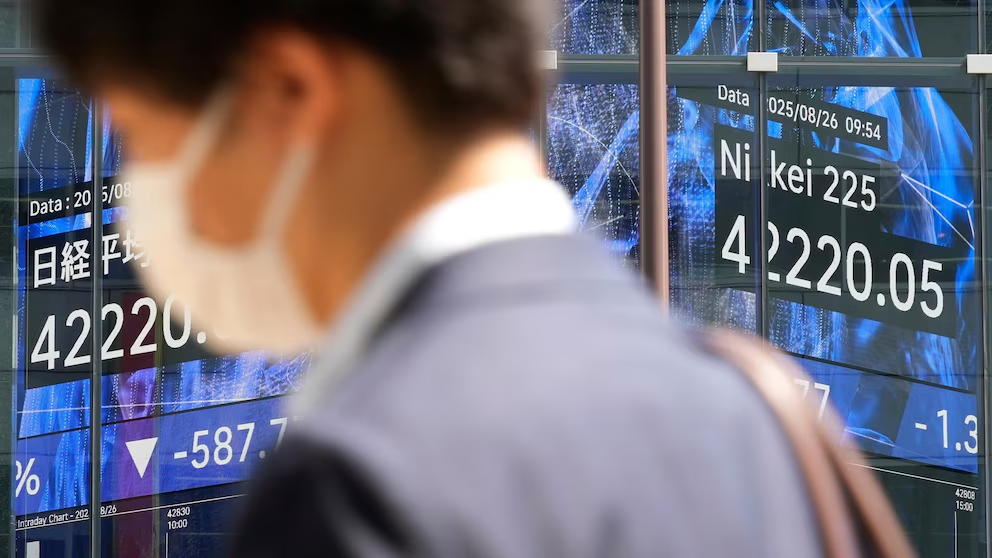
- Japan’s Nikkei fell 1.6%, led by a 9% drop in chipmaker Advantest after a strong multi-month rally.
- South Korea’s Kospi lost 0.7%.
- Indonesia’s market fell 1.5% amid political protests and pressure on the rupiah.
- China’s markets bucked the trend, with the MSCI Asia-Pacific ex-Japan index up 0.4% after hitting a four-year high last week. Chinese blue chips also gained 0.4% in August, climbing 10% overall on strong liquidity flows.
Private PMI data from China showed factory activity expanding at its fastest pace in five months, contrasting with official surveys that still signaled contraction. Optimism was also lifted by Alibaba’s Hong Kong-listed shares, which soared nearly 19% on cloud business hopes, while reports suggested DeepSeek chose Huawei chips for AI training.
Trade and Politics in Focus
Uncertainty lingers over U.S. tariff policy after a Court of Appeals ruled many of President Donald Trump’s tariffs illegal, though they remain in place until mid-October pending a Supreme Court appeal. Analysts warn that if overturned, the U.S. Treasury could be forced to return nearly $100 billion in collected duties, while fragile trade talks with Japan and South Korea could unravel.
Meanwhile, political pressure on the Fed is rising. Governor Lisa Cook is preparing to file fresh arguments against her attempted dismissal, while Trump’s nominee Stephen Miran faces a Senate confirmation hearing this week.
Currencies and Commodities
The U.S. dollar remained under pressure, trading at 97.791 on the dollar index after a 2.2% loss in August. The euro rose 0.3% to $1.1710, while the dollar held steady at 146.93 yen.
In commodities, gold benefited from the weaker dollar and expectations of lower rates, climbing another 1% to $3,481 an ounce after a 2.2% gain last week. Oil prices, however, remained soft ahead of a planned OPEC+ supply increase, with Brent crude down 0.4% to $67.21 and WTI crude easing 0.4% to $63.78 per barrel.