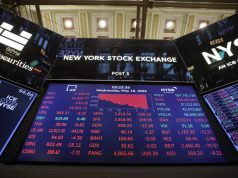
Asian Stocks Fall as U.S.–China Trade Tensions Resurface; Nikkei Leads Losses
Most Asian stock markets reversed early gains and turned lower on Tuesday as investors reacted to renewed U.S.–China trade tensions and ongoing political uncertainty in Japan.
Overnight, Wall Street posted strong gains after President Donald Trump adopted a softer stance toward China. However, Asian markets failed to maintain the same optimism, with regional traders remaining cautious.
U.S. stock index futures also slipped slightly during early Asian trading after rising earlier in the session.
U.S.–China Trade Friction Returns, Pressuring Global Markets
Trade concerns resurfaced after President Trump threatened to impose 100% tariffs on Chinese imports in response to Beijing’s recent export restrictions on critical minerals. The move reignited fears of another escalation in the trade war between the world’s two largest economies.
In an interview with Fox Business Network, Treasury Secretary Scott Bessent confirmed that Trump and Chinese President Xi Jinping still plan to meet later this month — a signal that some dialogue may continue.
China’s Ministry of Commerce said on Tuesday that working-level discussions were underway and pledged to “fight till the end” against any new U.S. measures.
Despite the possibility of talks, the hawkish rhetoric led investors to scale back risk-taking, even after Wall Street’s rally overnight.
Hong Kong’s Hang Seng Index dropped 0.8%, extending recent declines. Mainland Chinese stocks also lost momentum, with the Shanghai Shenzhen CSI 300 falling 0.4% and the Shanghai Composite edging slightly lower after early gains.
Nikkei Plunges on Political Uncertainty; KOSPI Retreats After Record High
Japan’s Nikkei 225 plunged 3% after returning from a market holiday. The sharp decline came as political uncertainty deepened when Prime Minister candidate Sanae Takaichi suffered a major setback following the withdrawal of a key coalition partner.
South Korea’s KOSPI index fell 0.6% to 3,563.19 points, retreating from an earlier record high of 3,646.77. Initial optimism was fueled by Samsung Electronics’ strong third-quarter earnings forecast, but the company’s shares later declined 3% after early gains.
In Australia, the S&P/ASX 200 traded flat after minutes from the Reserve Bank of Australia showed policymakers remained cautious about inflation risks and offered little clarity on near-term rate decisions.
Elsewhere in the region, Singapore’s Straits Times Index slipped 0.3% after the Monetary Authority of Singapore kept its monetary policy unchanged, as widely expected.
Preliminary GDP data showed Singapore’s economy grew more than anticipated in the third quarter. However, annual growth moderated from the previous quarter due to weak manufacturing output.
India’s Nifty 50 was little changed, while LG Electronics India Ltd surged more than 50% in its market debut after a $1.3 billion IPO that attracted strong investor demand.