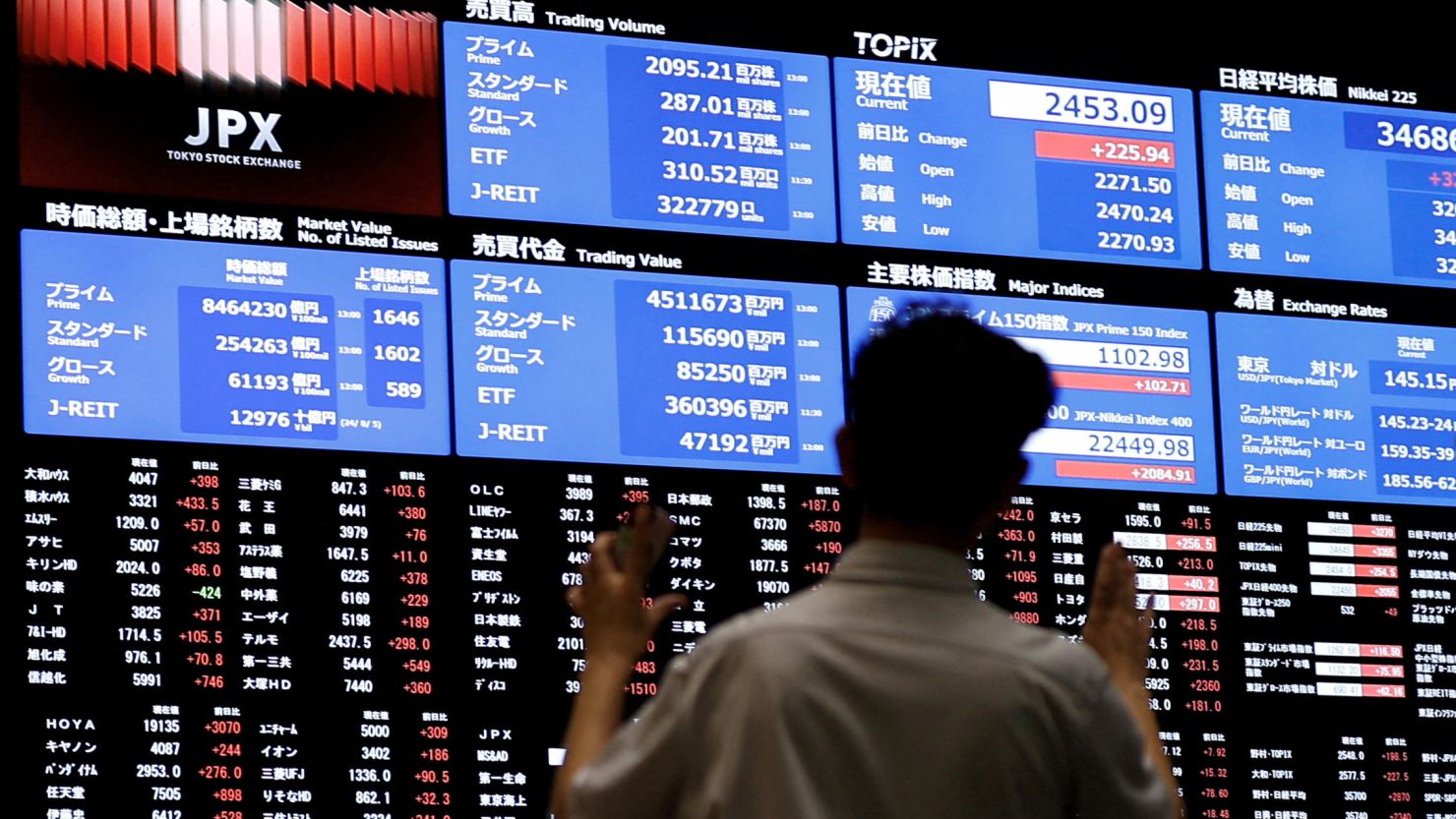
Asian stock markets advanced on Monday, supported by broad-based buying across the region. Gains were led by technology shares and chipmakers, as renewed optimism around artificial intelligence lifted investor sentiment. Markets also digested China’s decision to leave key lending rates unchanged.
Major U.S. stock indices finished mixed at the end of last week, but futures linked to Wall Street edged higher during Asian trading hours, providing additional support to regional markets.
Japan and South Korea lead gains on tech rebound
Equities across Asia tracked the late-week strength in U.S. markets, where technology stocks rebounded after concerns over heavy AI-related spending and stretched valuations began to ease.
Chipmakers, which had recently come under pressure on fears that capital expenditure could outpace near-term returns, staged a recovery. Investors judged that demand tied to artificial intelligence and data centres remains resilient.
Japan’s Nikkei 225 jumped 2%, while the broader TOPIX rose 0.8%. Shares of Advantest Corp gained sharply, while SoftBank Group climbed more than 5%.
In South Korea, the KOSPI also advanced 2%, driven by strong performances from heavyweight chipmakers Samsung Electronics and SK Hynix.
China, Hong Kong and broader Asia follow higher
China’s Shanghai Composite rose 0.6%, while the CSI 300 added 0.8%. In Hong Kong, the Hang Seng Index edged up 0.3%, with the Hang Seng TECH Index gaining 0.7%.
Elsewhere, Australia’s S&P/ASX 200 climbed 1%, while Singapore’s Straits Times Index rose 0.7%. Futures tied to India’s Nifty 50 were slightly higher, up 0.1%.
China keeps key lending rates steady
Investor attention also remained on China, where the People’s Bank of China left its benchmark Loan Prime Rates unchanged. The one-year LPR, which guides corporate borrowing costs, and the five-year LPR, used as a reference for mortgages, were both held steady, in line with expectations.
The move signaled a preference for policy stability, as Chinese authorities balance efforts to support economic growth against concerns over financial risks.
With the year-end holiday period approaching, trading volumes are expected to thin. However, investors are likely to continue favoring technology and AI-linked stocks, leaving Asian markets sensitive to movements in Wall Street equities.