Most Asian stock markets closed lower on Monday, weighed down by sharp losses in technology shares after cautious guidance from major U.S. companies raised concerns about stretched valuations linked to the artificial intelligence boom.
Investor sentiment across the region remained fragile after Wall Street ended last week sharply lower, led by a selloff in tech stocks. Disappointing outlooks from AI-exposed firms such as Broadcom and Oracle prompted investors to reassess whether lofty tech valuations can be sustained as AI spending rises.
Despite the weak regional tone, Chinese equities posted relatively smaller losses. However, a series of soft economic indicators and ongoing worries about the country’s property sector continued to limit risk appetite toward mainland China and Hong Kong markets.
U.S. stock futures showed modest gains in early Asian hours, with S&P 500 futures up 0.3%. Markets are now focused on key U.S. data due this week, including the November nonfarm payrolls report and consumer price inflation figures, which could shape expectations for Federal Reserve policy.
China markets subdued amid weak data and property concerns
China’s CSI 300 and Shanghai Composite indexes both slipped around 0.1%, outperforming regional peers due to their lower exposure to the global AI-driven tech trade. Still, sentiment remained cautious following signs of slowing economic momentum.
Recent data showed that industrial production and retail sales growth came in below expectations, while fixed asset investment declined more sharply than forecast. These readings reinforced concerns that economic growth in the world’s second-largest economy is losing pace, increasing pressure on Beijing to deliver further stimulus.
Concerns surrounding China’s property sector also remained prominent. State-backed developer China Vanke failed to secure approval from bondholders to delay repayment on an onshore bond due later this month, adding to fears of stress across the real estate industry. Shares of Vanke fell sharply, while other property stocks also came under pressure.
ING analysts noted that persistent economic weakness, combined with multiple structural headwinds, strengthens the case for additional policy support from Chinese authorities.
Asian tech stocks slide after U.S. selloff
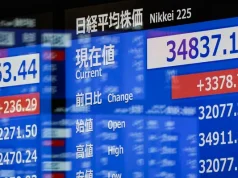
Technology-heavy Asian markets recorded the steepest declines, mirroring losses seen in U.S. equities late last week. South Korea’s KOSPI dropped 1.4%, while Japan’s Nikkei 225 fell 1.2% and Hong Kong’s Hang Seng index declined 0.8%.
The tech sector was hit after Broadcom issued weaker-than-expected margin guidance, raising doubts about how quickly AI investments will translate into profits. Oracle’s recent warning about higher costs and softer guidance further fueled skepticism over the near-term returns from massive AI spending by global tech giants.
Broader Asian markets also traded lower, though some pockets of resilience emerged. Japan’s TOPIX index edged up 0.2%, supported by data showing solid capital spending among major manufacturers. Investor attention is also turning to an upcoming Bank of Japan policy meeting.
Australia’s ASX 200 fell 0.7%, while Singapore’s Straits Times index slipped 0.3%. India’s Nifty 50 declined 0.2%, giving back some gains after rising on Friday following a softer consumer inflation reading.