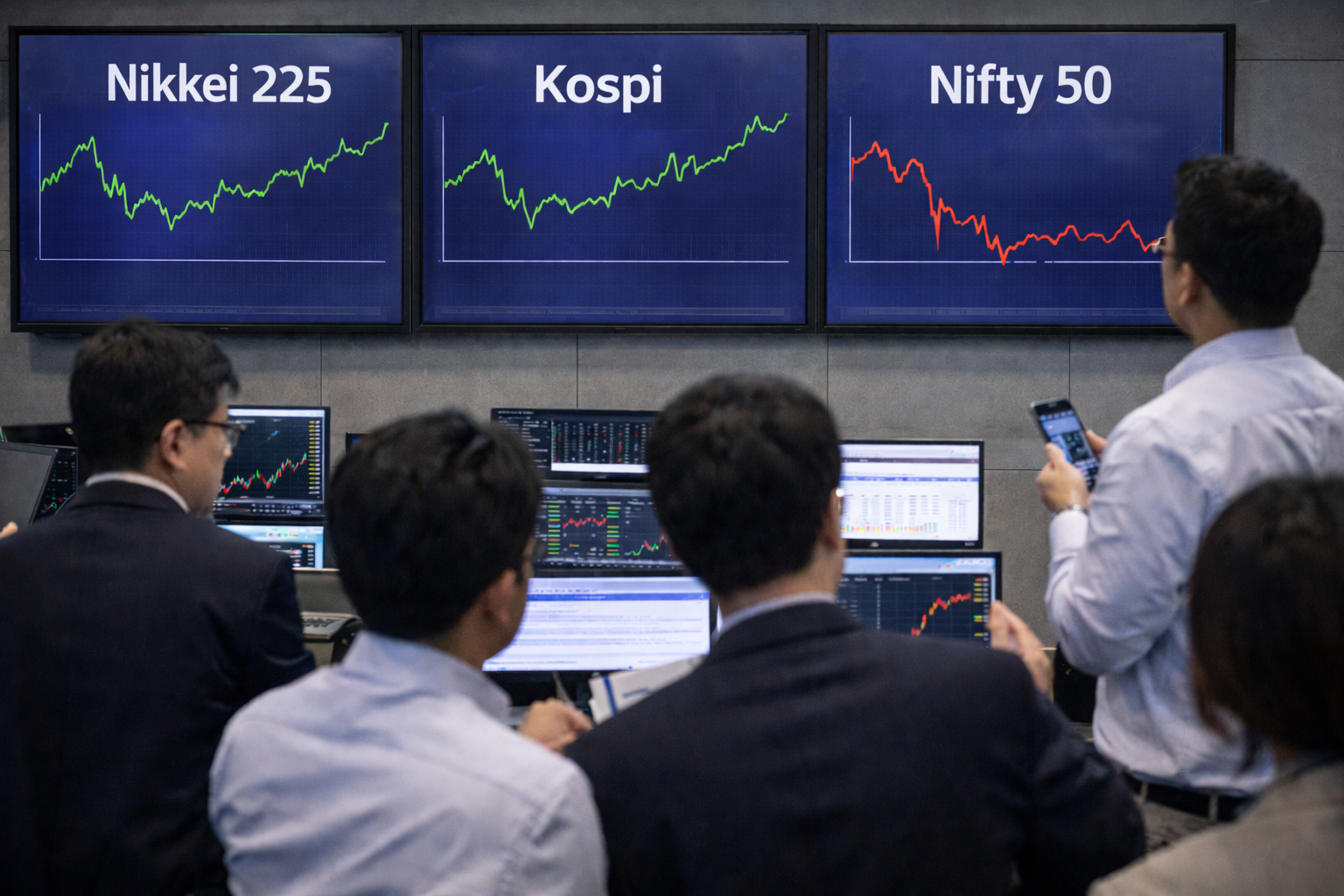
Asian stock markets traded unevenly on Friday, while the Japanese yen and U.S. Treasuries gained as investors shifted toward safe-haven assets. Concerns about elevated technology valuations and rising geopolitical tensions weighed on overall market sentiment.
Chinese equities declined, and shares in Japan and South Korea showed mixed performance. Strong quarterly results from Nvidia, a key player in the artificial intelligence sector, failed to boost investor confidence. Despite beating earnings expectations and projecting higher revenue for the current quarter, U.S. markets closed lower and Nvidia shares were little changed in after-hours trading.
Market analysts suggested that investors may have expected even stronger guidance, especially given Nvidia’s high valuation. As a result, enthusiasm around AI-related stocks cooled, contributing to a broader pullback in risk assets.
Geopolitical developments also remained a major focus. An Omani mediator described recent U.S.–Iran nuclear talks as constructive, but no concrete breakthrough emerged that would eliminate the risk of potential U.S. military action. At the same time, tensions escalated between Pakistan and Afghanistan following air and ground strikes targeting Taliban positions along the border.
This combination of artificial intelligence uncertainty and geopolitical risks pushed investors toward defensive assets. The MSCI Asia-Pacific index excluding Japan was largely flat. Japan’s Nikkei edged up 0.22%, while China’s CSI300 fell 0.34% and South Korea’s Kospi declined 0.6%.
In currency markets, the U.S. dollar index slipped 0.05% to 97.68. The euro rose slightly to $1.1808, while the Japanese yen strengthened 0.2% to 155.78 per dollar, reflecting demand for safer currencies.
Oil prices moved higher amid ongoing geopolitical uncertainty. U.S. crude gained 0.54% to $65.56 per barrel, and Brent crude rose 0.35% to $71.00. Gold also advanced 0.15% to $5,194.48 per ounce, supported by increased safe-haven demand.
U.S. Treasury yields declined as bond prices rose. The yield on the benchmark 10-year note fell to 4%, while the 30-year bond yield eased to 4.6556%. Lower yields reflected a cautious mood among investors seeking stability.
In Japan, fresh economic data showed slower inflation in Tokyo and weaker-than-expected factory output. These figures complicate the Bank of Japan’s case for additional interest rate hikes. The data followed Prime Minister Sanae Takaichi’s nomination of two dovish candidates to the BOJ board, reinforcing expectations of a cautious monetary policy stance.
Japan’s Finance Minister Satsuki Katayama also signaled that authorities are closely monitoring currency movements, expressing concern about recent fluctuations in the yen.
In the United Kingdom, sterling rose 0.07% to $1.3489 after Prime Minister Keir Starmer’s Labour Party suffered a surprise defeat in a Greater Manchester constituency it had held for decades. The Green Party won the seat, with Reform UK finishing second.
Early European futures indicated a modestly positive start. Euro Stoxx 50 futures rose 0.1%, German DAX futures added 0.07%, and FTSE futures gained 0.24%. Meanwhile, U.S. S&P 500 futures were down 0.23%, pointing to a cautious open on Wall Street.