Asian equity markets surged on Monday, starting the first full trading week of the new year on a strong footing as technology and semiconductor stocks extended their powerful year-end rally.
U.S. markets closed last week with mixed results, and futures were largely steady during Asian hours on Monday. The tech-heavy Nasdaq pointed modestly higher, offering limited direction to the region.
Japan and South Korea hit record levels
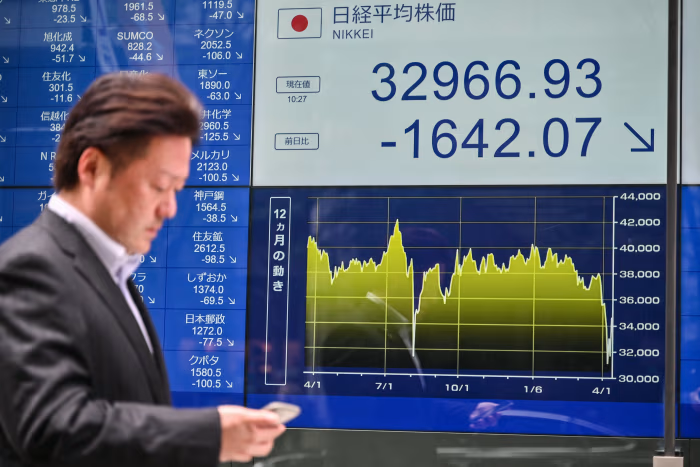
Japan’s Nikkei 225 jumped 2.7% to a two-month high, while the broader TOPIX climbed 2.1% to a fresh record of 3,486.0 points.
Semiconductor-linked stocks led the advance, with Advantest Corp and Tokyo Electron both rising more than 6%.
In South Korea, the KOSPI surged nearly 3% to a record high of 4,434.27 points. Heavyweights Samsung Electronics and SK Hynix gained between 3% and 6%, tracking renewed optimism around chip demand.
China mixed, broader Asia steady
China’s blue-chip CSI 300 advanced 1.6%, while the Shanghai Composite rose 1.1%. Hong Kong’s Hang Seng Index was little changed after ending nearly 3% higher on Friday.
Elsewhere, futures linked to India’s Nifty 50 were flat. Singapore’s Straits Times Index added 0.5%, while Australia’s S&P/ASX 200 finished broadly unchanged.
Asian markets continued to benefit from their strong exposure to the global semiconductor supply chain, as expectations grew that demand for advanced processors and memory chips will remain resilient through 2026.
China data and geopolitics in focus
The rally in Asian tech stocks contrasted with Wall Street’s muted performance at the end of last year, when U.S. equities failed to deliver a traditional year-end rally amid cautious positioning and mixed economic signals.
Regional risk appetite appeared largely unfazed by geopolitical tensions following the U.S. attack on Venezuela and the capture of President Nicolas Maduro over the weekend.
Meanwhile, a private survey showed China’s services sector expanded at its slowest pace in six months in December, according to the RatingDog services PMI. Although activity remained in expansionary territory, weaker growth in new business highlighted ongoing challenges facing the world’s second-largest economy.