
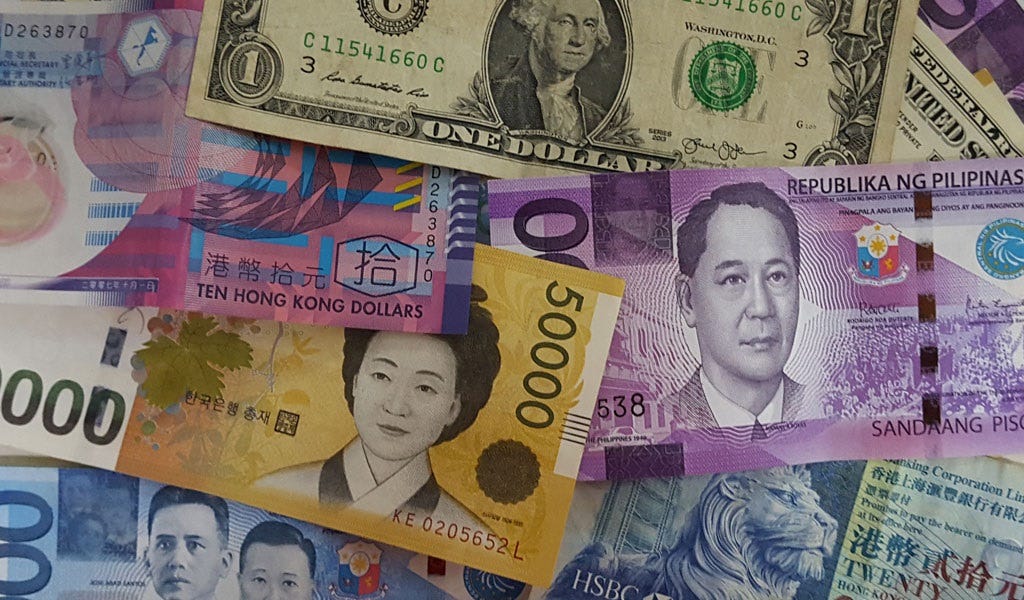
Asian currencies moved modestly higher on Monday, while the U.S. dollar weakened, as investors evaluated the fallout from a U.S. Supreme Court ruling against President Donald Trump’s earlier tariff programme and his subsequent decision to introduce new trade levies under a separate legal provision.
The U.S. Dollar Index declined 0.4% during early Asian trading hours. U.S. Dollar Index futures also slipped by 0.4% as of 05:04 GMT, reflecting softer demand for the greenback.
Asian currencies gain amid U.S. trade policy uncertainty
In Japan, the yen strengthened, with the USD/JPY pair falling 0.5%. The Japanese currency drew support from renewed safe-haven demand as global trade uncertainty resurfaced.
The South Korean won also firmed slightly, as USD/KRW edged down 0.2%. Meanwhile, the offshore Chinese yuan saw mild gains, with USD/CNH dipping 0.1%.
Last week, the U.S. Supreme Court ruled that the broad tariffs introduced by President Donald Trump under emergency powers lacked sufficient legal basis. The decision struck at a central element of his trade strategy. Initially, financial markets viewed the ruling as a sign that trade tensions could ease, potentially supporting global economic growth.
However, President Donald Trump quickly responded by unveiling a new 10% global tariff on imports for 150 days under Section 122 of U.S. trade law. He later raised the rate to 15%, the maximum permitted under that statute. This move reintroduced uncertainty into global trade flows.
The renewed tariffs complicate the outlook for Asian exporters that depend heavily on U.S. consumer demand. Economies such as Japan and South Korea, along with several others in the region, had previously secured trade agreements or tariff exemptions with Washington. The latest developments could put those arrangements under pressure.
Regional equity markets showed mixed performance, as investors remained cautious about the potential impact of higher U.S. tariffs on supply chains, corporate earnings, and capital flows across Asia.
Federal Reserve outlook remains uncertain
Investor sentiment was further weighed down by recent U.S. economic data. Reports released last week indicated slower economic growth alongside persistent inflationary pressures. This combination of soft growth and sticky inflation has complicated expectations for Federal Reserve interest rate policy.
As a result, markets have scaled back forecasts for significant interest rate cuts this year, reinforcing a cautious tone across global financial markets.
Elsewhere in Asia, the Indian rupee traded largely unchanged, with USD/INR holding steady. The Singapore dollar gained slightly, as USD/SGD slipped 0.1%, while the Australian dollar weakened marginally, with AUD/USD edging 0.2% lower.