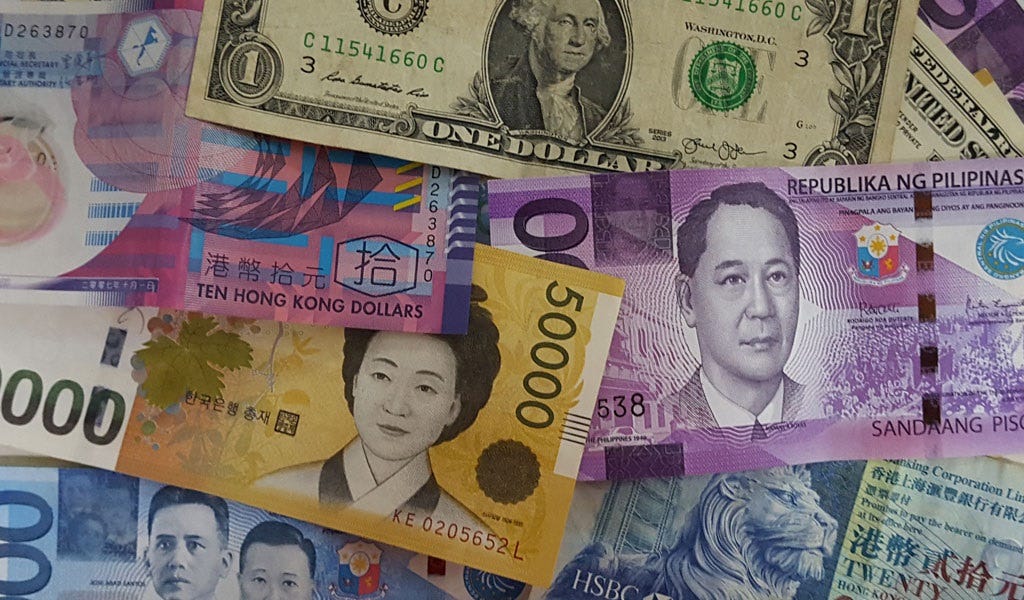
Asian Currencies Weaken as Dollar Gains Safe-Haven Demand
Most Asian currencies declined on Monday, while the U.S. dollar strengthened as investors sought safe-haven assets. The move followed the collapse of U.S.-Iran peace talks and growing expectations that Washington will move forward with a blockade of Tehran’s ports.
Inflation Data Supports Stronger Dollar
Regional currencies also came under pressure after recent data showed a sharp rise in U.S. consumer inflation. This reinforced concerns that the Federal Reserve may keep interest rates higher for longer, further supporting demand for the dollar.
Markets Await Key US and China Economic Data
Investor attention this week is focused on a series of important economic releases from both the United States and China. Traders are closely monitoring these indicators for insights into the health of the world’s largest economies, as well as the broader impact of the Iran conflict.
Broad Weakness Across Asian FX Markets
Currency movements across Asia reflected the stronger dollar trend. The Japanese yen weakened slightly, with USD/JPY rising 0.3%, while the Chinese yuan also edged lower as USD/CNY gained 0.1%.
The Australian dollar fell 0.3%, while the South Korean won weakened with USD/KRW rising 0.2%. Similarly, the Singapore dollar slipped as USD/SGD increased 0.2%, and the Indian rupee declined with USD/INR up 0.1%.
Indian Rupee Under Pressure from Energy Exposure
The Indian rupee remained among the most affected currencies due to India’s heavy reliance on energy imports. While some support emerged last week from hopes of a ceasefire, renewed geopolitical tensions could reverse that trend if military actions escalate.
Key Asian Economic Releases in Focus
Markets are also watching closely for major economic data releases across Asia. China is set to publish trade data for March along with first-quarter GDP figures later this week.
India’s consumer inflation data is expected later today, followed by Singapore’s GDP figures on Tuesday. Additionally, South Korea’s trade data and Australia’s employment figures are scheduled for release later in the week.
Iran Conflict Raises Global Growth Concerns
The ongoing Iran conflict remains a central risk factor for global markets, particularly due to disruptions in energy supply. The conflict has already impacted roughly 20% of global energy flows, raising concerns about inflation and economic growth worldwide.
Dollar Strengthens as Iran Talks Collapse
The U.S. dollar continued to gain strength, with both the dollar index and its futures rising around 0.4%. The rally reflects renewed safe-haven demand after U.S.-Iran negotiations failed to produce a breakthrough.
Strait of Hormuz Blockade Adds Market Uncertainty
Key sticking points in the negotiations included Iran’s nuclear program, its support for regional militant groups, and control over the Strait of Hormuz. U.S. President Donald Trump announced plans for a blockade of the strategic waterway, although officials later clarified that actions would primarily target Iranian vessels and ports.
Fragile Ceasefire Fails to Calm Markets
Despite the absence of new military strikes, a fragile ceasefire remains in place. However, the breakdown in diplomatic efforts suggests limited prospects for immediate de-escalation, keeping markets on edge.
Inflation Surge Dampens Rate Cut Expectations
The dollar also drew support from recent consumer price index data, which showed a notable increase in inflation driven by rising energy costs linked to the Iran conflict. This has reduced expectations for near-term Federal Reserve rate cuts.
Upcoming US Producer Price Data
Looking ahead, markets will closely watch U.S. producer price index data for March, scheduled for release on Tuesday, for further signals on inflation trends and monetary policy direction.