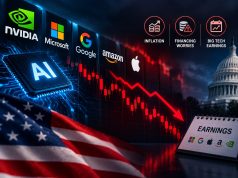
The Nasdaq Composite plunged into correction territory on Thursday, November 5, as a massive selloff in artificial intelligence and semiconductor stocks sent Wall Street sharply lower.
The technology-heavy index fell more than 4%, extending its decline to over 10% from its October record high. Investors rushed to reduce exposure to chipmakers amid growing concerns about stricter AI regulations following the Democratic Party’s sweeping victory in the US midterm elections.
Nvidia, AMD, Intel, and other major semiconductor companies suffered substantial losses as traders questioned whether new political restrictions could slow the expansion of artificial intelligence infrastructure.
The downturn also erased much of Wednesday’s post-election rally, highlighting a dramatic reversal in investor sentiment.
Nasdaq Enters Correction Territory as Wall Street Selloff Intensifies
US stock markets experienced significant selling pressure on Thursday as technology shares led a broad market decline.
At approximately 11:19 a.m. Eastern Time, the Nasdaq Composite had fallen 4.2% to 24,665.60 points.
Earlier in the session, the index had dropped as much as 5.7%, placing it more than 10% below its most recent record closing high.
A decline of at least 10% from a recent market peak is widely considered a technical correction.
The S&P 500 also suffered heavy losses, declining 2.9% to 7,468.48 points.
Meanwhile, the Dow Jones Industrial Average reversed its earlier gains and dropped 2.3% to 52,151.00 points.
The widespread retreat demonstrated how quickly investor confidence deteriorated following Wednesday’s strong market recovery.
US Stocks Erase Gains Following Democratic Election Victory
Wall Street had initially reacted positively to the results of the US midterm elections.
On Wednesday, the Nasdaq Composite advanced 1.4%, while the S&P 500 climbed 1.6%.
The Dow Jones Industrial Average surged approximately 3%, recording its strongest daily performance since April 9, 2025.
Deutsche Bank analysts attributed the rally partly to relief that uncertainty surrounding the election outcome had diminished.
However, investors quickly began reassessing the potential economic consequences of Democratic control of Congress.
The change in political leadership raised questions about future taxation, government spending, technology regulation, and corporate investment.
Peter Schiff, chief economist and global strategist at Euro Pacific Asset Management, expressed a particularly pessimistic outlook.
Schiff argued that the election results could lead to increased regulation, higher taxes, larger government deficits, and additional inflationary pressures.
He warned that these developments could negatively affect economic growth and stock market performance.
However, these concerns reflect Schiff’s interpretation of the political outlook rather than confirmed economic consequences.
Other market observers believe the selloff may be excessive, particularly given the longer-term economic opportunities associated with artificial intelligence.
Nvidia, AMD and Intel Stocks Plunge as Chip Selloff Accelerates
Semiconductor companies experienced some of the largest losses as investors reconsidered the outlook for artificial intelligence infrastructure spending.
Nvidia shares declined approximately 7% during the reported trading period.
Advanced Micro Devices (AMD) suffered an even sharper decline, falling 12.2%, while Intel dropped 5.2%.
The Philadelphia Semiconductor Index, a widely followed benchmark for chipmakers, plunged more than 11%.
The decline reflected growing concerns that stricter regulations could disrupt the rapid expansion of data centers and reduce near-term demand for advanced processors.
Chip manufacturers have benefited from substantial investment in AI infrastructure over recent years.
However, their growth expectations depend heavily on continued spending by major technology companies.
Any delays to new computing facilities could affect semiconductor orders, hardware deliveries, and future revenue projections.
The selling pressure extended beyond the United States.
South Korean semiconductor companies Samsung Electronics and SK Hynix also declined.
In Taiwan, Foxconn shares dropped more than 3%, while Taiwan Semiconductor Manufacturing Company (TSMC) fell approximately 0.9%.
The international weakness highlighted the interconnected nature of the global semiconductor supply chain.
Democratic Victory Raises Concerns About AI Data Center Regulations
Investors are increasingly focused on how Democratic control of Congress could influence the future development of artificial intelligence infrastructure.
Some analysts believe the new political environment may lead to tighter oversight of data center construction, electricity consumption, and environmental requirements.
These potential restrictions could complicate expansion plans for technology companies investing billions of dollars in advanced computing facilities.
Deutsche Bank analysts noted that uncertainty surrounding data center regulation had already affected parts of the technology sector during Wednesday’s session.
The concerns intensified overnight, contributing to Thursday’s broader semiconductor selloff.
One important development is the election of Democrat Gina Hinojosa as governor of Texas.
Texas has become a major destination for large-scale data center investments because of its available land and energy infrastructure.
However, Hinojosa has proposed temporarily restricting new data center approvals until lawmakers establish additional protections concerning electricity demand, water consumption, and community impacts.
Analysts at Macquarie Group suggested that the Texas election result could signal a more restrictive approach toward future AI infrastructure development.
Nevertheless, the eventual impact will depend on which regulations are introduced and how they are implemented.
Mohamed El-Erian Warns Against Overreacting to AI Regulation
Not all economists believe the political changes will undermine the long-term growth potential of artificial intelligence.
Mohamed El-Erian, former chief executive of PIMCO, suggested that the market may be reacting too aggressively to the prospect of tighter oversight.
Speaking to CNBC, El-Erian acknowledged that the technology industry could benefit from a more balanced approach to AI development.
He argued that allowing infrastructure expansion without sufficiently considering its economic and social consequences could create problems similar to those associated with earlier phases of globalization.
However, El-Erian remained optimistic about the long-term economic benefits of artificial intelligence.
In his view, stronger oversight could encourage more efficient AI adoption rather than prevent the technology from expanding.
He also noted that strong earnings and substantial investment by major technology companies have helped support the broader stock market.
A slowdown in that spending could therefore expose weaknesses elsewhere in the economy.
Nevertheless, El-Erian suggested that the current market reaction may be exaggerated relative to the longer-term implications of the political changes.
Qualcomm and Arm Shares Slide Following Earnings Reports
Company-specific earnings developments added further pressure to semiconductor stocks.
British chip designer Arm Holdings dropped more than 11% after issuing quarterly revenue and profit guidance that failed to impress investors.
Although the company exceeded expectations for revenue and earnings in its September quarter, its outlook for the following period disappointed the market.
Qualcomm also experienced a sharp decline, with its shares falling nearly 12%.
The company reported weaker-than-expected smartphone chip revenue and warned that semiconductor manufacturing costs were increasing.
Higher expenses across chip fabrication, packaging, memory, and other production processes raised concerns about future profit margins.
These developments overshadowed Qualcomm’s stronger revenue outlook for its emerging data center business.
The disappointing reactions to both companies’ earnings reports intensified selling pressure across the semiconductor sector.
Oil Prices Rebound While Gold Climbs Above $4,100
Outside equity markets, investors continued monitoring developments in energy, currencies, and precious metals.
Brent crude futures rose approximately 2.4% to $96.91 per barrel, recovering some of the substantial losses recorded during the previous session.
Oil prices had plunged on Wednesday amid expectations that Democratic control of Congress could increase pressure for a diplomatic resolution to the US-Iran conflict.
The selloff pushed Brent below $100 per barrel and toward its lowest levels in approximately two months.
Lower energy prices could eventually help ease inflation concerns by reducing transportation and production costs.
Such a development might also reduce expectations for aggressive Federal Reserve interest rate increases.
Meanwhile, the US dollar stabilized during Thursday’s trading session.
Longer-term Treasury yields declined, while shorter-term yields remained relatively unchanged.
Gold prices climbed above $4,100 per ounce, supported partly by lower bond yields and broader financial market uncertainty.
Investors Await US Jobs Report and Federal Reserve Signals
Economic data and monetary policy expectations remain important factors influencing Wall Street.
Investors are preparing for the October nonfarm payrolls report, scheduled for Friday, November 6.
The employment figures could provide new evidence about the strength of the US labor market and influence expectations for the Federal Reserve’s December interest rate decision.
The central bank has maintained a restrictive monetary policy stance as inflationary pressures remain elevated.
Market participants expect another interest rate increase in December, although the decision will depend on upcoming economic indicators.
Strong employment figures could strengthen the argument for additional monetary tightening.
Conversely, signs of weakening labor market conditions could complicate the Federal Reserve’s outlook.
The latest weekly jobless claims data showed that applications for unemployment benefits fell to 189,000, matching a 57-year low.
The figures reinforced expectations that the labor market remains relatively resilient despite uncertainty surrounding economic growth.
Corporate earnings will also remain in focus, with companies including Parker-Hannifin, Southern Company, Duke Energy, and Airbnb scheduled to release quarterly results.
What Comes Next for the Nasdaq and AI Stocks?
The Nasdaq correction highlights the growing uncertainty surrounding the artificial intelligence investment boom.
Semiconductor companies have benefited from enormous demand for advanced computing hardware, but their valuations remain sensitive to changes in infrastructure spending expectations.
Potential regulatory restrictions could delay data center projects, increase construction costs, and complicate the financial outlook for AI-related businesses.
However, tighter regulation does not necessarily mean artificial intelligence adoption will decline over the longer term.
Existing data center operators may even benefit if restrictions make new computing capacity more difficult to develop.
Investors will therefore need to distinguish between companies vulnerable to construction delays and those positioned to benefit from limited infrastructure supply.
The Nasdaq’s ability to stabilize following its correction will likely depend on renewed confidence in technology earnings, AI investment plans, and broader economic conditions.
Upcoming employment data and Federal Reserve policy expectations could also influence whether the selling pressure continues.
For now, the sharp decline in semiconductor stocks demonstrates how quickly market sentiment can change when investors begin questioning the assumptions supporting a major investment trend.
Whether the current Nasdaq correction develops into a deeper downturn will depend on the severity of future regulatory changes, corporate earnings performance, and the resilience of the broader US economy.