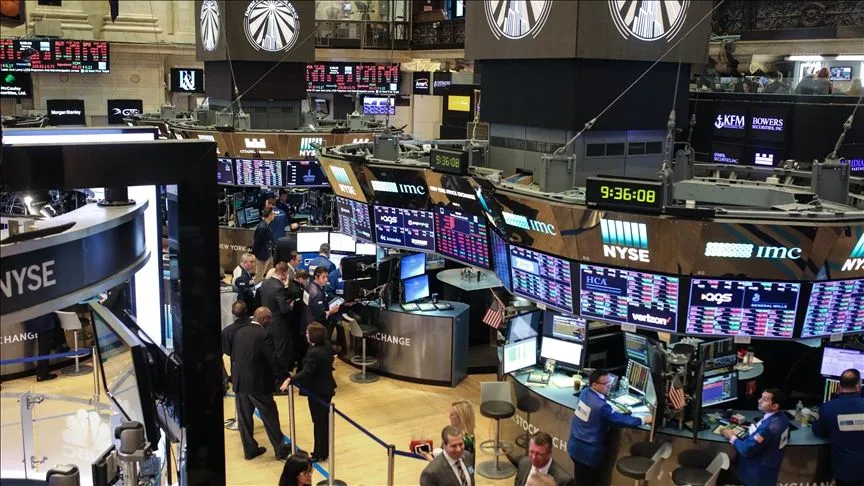
US stocks traded mixed on Tuesday as investors monitored the 2026 US midterm elections, renewed volatility in artificial intelligence stocks and earnings reports from major technology companies.
The S&P 500 and Nasdaq Composite moved higher during the session, supported by renewed interest in technology shares. However, the Dow Jones Industrial Average declined as concerns about corporate profitability and geopolitical uncertainty weighed on market sentiment.
At 11:37 a.m. ET, the S&P 500 gained 0.4% to 7,575.05 points, while the Nasdaq Composite advanced 0.8% to 25,373.07 points. Meanwhile, the Dow Jones Industrial Average fell 0.4% to 51,787.42 points.
The mixed performance followed a volatile session on Monday, when early gains faded amid renewed selling pressure across artificial intelligence-related stocks.
S&P 500 and Nasdaq Gain as Wall Street Watches US Midterms
The 2026 US midterm elections dominated investor attention on Tuesday, with voters deciding the future balance of power in Congress.
Republicans entered Election Day controlling both the House of Representatives and the Senate, providing President Donald Trump with congressional support for his legislative agenda.
However, the elections could change that political balance and introduce new challenges for the administration.
A Democratic victory in either chamber could complicate future legislation involving taxation, government spending and financial regulation.
The potential consequences extend across multiple sectors, including technology, energy, healthcare and utilities.
Investors are therefore evaluating how different election outcomes could influence corporate earnings, economic growth and market valuations.
Meanwhile, technology shares helped support the S&P 500 and Nasdaq despite continued uncertainty surrounding artificial intelligence investments.
Inflation and Iran Conflict Remain Major Election Issues
Economic affordability has emerged as a central issue for American voters heading into the midterm elections.
Rising energy prices have contributed to higher living costs, particularly following the escalation of the US-Iran conflict earlier this year.
Increased gasoline and diesel prices have added pressure on household budgets, while businesses continue facing higher transportation and operating expenses.
However, the broader US economy has received support from resilient consumer spending and substantial investment in artificial intelligence infrastructure.
These competing economic forces have complicated expectations for future growth and monetary policy.
Oil markets have also experienced considerable volatility as traders assess developments in the Middle East.
Crude prices briefly strengthened on Tuesday following reports of a US military strike targeting Iran’s Qeshm Island, a strategically important location near the Strait of Hormuz.
The reported operation renewed concerns about potential disruptions to regional energy exports.
However, diplomatic developments and expectations for negotiations have also placed downward pressure on crude oil prices.
The uncertainty surrounding the conflict continues to influence inflation expectations and investor sentiment across financial markets.
Artificial Intelligence Investments Face Growing Scrutiny
The rapid expansion of artificial intelligence remains another important factor influencing Wall Street.
Major technology companies have invested heavily in data centers, advanced semiconductors and computing infrastructure to support AI development.
Although these investments have helped drive economic activity and corporate growth, investors have become increasingly concerned about their long-term profitability.
Some companies have relied on substantial borrowing and equity financing to fund infrastructure expansion, raising questions about the sustainability of current spending levels.
The AI industry has also become a political issue as voters express concerns about employment, energy consumption and the construction of large data centers.
President Trump has consistently supported American leadership in artificial intelligence, emphasizing the importance of maintaining a technological advantage over China.
However, growing public scrutiny and uncertainty surrounding future government policies could affect companies exposed to the sector.
Analysts at Deutsche Bank highlighted the competing influence of energy prices and artificial intelligence developments on financial markets during Election Day.
These factors have contributed to sharp fluctuations in technology stocks, particularly as investors reassess earnings expectations and company valuations.
Apple Stock Falls as Rising Memory Costs Threaten Margins
Apple shares declined approximately 2% during Tuesday’s session after the company issued a cautious profitability outlook.
Despite reporting better-than-expected fiscal fourth-quarter earnings, the technology giant warned that increasing memory-chip prices could weigh on margins during the December quarter.
Apple expects gross margins between 45% and 46%, below analysts’ forecasts of approximately 46.9%.
Chief Executive Officer John Ternus, who succeeded Tim Cook in September, described the recent increase in memory costs as unusually severe.
Management also indicated that component prices could continue rising beyond the current quarter.
The warning raised concerns about Apple’s ability to protect profitability while maintaining strong demand for its products.
Apple Services Growth Slows Despite Strong iPhone Sales
Apple also forecast slower growth in its Services business, which includes subscriptions, digital platforms and App Store-related revenue.
The company cited unfavorable foreign exchange movements, regulatory pressures and continued weakness in mobile gaming.
However, Apple’s hardware operations delivered a stronger performance.
The company exceeded Wall Street’s revenue and earnings expectations for the September quarter, supported largely by robust demand for its iPhone 18 lineup.
Apple’s first foldable smartphone, the iPhone Duo, also attracted significant attention following its October launch.
Early demand exceeded available inventory, although management warned that production constraints could continue limiting shipments in the near term.
Meanwhile, Apple introduced an updated version of its Siri voice assistant but provided relatively limited details about the broader integration of advanced AI capabilities into its services.
Some investors have viewed Apple’s comparatively restrained AI infrastructure spending as a potential advantage during the recent volatility affecting technology stocks.
Nevertheless, rising component costs and slowing Services growth have introduced new concerns about the company’s earnings outlook.
Palantir Shares Retreat Despite Strong Quarterly Earnings
Palantir Technologies also experienced selling pressure, with its shares declining approximately 3% during the session.
The AI-focused data analytics company reported better-than-expected quarterly financial results, supported by strong demand from commercial and government customers.
However, investors focused on concerns about the pace of future contract growth.
Despite impressive revenue expansion, some analysts questioned whether the company could maintain its recent momentum.
The decline highlighted the increasingly demanding expectations facing artificial intelligence companies.
Strong earnings alone may not be sufficient to support share prices when investors are concerned about future growth, valuations and the sustainability of AI-related spending.
Palantir’s performance also demonstrated the broader uncertainty affecting the technology sector as markets reassess the potential returns from artificial intelligence investments.
Wall Street Outlook Depends on Elections and Tech Earnings
The mixed performance of the S&P 500, Nasdaq and Dow Jones Industrial Average reflects the competing forces shaping US financial markets.
Technology stocks have provided support to major indexes, but concerns about AI investment costs, corporate profitability and geopolitical developments continue to create volatility.
The 2026 US midterm elections could introduce further uncertainty by changing the political balance in Washington.
Investors will closely monitor the results for indications of how taxation, trade policy, government spending and regulation could evolve during the remaining two years of Trump’s presidency.
Corporate earnings will also remain an important market driver, particularly as major technology companies provide updated forecasts for the coming quarters.
For now, the S&P 500 and Nasdaq have demonstrated resilience despite weakness in Apple and Palantir, while the Dow’s decline underscores the uneven performance across Wall Street.
The next significant market movements could depend on election results, developments in the Middle East and whether technology earnings can justify elevated expectations for artificial intelligence growth.