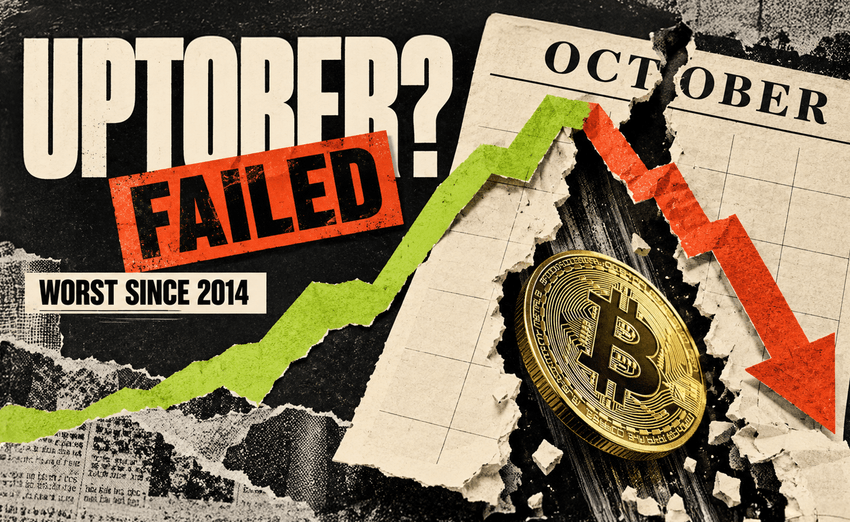
Bitcoin’s historically bullish October performance is facing renewed scrutiny after the cryptocurrency recorded a 7.3% decline in October 2026, marking its second consecutive loss during a month traditionally associated with strong returns.
According to CoinGlass data, Bitcoin also fell approximately 4% in October 2025, challenging the widely followed seasonal trend known as “Uptober.”
The disappointing performance has raised questions about whether Bitcoin’s historical trading patterns remain reliable as institutional investors, macroeconomic developments, and changing market conditions increasingly influence cryptocurrency prices.
Meanwhile, major cybersecurity incidents, including Binance’s reported $6.3 billion hack, prompted some market participants to replace the familiar Uptober nickname with darker terms such as “Hacktober” and “Black October.”
Bitcoin Uptober Trend Weakens After Two Consecutive October Losses
October has historically ranked among Bitcoin’s strongest months, frequently delivering substantial gains for cryptocurrency investors.
According to Andrew Yang, a researcher at blockchain analytics company Kaiko, Bitcoin recorded positive October returns in 10 of the 13 years between 2013 and 2025.
During that period, October generated a median monthly return of approximately 15.4%, making it Bitcoin’s strongest month by that measure.
However, the cryptocurrency’s recent performance has challenged expectations of a predictable seasonal rally.
The 7.3% decline in October 2026 followed a loss of approximately 4% during the same month in 2025.
Consequently, traders are increasingly questioning whether historical monthly trends remain useful for forecasting Bitcoin price movements.
Nevertheless, analysts caution that two disappointing Octobers do not necessarily invalidate a pattern established over more than a decade.
Bitcoin Seasonality Changes as Market Volatility Declines
One possible explanation for Bitcoin’s changing seasonal behavior is the gradual reduction in its typical monthly price fluctuations.
According to Kaiko’s research, Bitcoin’s average monthly movement declined from approximately 14% during 2013–2016 to 9.6% since 2024.
This reduction suggests that Bitcoin’s market dynamics have evolved as the cryptocurrency industry has matured.
Furthermore, smaller monthly price movements may make dramatic seasonal rallies less common than they were during Bitcoin’s earlier trading history.
September’s Historical Weakness Is Also Disappearing
Changes in seasonal behavior are not limited to October.
September has traditionally been considered a difficult month for Bitcoin, earning a reputation among cryptocurrency traders for negative returns.
However, Bitcoin has recorded positive September performances every year since 2023.
Yang suggested that this shift could partially reflect investors anticipating October’s historically strong performance.
For example, traders expecting an Uptober rally may begin accumulating Bitcoin during September, potentially moving buying pressure forward.
As a result, gains that previously occurred in October could increasingly appear earlier in the calendar.
Institutional Investors Are Reshaping Bitcoin Price Trends
The growing influence of institutional investors represents another important factor behind Bitcoin’s changing seasonal patterns.
Justin d’Anethan, head of research at digital asset investment firm Arctic Digital, highlighted the increasing importance of exchange-traded funds (ETFs) and corporate Bitcoin investment strategies.
Unlike retail traders who may follow historical seasonal trends, institutional investors typically base their decisions on broader financial considerations.
These include market liquidity, interest rates, portfolio allocation requirements, and macroeconomic conditions.
Consequently, Bitcoin’s price movements may increasingly reflect traditional financial market dynamics rather than recurring calendar-based patterns.
Bitcoin and Ethereum ETFs Record Significant October Outflows
Institutional investment flows also reflected the cryptocurrency market’s weakness during October 2026.
U.S.-listed spot Bitcoin ETFs recorded approximately $515 million in net outflows during the month.
Meanwhile, spot Ethereum ETFs experienced a record $1.61 billion in monthly withdrawals.
These developments suggest that investors were reducing exposure to major cryptocurrency investment products during a period of heightened market uncertainty.
However, analysts emphasize that the relationship between ETF activity and Bitcoin’s long-term seasonal behavior remains difficult to measure.
Spot Bitcoin ETFs launched in the United States in January 2024, meaning their trading history is still relatively short.
Therefore, additional market data will be necessary to determine whether institutional investment flows are fundamentally changing Bitcoin’s historical seasonal patterns.
Macroeconomic Conditions May Matter More Than the Calendar
As Bitcoin becomes increasingly integrated into traditional financial markets, economic developments are playing a larger role in determining its price direction.
Federal Reserve interest rate decisions, inflation expectations, global liquidity, and investor risk appetite can all influence cryptocurrency demand.
For example, tighter monetary conditions may reduce the attractiveness of speculative assets, while improving liquidity could encourage additional investment in Bitcoin.
Similarly, changes in institutional portfolio allocations can create substantial buying or selling pressure regardless of the calendar month.
This growing sensitivity to economic conditions suggests that Bitcoin may increasingly behave like a macroeconomic investment asset.
As a result, relying exclusively on historical seasonal performance could become less effective for cryptocurrency traders.
Is Bitcoin’s Uptober Rally Becoming Obsolete?
Despite two consecutive October losses, several cryptocurrency analysts believe it is premature to declare the end of Bitcoin’s seasonal tendencies.
Julio Moreno, head of research at CryptoQuant, emphasized the importance of the broader Bitcoin market cycle.
Historically, October has generally produced stronger returns during cryptocurrency bull markets and weaker performance during bearish periods.
Therefore, market direction and actual spot demand may provide more useful insights than seasonal averages alone.
Can Traders Anticipate Seasonal Bitcoin Rallies Too Early?
Another possible explanation involves the growing popularity of seasonal trading strategies.
Markus Levin, co-founder of XYO, suggested that when enough investors expect Bitcoin to rally during October, they may purchase the asset ahead of time.
This behavior could push anticipated gains into September or other earlier periods.
Consequently, a widely recognized seasonal pattern may become less predictable as more traders attempt to benefit from it.
Arctic Digital’s d’Anethan also acknowledged that Bitcoin’s historical October strength remains statistically relevant, even though seasonal indicators cannot guarantee positive returns.
The key challenge is determining when broader market conditions support or contradict those historical tendencies.
Bitcoin Price Outlook: Are Historical Seasonal Patterns Still Reliable?
Bitcoin’s disappointing October 2026 performance has intensified debate about the usefulness of traditional cryptocurrency trading patterns.
Although Uptober has historically delivered impressive returns, consecutive monthly losses demonstrate that seasonal expectations cannot consistently predict future price movements.
Meanwhile, declining volatility, growing institutional participation, and changing macroeconomic conditions are reshaping the cryptocurrency market.
The increasing influence of Bitcoin ETFs and corporate investors could make liquidity trends, monetary policy, and spot demand more important than calendar-based strategies.
Nevertheless, two consecutive negative Octobers are insufficient evidence to conclude that Bitcoin seasonality has disappeared entirely.
Ultimately, investors may benefit from treating historical seasonal performance as one analytical factor rather than a reliable standalone trading signal.