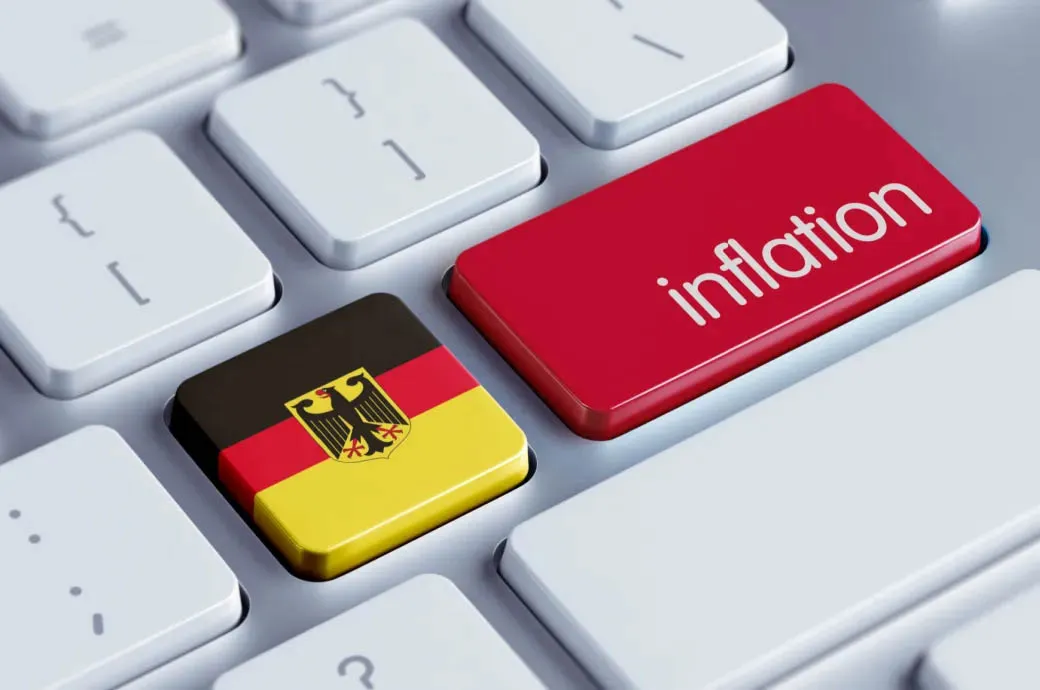
German inflation declined more sharply than expected in October, offering fresh signs that Europe’s largest economy may be coping better than anticipated with the economic consequences of the Iran war.
A government fuel tax reduction helped ease energy-related price pressures, while stronger-than-expected economic growth provided another encouraging signal.
However, economists warned that Germany’s recovery remains heavily dependent on public spending, with private investment showing limited signs of improvement.
German Inflation Falls to 2.8% as Energy Pressures Ease
Germany’s annual inflation rate slowed to 2.8% in October, down from 3.3% in September, according to preliminary figures released by the country’s statistics office.
The decline exceeded economists’ expectations, as analysts surveyed by Reuters had forecast inflation of 3.1%.
Lower energy inflation played a significant role in the improvement. Energy prices increased 12.2% compared with a year earlier, slowing from September’s 14.9% annual rise.
The moderation coincided with the introduction of a government fuel tax reduction designed to protect consumers from soaring oil prices linked to the conflict in Iran.
The temporary measure, which is scheduled to remain in place until the end of the year, appears to be helping contain inflationary pressures.
Meanwhile, core inflation, which excludes volatile food and energy prices, eased to 2.1% from 2.4% in the previous month.
These figures suggest that price pressures are moderating across parts of the German economy, although energy costs remain elevated.
Eurozone Inflation and ECB Interest Rates Remain in Focus
Germany’s inflation figures come ahead of the eurozone’s latest consumer price report, scheduled for Wednesday.
Economists surveyed by Reuters expect annual inflation across the currency bloc to reach 3.9% in October, slightly higher than September’s 3.8%.
Persistent inflation continues to complicate monetary policy decisions for the European Central Bank (ECB).
The ECB left interest rates unchanged at its latest meeting on Thursday. However, policymakers signaled that another increase could be considered in December.
Alexander Krueger, chief economist at Bethmann Bank, expects German inflation to remain close to 3% for an extended period.
He also believes that another ECB interest rate increase cannot be ruled out under current economic conditions.
With geopolitical tensions remaining elevated and energy prices showing limited signs of a sustained decline, inflation risks could persist in the coming months.
German Economy Beats Expectations With 0.2% GDP Growth
Alongside the encouraging inflation figures, Germany’s economy expanded slightly faster than expected during the third quarter.
Gross domestic product (GDP) increased 0.2% compared with the previous quarter, according to preliminary government data.
The result exceeded economists’ forecasts of 0.1% growth.
Although the expansion was modest, it marked another positive quarter for Europe’s largest economy.
Germany previously recorded GDP growth of 0.4% in the first quarter and 0.3% in the second quarter.
The latest figures suggest that economic activity continues to recover following an extended period of weakness.
However, the pace of expansion remains relatively slow, raising questions about the strength of underlying domestic demand.
Government Infrastructure and Defense Spending Support Growth
Germany’s economic recovery has received substantial support from increased government investment in infrastructure and defense.
Under Chancellor Friedrich Merz, Berlin has significantly expanded public expenditure following the approval of a €500 billion infrastructure fund.
The government also introduced exemptions for substantial defense spending under Germany’s constitutional debt brake framework.
These measures have provided an important boost to economic activity, helping offset weak private investment and ongoing pressure from elevated energy costs.
However, several economists believe the recovery remains too dependent on government spending.
Commerzbank chief economist Joerg Kraemer warned that Germany’s business environment continues to face structural challenges.
Without broader economic reforms, the country could struggle to attract sufficient private investment to support stronger long-term growth.
Bethmann Bank’s Alexander Krueger similarly suggested that economic output might have remained stagnant without the additional stimulus provided by public expenditure.
High Energy Prices Threaten Germany’s Economic Outlook
Despite the recent improvement in inflation, Germany continues to face risks from geopolitical uncertainty and expensive energy imports.
The conflict in Iran has contributed to higher global oil prices, increasing costs for businesses and households.
Deutsche Bank economist Marc Schattenberg expects the temporary fuel tax reduction to provide additional support to economic activity during the fourth quarter.
However, analysts remain cautious about the longer-term outlook.
Without a lasting reduction in Middle East tensions, energy prices could remain elevated and continue fueling inflation.
This would create additional challenges for German businesses, particularly energy-intensive industries already facing competitive pressures.
Can Germany’s Economic Recovery Become Self-Sustaining?
Economists increasingly agree that Germany is emerging from its prolonged economic slowdown. Nevertheless, uncertainty remains over whether the recovery can continue without substantial government support.
LBBW economist Jens-Oliver Niklasch believes developments in the coming year will help determine whether Germany’s improvement represents a lasting recovery or a temporary rebound.
A stronger increase in private investment would be essential for achieving more sustainable economic growth.
So far, however, businesses have shown limited willingness to expand investment significantly.
The German government expects GDP to grow by 1.3% in 2026 and 1.1% in 2027.
Earlier this month, the Economy Ministry indicated that the economic consequences of the Iran war and higher energy prices had been less severe than initially feared.
Additional optimism came from the Ifo Institute’s closely watched business climate index, which increased for a sixth consecutive month in October.
The improvement suggests that German businesses are becoming more confident about economic conditions.
Nevertheless, the combination of persistent inflation, geopolitical uncertainty and weak private investment means Germany’s recovery still faces significant obstacles.
While lower inflation and better-than-expected GDP growth offer encouraging signs, sustained economic expansion will likely require stronger business investment and improvements in the country’s long-term competitiveness.