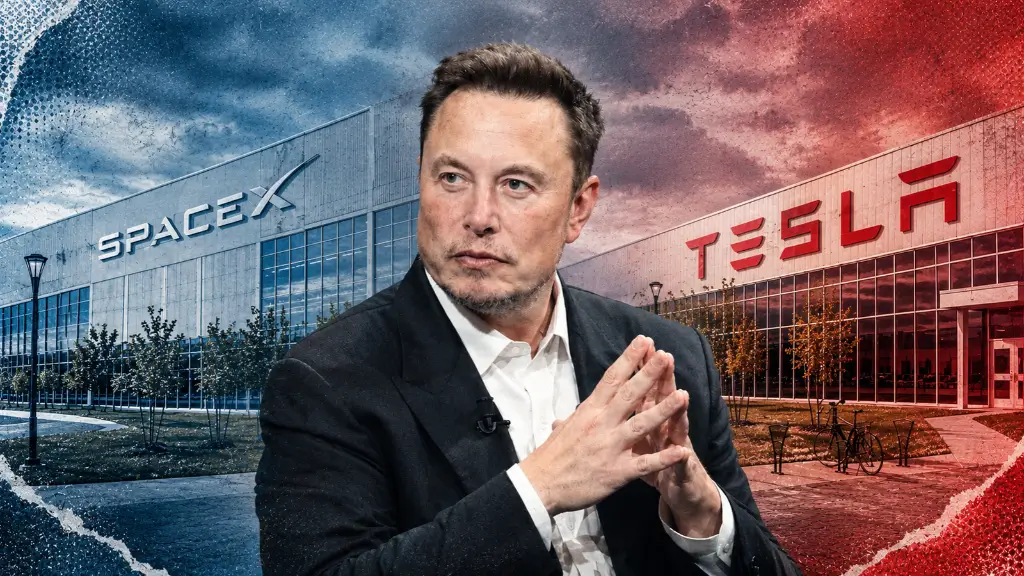
A potential merger between Tesla and SpaceX has raised concerns among company insiders after Elon Musk publicly expressed support for combining the two businesses.
According to Reuters, Musk’s endorsement of a possible $3.5 trillion Tesla-SpaceX merger could intensify shareholder scrutiny, create additional regulatory challenges and potentially delay negotiations.
The billionaire, who serves as chief executive of both companies, confirmed that independent committees have been established to evaluate a possible transaction.
However, discussions remain at an early stage, and no final merger agreement has been reached.
Elon Musk’s Tesla-SpaceX Merger Endorsement Raises Concerns
Musk publicly supported the idea of merging Tesla and SpaceX during the aerospace company’s earnings conference call earlier this week.
He suggested that combining the businesses could be beneficial, although he emphasized that a transaction was far from guaranteed.
The announcement reportedly unsettled some individuals involved in the negotiations.
According to Reuters, citing a person directly familiar with the discussions, insiders are concerned that Musk’s public comments could raise questions about whether Tesla shareholders would receive fair treatment.
The disclosure could also attract additional regulatory attention and delay the merger process.
These concerns are particularly significant because Musk holds substantial ownership stakes in both companies and would have financial interests on both sides of any transaction.
Independent Committees Evaluate Potential $3.5 Trillion Deal
Tesla and SpaceX have established special committees of independent directors to examine whether a merger would benefit their respective shareholders.
The companies have also reportedly appointed financial and legal advisers to evaluate possible transaction structures.
One option under consideration would involve SpaceX acquiring Tesla.
Another possibility would see both businesses combined under a newly created holding company.
An all-stock transaction is also among the potential structures being discussed.
However, the committees have not agreed on final terms, and the reported $3.5 trillion figure represents the potential scale of the combination rather than an agreed acquisition price.
A transaction of this magnitude would rank among the largest corporate mergers in history.
How Could Tesla Shareholder Interests Be Protected?
Protecting shareholder interests is one of the central challenges surrounding a potential Tesla-SpaceX merger.
Musk’s leadership positions and financial holdings in both companies create potential conflicts of interest.
As a result, independent directors would need to evaluate whether the proposed transaction offers appropriate value to shareholders.
Independent board committees, external financial advisers and transparent valuation procedures could help strengthen the fairness of the process.
The committees could also seek independent assessments of both companies and negotiate transaction terms without Musk’s participation.
Musk has acknowledged his conflicting interests and indicated that he cannot take part in the committees’ deliberations.
A Tesla shareholder vote would represent another important stage if a merger proposal advances.
Nevertheless, the effectiveness of these safeguards would depend on the independence of the negotiations and the final terms presented to investors.
Tesla’s SolarCity Acquisition Raises Questions About Merger Risks
The potential transaction has revived comparisons with Tesla’s controversial acquisition of SolarCity in 2016.
At the time, Tesla acquired the solar energy company in a deal involving another business closely associated with Musk.
The acquisition subsequently faced legal challenges from shareholders who alleged that Musk had improperly influenced the transaction.
Critics argued that the deal favored SolarCity and its existing investors rather than delivering appropriate value to Tesla shareholders.
The litigation continued for several years as courts examined Musk’s involvement and the fairness of the acquisition process.
Ultimately, Delaware courts upheld the SolarCity transaction, rejecting the remaining claims against Musk.
However, the lengthy legal proceedings demonstrated the scrutiny that related-party mergers can face when a prominent executive maintains significant interests in both businesses.
For the proposed Tesla-SpaceX merger, independent negotiations and clear shareholder protections could therefore become particularly important.
Tesla Reports $140 Million Loss on SpaceX Investment
The potential merger discussions also coincide with Tesla’s latest quarterly financial results.
The electric vehicle manufacturer reported an approximately $140 million unrealized mark-to-market loss on its SpaceX investment during the third quarter.
The accounting adjustment reflected a decline in the reported value of Tesla’s existing stake in the aerospace company.
Because the loss was unrealized, it did not represent an equivalent cash outflow during the quarter.
However, it negatively affected Tesla’s reported earnings.
The investment highlights the financial relationship that already exists between the two companies.
A full merger would introduce additional considerations surrounding valuation, capital allocation and the treatment of existing shareholders.
Tesla-SpaceX Merger Could Face Regulatory Scrutiny
A potential combination of Tesla and SpaceX would likely attract attention from competition authorities and other government regulators.
The two companies operate across several strategically important industries, including electric vehicles, aerospace, satellite communications, artificial intelligence and energy technology.
SpaceX also maintains significant relationships with the US government through defense and space-related contracts.
Meanwhile, Tesla operates internationally, including extensive business activities in China.
These factors could complicate regulatory assessments of a proposed merger.
Authorities may need to examine competition concerns, national security considerations and the implications of combining businesses with substantial technological capabilities.
The size of the transaction alone would not determine whether regulators approve or reject it.
Instead, the outcome would depend on the merger’s specific structure, competitive effects and applicable legal requirements.
What Could a Tesla-SpaceX Merger Mean for Investors?
A merger between Tesla and SpaceX could create a major industrial and technology group with operations spanning transportation, aerospace, energy and artificial intelligence.
Supporters of the idea may see opportunities for closer technological cooperation, shared infrastructure and more coordinated investment strategies.
Combining the companies could also simplify some aspects of Musk’s management responsibilities.
However, investors would need to consider several important risks.
These include the valuation assigned to each company, potential shareholder dilution, corporate governance concerns and the financial demands of their respective expansion plans.
For Tesla shareholders, the terms of any stock exchange would be especially important in determining the economic value received.
Meanwhile, SpaceX investors would need to assess the potential benefits and risks of gaining exposure to Tesla’s automotive and energy businesses.
What Comes Next for the Tesla-SpaceX Merger?
The proposed Tesla-SpaceX merger remains uncertain despite Musk’s public support.
Independent committees are continuing to evaluate possible transaction structures, while advisers assess financial, legal and regulatory considerations.
The companies have not announced an agreement on valuation, ownership arrangements or a definitive transaction timeline.
Musk’s endorsement could generate additional investor interest, but it may also complicate negotiations by increasing scrutiny of the decision-making process.
Ultimately, shareholder protections, valuation fairness and regulatory approval could determine whether the potential $3.5 trillion combination moves forward.
Until the companies announce formal terms, the Tesla-SpaceX merger remains a proposal under consideration rather than a confirmed corporate transaction.