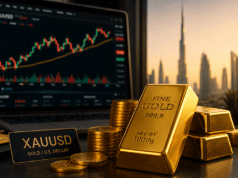
Gold prices moved higher on Friday, recovering from a nearly 2% decline in the previous session as investors returned to buy the dip.
The rebound came even as stronger U.S. inflation data increased expectations that the Federal Reserve could raise interest rates at its upcoming policy meeting.
Gold Prices Rebound After Thursday’s Sell-Off
At 09:51 ET, spot gold was up 1.7% at $4,390.39 an ounce, while gold futures gained around 0.6% to $4,432.30 an ounce.
Despite Friday’s recovery, gold remained on course for a third consecutive weekly decline.
Investors continue to weigh the outlook for tighter U.S. monetary policy, which could place further pressure on non-yielding assets such as gold.
U.S. Inflation Boosts Fed Rate Hike Expectations
U.S. consumer inflation accelerated in August broadly in line with expectations, while a key underlying measure came in slightly stronger than forecast.
Federal Reserve policymakers have repeatedly emphasized the need to bring inflation sustainably back toward the central bank’s 2% target.
That has increased speculation that the Fed could raise interest rates following its upcoming two-day policy meeting.
Fed Chair Kevin Warsh has also indicated that policymakers may still have more work to do if inflation fails to show convincing signs of returning toward target.
Following the latest inflation report, markets were pricing in around an 86% probability of a 25-basis-point rate hike, according to CME FedWatch.
That was up from roughly 70% before the data was released.
PCE Inflation Signals Add Pressure
Additional pressure on gold came from economic data released on Thursday.
Several components that feed into the Federal Reserve’s preferred inflation gauge, the Personal Consumption Expenditures Price Index, showed stronger price increases in August.
Persistently elevated inflation could encourage the Fed to maintain a more restrictive monetary policy stance.
Higher interest rates generally increase the opportunity cost of holding gold because the precious metal does not generate interest or dividends.
Oil Prices Remain a Key Inflation Risk
Oil has also become an increasingly important factor in the inflation outlook.
Brent crude futures moved lower on Friday but remained on track to finish the week above $100 per barrel for the first time in almost four months.
Geopolitical tensions between the United States and Iran have continued to create uncertainty around global energy supplies.
Any prolonged disruption could push oil prices higher and add further inflationary pressure.
That, in turn, could strengthen the case for additional Federal Reserve rate hikes.
UBS Sees Gold Recovery Remaining Intact
Despite growing expectations for tighter monetary policy, gold has shown signs of resilience.
UBS analysts said the metal’s recent strength does not suggest that interest-rate expectations have become irrelevant.
Instead, they believe the market has already priced in a significant amount of monetary tightening.
UBS expects a potential September rate hike to trigger an initial pullback in gold prices.
However, the bank does not believe such a move would necessarily derail the broader recovery.
For now, gold remains caught between renewed dip-buying demand and expectations for tighter Federal Reserve policy, leaving inflation data and interest rates as key drivers for the precious metal.