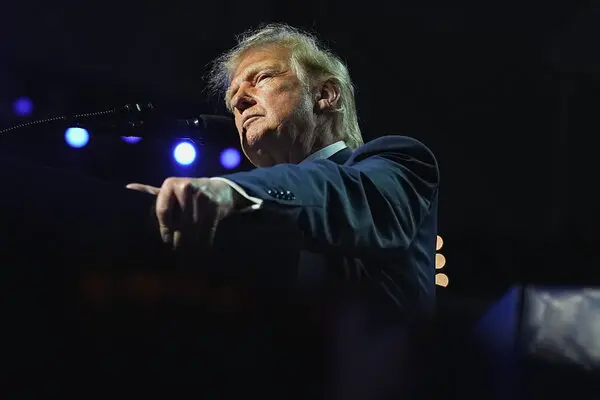
U.S. President Donald Trump has promised a $5,000 payment to every American adult if Republicans win control of both chambers of Congress in the upcoming midterm elections.
Trump announced the proposal on Wednesday during a keynote speech at a Republican convention in Dallas.
Trump Links $5,000 Dividend to Republican Victory
Trump said the payment would depend on Republicans winning both the House of Representatives and the Senate.
Under the proposal, every adult U.S. citizen would receive a $5,000 dividend.
Trump added one major condition: the money would have to be spent inside the United States.
However, he did not provide further details about eligibility, timing, implementation or how the program would be funded.
Trump Has Proposed Dividend Payments Before
This is not the first time Trump has suggested distributing government revenue directly to Americans.
Last year, he proposed a $2,000 payment that would have been financed using revenue collected from U.S. tariffs.
Trump repeatedly promoted the idea as a way for Americans to benefit directly from what he described as the strength of the economy during his second term.
However, discussion surrounding the proposed tariff dividend later faded.
Previous Tariff Dividend Plan Lost Momentum
The earlier $2,000 payment proposal was closely linked to revenue generated by Trump’s trade tariffs.
Momentum behind the idea weakened after much of the administration’s tariff policy was struck down by the U.S. Supreme Court in early 2026.
That development reduced expectations that tariff revenue could provide a reliable source of funding for a nationwide dividend.
The latest $5,000 proposal therefore raises new questions about where the money would come from.
Funding the $5,000 Payments Could Be a Major Challenge
It remains unclear how Washington could finance payments of $5,000 to every adult American.
The United States is already dealing with a large federal budget deficit and rising government debt.
Critics argue that without a dedicated source of revenue, the payments could require additional federal borrowing rather than representing a traditional dividend funded by surplus income.
The nonpartisan Congressional Budget Office estimates that the U.S. fiscal deficit will reach approximately $2.1 trillion in 2026.
That fiscal backdrop could make approval of such a large-scale payment program more difficult.
Midterm Elections Become Crucial for Trump’s Plan
Trump has explicitly tied the proposed $5,000 dividend to Republican success in the midterm elections.
For the plan to move forward under the conditions he outlined, the GOP would need to secure control of both the House and Senate.
Republicans, however, face a challenging political environment heading into the elections.
Public concern over the ongoing U.S.-Iran conflict and its economic consequences has increased pressure on the administration.
Higher Gas Prices Add to Cost-of-Living Concerns
Energy prices have become another important issue ahead of the midterms.
Gasoline prices rose sharply in early September as renewed hostilities between the United States and Iran pushed energy markets higher.
Higher fuel costs can quickly affect household budgets through transportation expenses and increased prices for goods and services.
As a result, the cost of living could become an important factor influencing voters during the midterm elections.
Trump’s proposed $5,000 dividend may therefore become part of a broader Republican effort to focus the campaign on household finances and the economy.
Questions Remain Over Trump’s $5,000 Dividend
For now, Trump’s announcement remains a political proposal rather than an approved federal payment program.
Important questions remain about its funding, eligibility requirements, economic impact and whether Congress would support such a measure.
The future of the proposal could also depend heavily on the outcome of the midterm elections, particularly whether Republicans succeed in gaining control of both chambers of Congress.