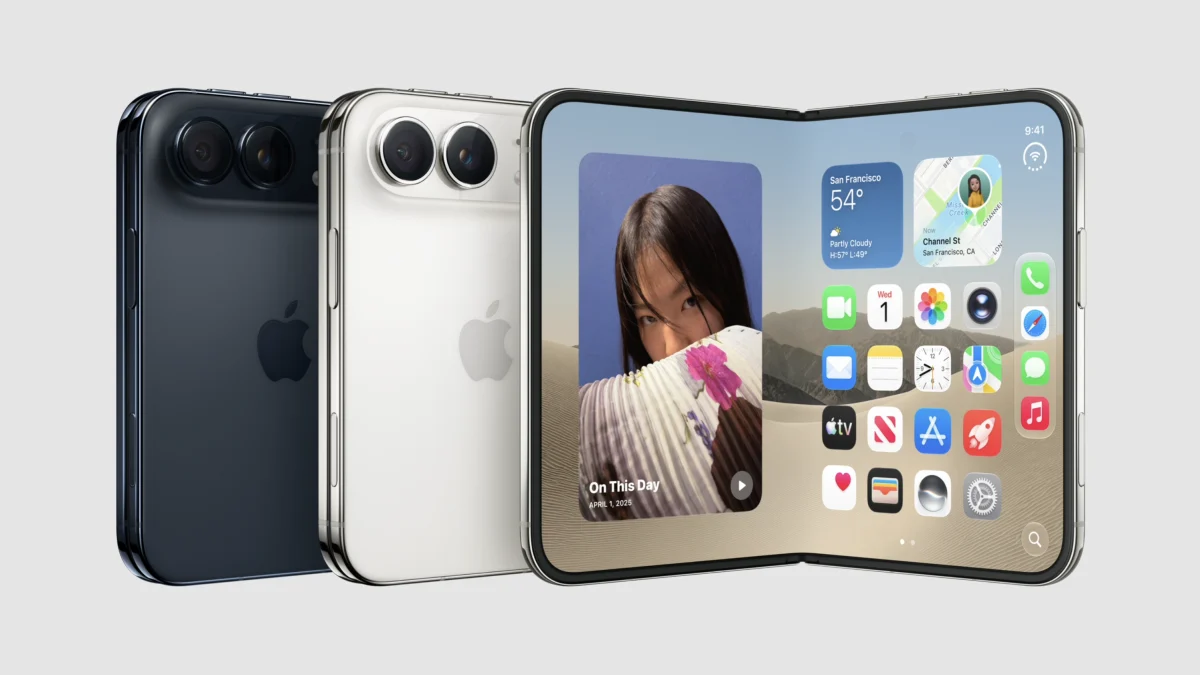
Apple has entered the foldable smartphone market with the launch of the iPhone Duo, a $1,999 device that represents one of the biggest changes to the iPhone lineup in years.
The company is betting that its design, software ecosystem and focus on privacy can help it challenge established foldable-phone makers such as Samsung and Huawei.
Apple’s arrival could also give the broader foldable market a major boost. Until now, folding smartphones have remained a relatively small segment despite years of development by rival manufacturers.
Apple Unveils Its First Foldable iPhone
The iPhone Duo has been designed to resemble the size and shape of a passport when folded.
It opens into a 7.6-inch horizontal display that can also be used vertically. A smaller outer screen allows users to access the phone while it remains closed.
Apple says the Duo is its thinnest iPhone when fully opened. However, the device remains thicker when folded than some competing models from Chinese smartphone makers.
The new design marks the most significant overhaul of Apple’s flagship smartphone since the iPhone X was introduced in 2017.
That makes the launch especially important for the company. The iPhone generated about $209.6 billion in revenue during Apple’s latest fiscal year, accounting for just over half of total sales.
Apple Targets Samsung and Huawei
Apple is entering a foldable market already occupied by major rivals.
Samsung has been one of the leading global players in the category since launching its first foldable devices in 2019. Huawei, meanwhile, has built a particularly strong position in China.
Apple believes it can differentiate the iPhone Duo by making foldable smartphones more practical for everyday use.
CEO John Ternus argued that many existing foldable devices remain uncomfortable for common activities such as scrolling, watching videos and switching between applications.
The iPhone Duo uses a custom hinge, two displays with a consistent aspect ratio and a titanium body. Apple says the design is intended to provide an iPad-like experience in a device that can still fit inside a pocket.
iPhone Duo Focuses on Productivity
Apple is also positioning the iPhone Duo as a productivity device rather than simply a redesigned smartphone.
The larger display can show several applications at the same time. Apple demonstrated uses including multi-participant Zoom calls and expanded views of messaging apps such as Slack.
This approach follows some of the multitasking features already available on the iPad.
For business users, the larger screen could make the Duo more suitable for communication, document viewing and multitasking while travelling.
iPhone Duo Price and Release Date
The iPhone Duo will be priced at $1,999, making it one of Apple’s most expensive mainstream consumer devices.
Apple plans to release the foldable iPhone on October 23.
The company says the device will be powered by its new A20 Pro processor. It will also feature Apple’s C2 modem chip as the company continues reducing its dependence on Qualcomm technology.
Battery life is rated at up to 24 hours of mixed dual-screen use.
Apple also says the battery can reach around 50% charge in approximately 20 minutes.
Analysts Expect Strong Foldable iPhone Demand
Market analysts believe Apple could quickly become a major player in the foldable smartphone market.
International Data Corporation expects Apple to sell most of the foldable iPhones it can initially produce and potentially capture around 40% of the segment by the end of next year.
The biggest challenge could be China.
Huawei currently dominates the Chinese foldable-phone market, making the country an important battleground for Apple.
IDC analyst Francisco Jeronimo believes Apple’s entry could change how consumers evaluate foldable devices and establish new expectations for pricing and design.
Samsung Faces New Competition
Samsung has already stepped up promotion of its own foldable smartphones as competition intensifies.
The company helped pioneer the modern foldable category and has spent years refining the technology.
However, Apple’s entry creates a different competitive threat.
Industry analyst Paolo Pescatore of PP Foresight said Apple’s arrival could be particularly significant in North America, where it has the brand strength and customer base required to bring foldable phones to a much larger audience.
Apple shares closed 0.3% lower at $315.34 following the product presentation.
Apple Emphasizes Privacy and Artificial Intelligence
The event was also one of John Ternus’ biggest public appearances since becoming Apple CEO.
Former CEO Tim Cook introduced Ternus during the presentation before handing over the spotlight to Apple’s new leadership.
Ternus placed particular emphasis on artificial intelligence and user privacy.
Apple is positioning the iPhone as a personal AI platform where as much processing as possible takes place directly on the device.
The company argues that this approach gives users greater control over their personal information compared with AI services that depend heavily on cloud-based data processing.
Siri and Apple Intelligence Receive Updates
Apple also revealed improvements to Siri and its wider Apple Intelligence platform.
Lilian Rincon, who leads AI product development at Apple after joining from Google earlier this year, presented an updated version of Siri.
The company is increasingly integrating artificial intelligence into everyday iPhone functions while emphasizing on-device processing.
The A20 Pro chip has been designed partly to support more advanced AI models directly on Apple devices.
Apple Also Launches iPhone 18 Pro Models
Alongside the foldable iPhone Duo, Apple introduced the traditional iPhone 18 Pro and iPhone 18 Pro Max.
These devices retain the conventional smartphone design rather than adopting a folding display.
The iPhone 18 Pro starts at $1,199, while the iPhone 18 Pro Max begins at $1,299.
Both starting prices are $100 higher than those of the previous iPhone 17 Pro generation.
The new Pro models will also use Apple’s A20 Pro processor.
Apple Introduces New Image Authenticity Technology
Apple also announced technology designed to address concerns surrounding AI-generated and manipulated images.
The company introduced a system called Apple Reference Image, which is designed to help verify the authenticity of photos captured by newer iPhone cameras.
Apple will also support SynthID, an emerging technology for identifying content that has been created or modified using artificial intelligence.
However, Apple Reference Image will not initially be available in the European Union or China.
New AirPods and Apple Watch Models Unveiled
Apple’s launch event extended beyond the iPhone lineup.
The company introduced a new version of its entry-level AirPods starting at $129. For the first time, the budget model will include active noise cancellation.
Apple also announced the Apple Watch Series 12 and Apple Watch Ultra 4.
Both devices focus heavily on health and fitness features, including improved heart-rate monitoring and new tools designed to measure recovery and physical performance.
AI Boom Increases Importance of Chip Suppliers
Micron CEO Sanjay Mehrotra also attended the launch, an unusual appearance for a major Apple supplier.
The presence highlights the growing importance of high-performance memory as Apple expands the use of artificial intelligence across its product range.
More advanced AI functions require greater computing power and memory capacity. As a result, suppliers such as Micron are becoming increasingly important to Apple’s hardware strategy.
The trend is particularly significant as the technology industry continues to deal with tight supplies of advanced memory chips.
Foldable iPhone Could Reshape the Smartphone Market
Apple’s iPhone Duo represents more than the launch of another premium smartphone.
Its entry could help determine whether foldable phones finally move beyond a niche category and become a mainstream part of the global smartphone market.
With a $1,999 price, Apple is clearly targeting premium buyers first. However, strong early demand could encourage the company to expand its foldable lineup in future generations.
For Samsung, Huawei and other manufacturers, Apple’s arrival also raises the competitive stakes in a market they have spent years developing.
The coming months will show whether Apple can once again enter an established product category late and rapidly reshape consumer expectations.