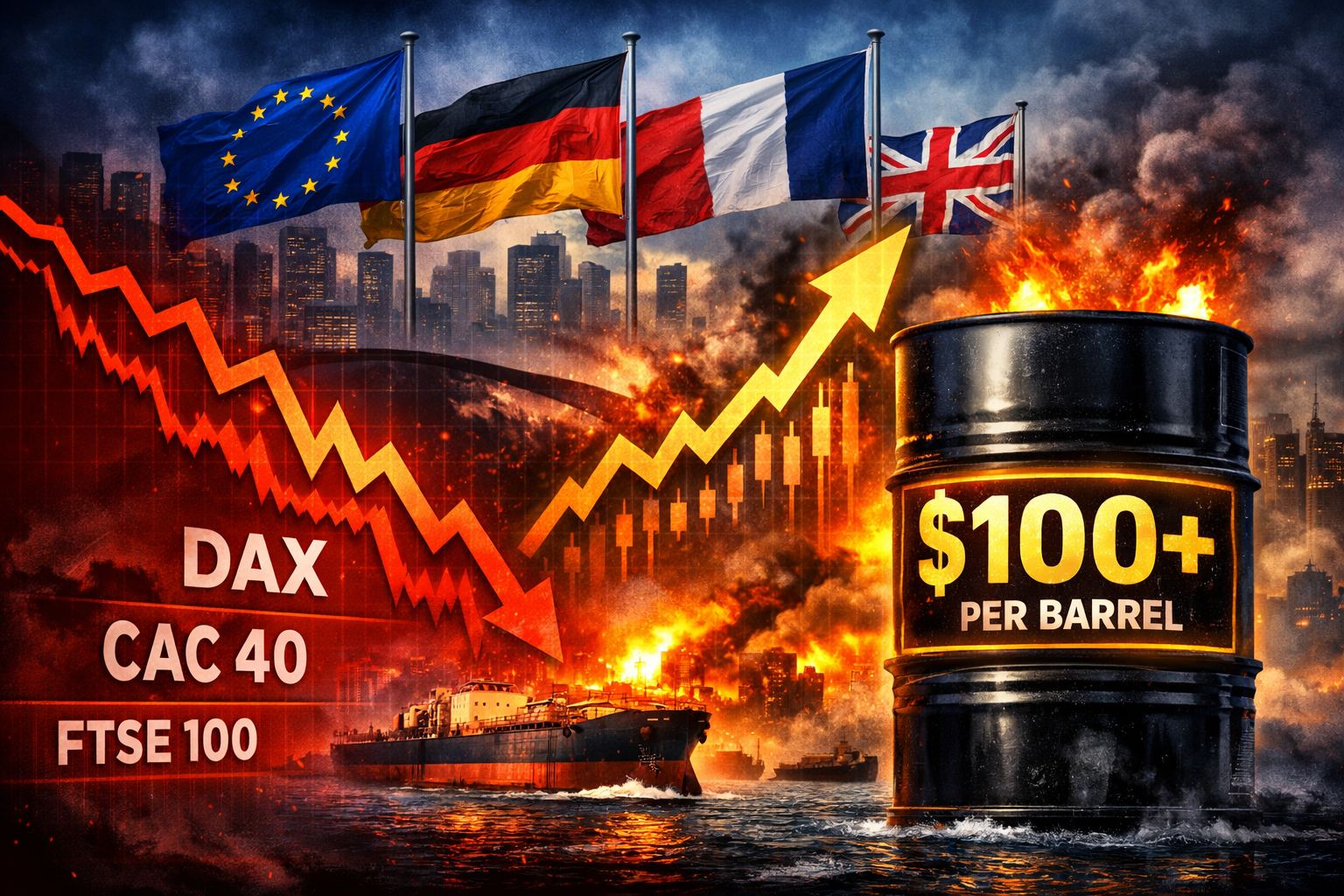
European stocks fell sharply on Wednesday, with major regional indexes dropping to multi-month lows as Brent crude moved above $100 per barrel and investors prepared for an expected European Central Bank interest-rate hike.
The sell-off was broad, with industrial, consumer, and growth stocks under pressure. Gains in energy and defense shares were not enough to offset the wider decline.
STOXX 600 Falls to Lowest Level Since July
The pan-European STOXX 600 dropped 1.2%, reaching its lowest level since July 24.
Selling pressure spread across several sectors, particularly industrial manufacturing, consumer discretionary, and rate-sensitive growth stocks.
These losses outweighed gains among major energy producers and defense companies.
DAX, CAC 40 and IBEX 35 Extend Losses
Germany’s DAX fell 1.3%, touching its lowest level since July 31.
France’s CAC 40 declined 1.5%, falling to its weakest point since June 11.
Spain’s IBEX 35 posted the steepest decline among major continental indexes, dropping 2% to its lowest level since July 30.
The UK’s FTSE 100 performed slightly better but still fell 0.6%.
Its heavier exposure to energy and commodity companies helped cushion some of the broader market weakness.
Brent Crude Breaks Above $100
Brent crude futures climbed 2.7% to around $100.60 per barrel, moving above the $100 level for the first time since July.
The rally followed a fresh escalation in the Middle East.
Iran-backed Houthi forces in Yemen launched coordinated attacks on several Saudi Arabian cities, increasing concerns about regional stability and energy infrastructure.
The attacks came alongside direct U.S. strikes on multiple Iranian oil tankers.
Iran later responded with a missile attack on a U.S. military base in Jordan.
$100 Oil Raises Inflation Fears
Brent moving above $100 is significant for European markets because higher energy prices can increase inflation and weaken consumer spending.
For businesses, more expensive crude raises transportation and manufacturing costs.
For households, higher fuel and energy bills can reduce disposable income and limit spending on non-essential goods and services.
These pressures are particularly important for Europe, where many companies remain sensitive to energy costs.
Strait of Hormuz Risks Add to Market Pressure
Investors are also concerned about shipping conditions around the Strait of Hormuz.
Any disruption to oil flows through the region could worsen the supply outlook and keep crude prices elevated.
The risk has now shifted beyond simple shipping delays.
Direct attacks on infrastructure and vessels have increased fears of longer-term damage to energy supply networks.
Energy Stocks Benefit From Higher Oil Prices
Despite the broader market decline, several energy stocks moved higher.
TotalEnergies, Eni, Neste, and Galp Energia gained between 1.2% and 1.9%.
Equinor rose 3.1%, while Repsol gained 2.1%.
Shell advanced 1.2% and BP climbed 1.8%.
Maurel & Prom also edged higher by 0.8%.
The gains reflected expectations that higher oil prices could support earnings for major energy producers.
ECB Rate Hike Weighs on European Stocks
European equities also faced pressure from expectations of an imminent ECB interest-rate increase.
Money markets have almost fully priced in a 25-basis-point hike from the European Central Bank on Thursday.
Such a move would lift the deposit facility rate to 2.50%.
The expectation of tighter monetary policy has weighed on equity valuations, particularly in sectors that are sensitive to borrowing costs.
Eurozone Inflation Keeps ECB Under Pressure
The case for another ECB rate hike strengthened after preliminary Eurozone inflation data showed headline CPI accelerating.
Higher energy prices were a major factor behind the increase.
With inflation still elevated, policymakers have less room to ease their focus on price stability.
That has reinforced expectations that ECB President Christine Lagarde and the Governing Council will maintain a hawkish stance.
Bond Yields Remain Elevated
Expectations for higher interest rates have kept European government bond yields near multi-year highs.
Higher yields can reduce the relative attractiveness of equities.
They also raise financing costs for companies and households, tightening financial conditions across the euro area.
This has added another layer of pressure on European stock markets.
U.S. Inflation Data Also in Focus
Investors are not only watching the ECB.
Markets are also preparing for important U.S. inflation data later this week.
The figures could influence expectations for Federal Reserve policy and global interest rates.
A stronger-than-expected inflation reading could increase pressure on both U.S. and European equities.
Fortum Jumps After Google Power Deal
Among individual European stocks, Fortum attracted attention after announcing a long-term power agreement with Google.
The Finnish energy company surged 10% on Tuesday after securing the agreement.
The deal is expected to provide long-term revenue visibility for one of Fortum’s nuclear power facilities.
Inditex Falls on Profitability Concerns
Zara-owner Inditex moved in the opposite direction.
The stock fell 4% after profitability figures disappointed investors.
The decline added to pressure in the consumer sector, which was already being weighed down by concerns over higher energy costs and weaker household spending.
European Markets Face Oil and Rate Risks
European stocks remain under pressure from two major forces: rising energy prices and tighter monetary policy.
Brent crude above $100 is increasing inflation concerns, while the expected ECB rate hike is raising borrowing costs and weighing on valuations.
Investors will now watch Thursday’s ECB decision, developments in the Middle East, and upcoming U.S. inflation data for clues about the next direction for European markets.