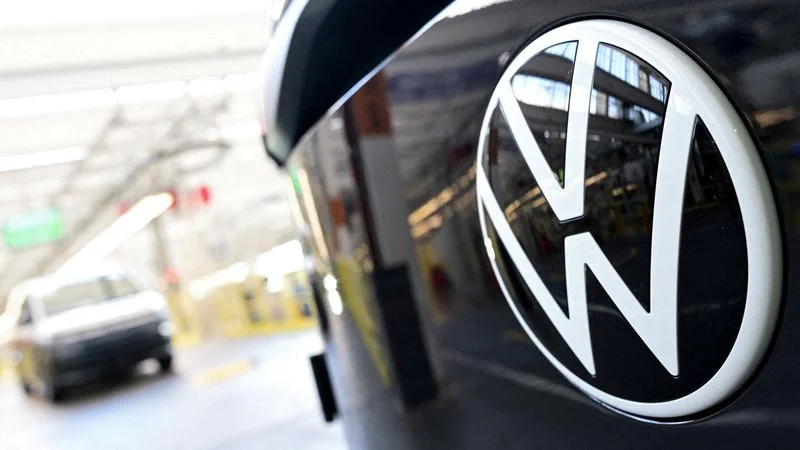
Volkswagen shares climbed to an 11-week high after the automaker’s supervisory board approved a major turnaround agreement aimed at cutting costs and avoiding a deeper conflict between key stakeholders.
The restructuring plan includes 50,000 additional job cuts, taking the total number of agreed reductions to around 100,000 positions.
The future of four German production sites also remains uncertain as Volkswagen continues to reshape its operations.
Volkswagen Faces Growing Pressure
Volkswagen is dealing with several major challenges across its global business.
The company has been hit by higher tariffs in the United States, weaker sales in China and stronger competition from Asian automakers entering the European market.
These pressures have weighed heavily on profitability.
Volkswagen’s operating margin fell to 3.8% in the first half of the year, compared with 7.9% in 2022, which was its highest level over the previous decade.
Volkswagen Shares Rise After Restructuring Deal
Investors welcomed the agreement as a sign that Volkswagen can still make major strategic decisions despite its complex corporate structure and powerful stakeholder groups.
Volkswagen employs more than 650,000 people worldwide, making the restructuring particularly significant.
The company’s shares rose 5.9%, making Volkswagen the second-best performer on the pan-European STOXX 600 index during the session.
The stock also reached its highest level since June 18.
Investors Welcome the Deal but Warn on Execution
Major shareholders described the agreement as an important step forward.
Ingo Speich of Deka Investment called the deal a breakthrough but warned that Volkswagen still faces major challenges.
He stressed that the company’s ability to execute the restructuring plan will now become the key issue.
Moritz Kronenberger of Union Investment also welcomed the agreement. However, he said responsibility now rests heavily with Volkswagen’s executive board.
The message from investors was clear: management must now deliver measurable results.
Volkswagen Avoids Major Stakeholder Conflict
Before the agreement was reached, Volkswagen management had considered calling a shareholder meeting to push through its restructuring demands.
Such a move could have triggered an unprecedented conflict between management, unions and the German state of Lower Saxony.
Labor representatives and Lower Saxony hold significant influence on Volkswagen’s supervisory board.
By reaching an agreement, the company avoided a potentially damaging confrontation at a time when its business is already under pressure.
Germany Could Face Around 25,000 Job Cuts
The agreement did not provide exact details on where or when the new job reductions will take place.
However, Volkswagen CEO Oliver Blume previously said that roughly half of the required savings would need to come from Germany.
That could imply around 25,000 job cuts across Volkswagen’s German operations.
Management and labor unions will still need to negotiate the details of the workforce reduction program.
Under an earlier restructuring agreement reached in 2024, unions secured job protections for most of Volkswagen’s German operations through 2030.
Analysts Remain Cautious on Volkswagen Outlook
Analysts welcomed the restructuring agreement but warned that it does not solve all of Volkswagen’s problems.
Citi analysts noted that the deal does not automatically improve the competitive environment in Europe.
Volkswagen continues to face declining market share in China, intense competition and pressure from higher raw material costs.
The company will therefore need more than workforce reductions to improve its long-term financial performance.
Future of Four German Volkswagen Plants Remains Unclear
Volkswagen is also reviewing the future of plants in Emden, Hanover, Zwickau and Neckarsulm.
Production changes planned for the next decade could leave these locations with excess capacity.
Possible solutions may include repurposing the factories or placing them under new ownership.
The company has not yet made a final decision on whether any of the plants will close.
Lower Saxony Pushes for Alternatives to Closures
Lower Saxony, which controls around 20% of Volkswagen’s voting rights, remains an important stakeholder in the negotiations.
State premier Olaf Lies said factory closures should not be viewed as inevitable.
He said Volkswagen management had been asked to explore alternative solutions before reducing capacity in Germany.
However, he also acknowledged that Europe’s automotive industry is facing significant pressure.
Volkswagen’s restructuring agreement may have reduced immediate tensions, but the company now faces the more difficult task of implementing deep cost cuts while protecting its competitiveness in Europe, China and other major markets.