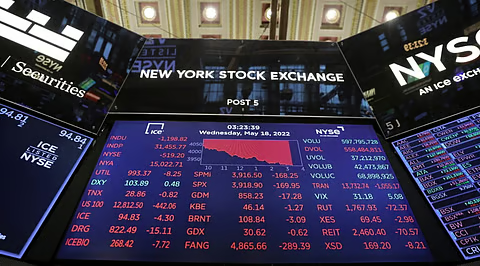
U.S. stocks moved lower on Friday after a much stronger-than-expected August jobs report pushed investors to increase bets on another Federal Reserve interest-rate hike.
The stronger labor-market data added to concerns that the Fed may need to keep monetary policy tighter for longer as inflation remains above its target.
Wall Street Falls After Strong Jobs Data
At 11:06 ET, the S&P 500 was down around 0.5% at 7,710.29 points.
The Dow Jones Industrial Average fell roughly 0.7% to 53,321.04 points, while the Nasdaq Composite declined about 0.4% to 26,473.89 points.
The losses came as investors reacted to the latest U.S. employment data and rising expectations for another Fed rate hike.
US Job Growth Smashes Expectations
The August nonfarm payrolls report was the main focus of Friday’s session.
According to the U.S. Bureau of Labor Statistics, the economy added 162,000 jobs in August.
Economists had expected an increase of only around 55,000.
The unemployment rate remained unchanged at 4.1%.
Payroll figures for June and July were also revised higher by a combined 55,000 jobs.
Fed Rate Hike Expectations Rise
The strong labor-market report strengthened expectations that the Federal Reserve could raise interest rates later this month.
According to the CME FedWatch tool, traders raised the probability of a 25-basis-point rate hike on September 16 to around 60%.
Before the employment report, the probability had been closer to 52%.
A resilient labor market gives policymakers more flexibility to tighten monetary policy if inflation continues to remain elevated.
Inflation Remains a Major Concern
The Federal Reserve continues to face persistent inflation pressures.
The personal consumption expenditures price index, the Fed’s preferred inflation measure, has remained above the central bank’s 2% target for an extended period.
That has contributed to disagreement within the Federal Open Market Committee over the future direction of interest rates.
Strong employment combined with stubborn inflation could strengthen the argument for another rate increase.
Treasury Yields Pressure Stock Valuations
Higher bond yields have also created additional pressure on U.S. stocks.
The benchmark 10-year Treasury yield moved toward 4.80%, while the 30-year yield climbed above 5.25%.
Higher yields typically reduce the relative appeal of equities, particularly high-growth technology stocks.
When bond yields rise, future corporate earnings are discounted at higher rates, which can place pressure on stock valuations.
US-Iran Tensions Add to Market Uncertainty
Geopolitical tensions have also weighed on investor sentiment.
Military exchanges between U.S. and Iranian forces around the Strait of Hormuz pushed crude oil prices above $90 per barrel earlier in the week.
Higher energy prices have renewed concerns about cost-driven inflation.
They could also put pressure on consumer spending if fuel and transportation costs remain elevated.
September Seasonality Returns to Focus
The recent market weakness has also revived concerns about September’s historically difficult reputation for U.S. equities.
September has often been one of the weaker months for major stock indexes.
While seasonality does not guarantee future performance, investors tend to pay closer attention to it when markets are already dealing with rising yields, inflation worries and geopolitical uncertainty.
Waller Comments Had Previously Lifted Stocks
Wall Street had rallied sharply on Thursday after Federal Reserve Governor Christopher Waller struck a more dovish tone.
The S&P 500 gained around 1.06%, while the Nasdaq climbed 1.4% and the Dow advanced approximately 1.18%.
Waller said recent economic data showed encouraging signs that inflation may be easing.
He indicated that he could support keeping interest rates unchanged at the Fed’s September 15-16 meeting if upcoming data confirms that trend.
Fed Officials Remain Divided
Waller’s comments were broadly consistent with cautious remarks from New York Fed President John Williams.
Those comments initially pushed traders to reduce expectations for another Fed rate hike.
The implied probability of a 25-basis-point increase fell to around 50.4%, compared with roughly 60.1% a day earlier and nearly 68% earlier in the week.
Treasury yields also moved lower, helping provide temporary relief for growth and technology stocks.
However, Friday’s stronger jobs report reversed part of that shift.
What Comes Next for US Stocks?
The outlook for U.S. stocks will likely depend heavily on inflation data and Federal Reserve expectations.
A strong labor market gives the Fed greater room to keep interest rates elevated or raise them further.
At the same time, persistent inflation, high Treasury yields and geopolitical uncertainty continue to create risks for equities.
Investors will now watch upcoming inflation reports for further clues on whether the Fed will raise rates at its September meeting or keep policy unchanged.