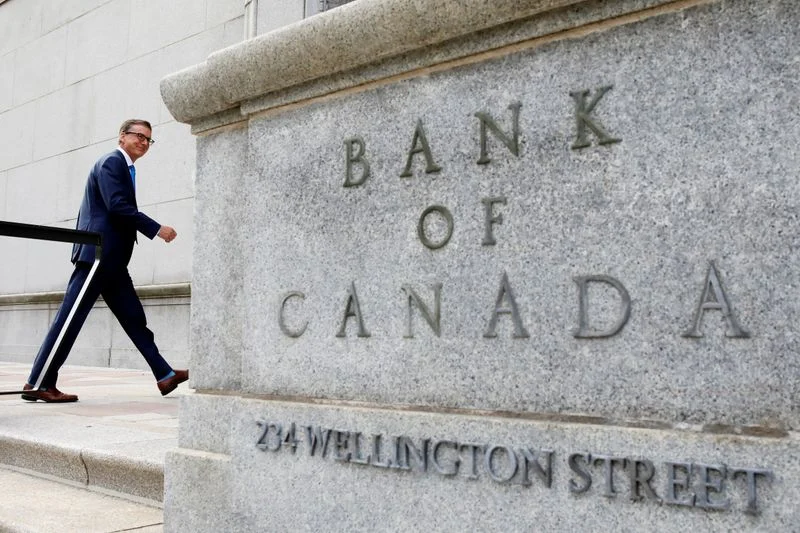
The Bank of Canada kept its benchmark interest rate unchanged on Wednesday as policymakers balanced stronger domestic economic activity against growing inflation and trade risks.
The central bank left its overnight rate target at 2.25%, while warning that higher oil prices and uncertainty surrounding US trade policy could complicate Canada’s economic outlook.
Bank of Canada Holds Interest Rate at 2.25%
The Bank of Canada maintained its overnight policy rate at 2.25%, in line with expectations.
The Bank Rate remained at 2.50%, while the deposit rate stayed at 2.20%.
The decision was broadly consistent with the central bank’s July outlook. However, policymakers stressed that inflation risks have increased since then.
New US tariffs have also created additional uncertainty around Canadian economic growth.
Canadian Economy Rebounds in the Second Quarter
Canada’s economy recovered strongly during the second quarter after a weak start to the year.
The improvement was broad-based, with stronger activity across consumer spending, housing, exports and business investment.
This rebound provided the Bank of Canada with some flexibility to keep interest rates unchanged rather than immediately adjusting monetary policy.
Canadian Labor Market Shows Signs of Improvement
Canada’s unemployment rate edged lower in July, providing another encouraging signal for the economy.
However, the Bank of Canada said demand for workers remained relatively weak.
Policymakers also noted that excess capacity is still present in the economy, suggesting that overall demand has not yet become strong enough to create significant domestic inflation pressure.
Inflation Remains Near 3%
Inflation has hovered around 3% during recent months.
Much of the increase has been driven by persistently high gasoline prices.
When gasoline is excluded, inflation stood at around 2.2% in July.
Meanwhile, the Bank of Canada’s preferred measures of core inflation remained close to the central bank’s 2% target.
This suggests underlying inflation pressures remain relatively contained despite higher headline inflation.
Oil Prices Increase Inflation Risks
Elevated oil prices have become one of the biggest risks facing Canadian policymakers.
Higher crude prices can quickly translate into more expensive gasoline, transportation and production costs.
These increases can then feed through to consumer prices and keep headline inflation elevated for longer.
The Bank of Canada warned that continued instability in the Middle East has increased the upside risks to its inflation forecast.
Strait of Hormuz Uncertainty Adds Pressure
The ongoing Middle East conflict and limited progress toward fully reopening the Strait of Hormuz remain major concerns for global energy markets.
The Strait is a critical route for international oil shipments.
Any prolonged disruption could keep oil prices elevated or cause another sharp increase in energy costs.
For Canada, that creates a complicated situation because higher oil prices can support parts of the energy sector while simultaneously increasing inflation for households and businesses.
US Tariffs Cloud Canada’s Growth Outlook
Trade relations with the United States represent another significant source of uncertainty.
New US tariffs could weaken Canadian exports, reduce business confidence and make companies more cautious about investment.
Because the United States is Canada’s largest trading partner, major changes in US trade policy can have a substantial impact on the Canadian economy.
The Bank of Canada must therefore consider both domestic conditions and external trade risks when deciding its next move.
Bank of Canada Faces a Difficult Policy Balance
The latest decision highlights the challenge facing Canadian policymakers.
Economic growth has improved, unemployment has edged lower and underlying inflation remains relatively close to target.
However, rising oil prices, geopolitical instability and uncertainty over US tariffs could create renewed inflation pressures while also threatening economic growth.
For now, the Bank of Canada appears willing to keep interest rates steady while monitoring incoming inflation, employment and trade data.
Future rate decisions could depend heavily on whether inflation accelerates further and how severely US trade measures affect the Canadian economy.