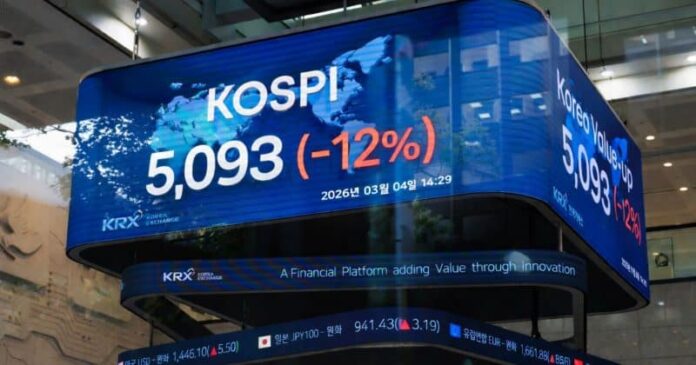
Citi remains bullish on South Korean stocks after the recent KOSPI selloff. The bank believes the decline has created a buying opportunity rather than signaling the start of a deeper market downturn.
According to Citi, pressure from capital outflows may be easing. At the same time, South Korea’s strong economic fundamentals and market-friendly policies could provide additional support for equities.
Citi Maintains 10,000 KOSPI Target
Citi kept its KOSPI target at 10,000. This forecast implies potential upside of more than 53% from Monday’s closing level.
The bank said strong memory-chip fundamentals and historically low valuations support its bullish outlook.
Citi believes the recent correction was mainly caused by foreign investors rebalancing their portfolios and taking profits. However, the bank expects this selling pressure to continue moderating.
Foreign Investment Pressure Begins to Ease
Citi highlighted stronger inflows into overseas passive exchange-traded funds linked to the KOSPI since early July.
The bank also pointed to tighter rules covering leveraged single-stock ETFs. These restrictions could reduce speculative retail trading and limit short-term market volatility.
In addition, Citi expects South Korea’s National Pension Service to remain overweight domestic stocks for longer.
The bank said a sharp reduction in local equity exposure could face public criticism, making a major rebalancing away from South Korean stocks less likely.
Strong Economic Growth Supports Korean Equities
Citi maintained its South Korean GDP growth forecasts of 3.7% for 2026 and 3.0% for 2027.
The bank expects semiconductor exports to remain a major economic driver. It also believes strength in the technology sector will gradually support other areas of the economy.
Although tighter monetary policy could weigh on growth, Citi expects expansionary government spending to offset part of that pressure.
The bank also noted that financial regulators have introduced rules designed to prevent asymmetrical dual listings.
KOSPI Valuation Falls Below Crisis Levels
Citi’s 10,000 target is based on a price-to-book ratio of 2.3 times. This would represent a price-to-earnings ratio of around nine times, slightly below the index’s 20-year average.
However, the KOSPI’s current valuation is significantly lower.
As of July 16, the index traded at a 12-month forward price-to-earnings ratio of 5.8 times.
That is below the 6.4 multiple recorded during the 2008 global financial crisis. It is also considerably lower than the 8.5 multiple seen during the 2020 COVID-19 pandemic.
These comparisons support Citi’s argument that South Korean equities are trading at historically attractive levels.
KOSPI Earnings Could Rise Sharply
Citi forecasts that KOSPI net profit will increase by 248% year over year in 2026.
The bank also expects earnings growth to become more diversified by 2027.
Artificial intelligence, robotics, exporters and manufacturing companies could join semiconductor businesses as major contributors to profit growth.
Memory-Chip Demand Remains Resilient
South Korea’s semiconductor industry remains one of the most important drivers of the KOSPI.
Citi said it has seen no meaningful change in memory-chip demand, despite concerns about slowing operating-profit growth and issues involving older technology agreements.
The bank expects memory-chip selling prices to remain strong during the second half of 2026.
An ongoing imbalance between supply and demand could continue supporting prices and profitability across the sector.
Citi described the recent decline in Korean memory suppliers as a technical correction caused by broad market profit-taking, rather than a deterioration in industry fundamentals.