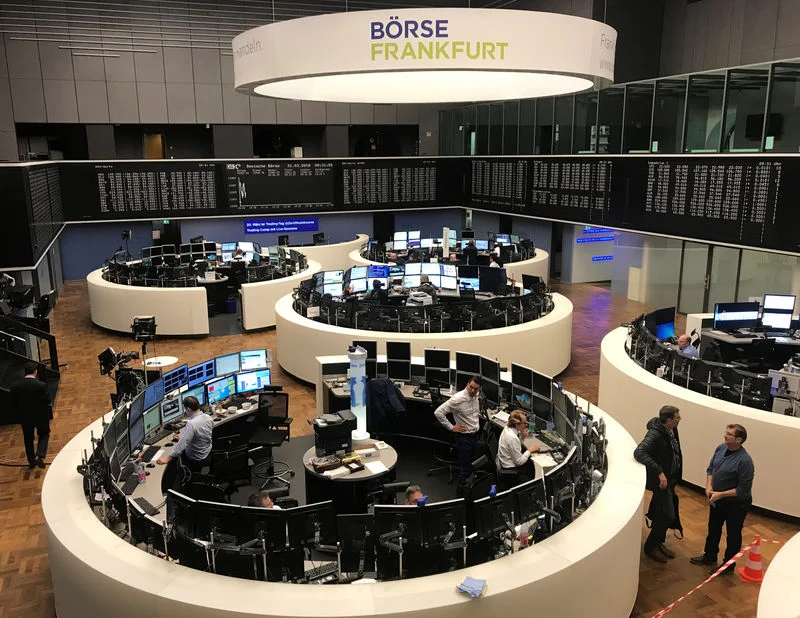
European stocks moved lower on Monday as renewed fighting in the Middle East pushed investors away from riskier assets.
Market sentiment weakened further after Iran announced that the Strait of Hormuz had been closed, raising concerns about global energy supplies and inflation.
European Stocks Open Lower
The pan-European STOXX 600 index fell 0.2% in early trading.
Germany’s DAX declined 0.3%, while France’s CAC 40 slipped 0.2%.
London’s FTSE 100 performed slightly better and gained 0.2%.
The mixed performance reflected pressure across most major European markets, while energy-related shares benefited from higher oil prices.
Oil and Gas Stocks Rise
Major European oil producers recorded strong gains as crude prices climbed.
Shell shares rose 1.8%, while BP gained 2.7%.
TotalEnergies advanced 2.3%.
The gains helped limit the wider decline in European stock markets.
Middle East Conflict Returns to Focus
The market downturn followed the collapse of a fragile truce over the weekend.
Iran’s Revolutionary Guards announced that the Strait of Hormuz would remain closed until further notice.
The declaration came after an attack on a commercial vessel and a series of retaliatory U.S. military strikes.
U.S. Disputes Iran’s Hormuz Claim
U.S. Central Command said the Strait of Hormuz remained open to lawful commercial traffic.
However, Iran’s threat of a blockade increased concerns over one of the world’s most important oil shipping routes.
Around one-fifth of global seaborne oil passes through the strait.
Any prolonged disruption could tighten supply and push energy prices higher.
Oil Prices Surge More Than 4%
Brent crude and West Texas Intermediate both rose by more than 4.4%.
The sharp increase reflected fears that renewed military action could disrupt oil exports from the Gulf.
Higher oil prices may also increase inflationary pressure across Europe and other major economies.
That risk could affect consumer spending, company costs and central-bank policy.
Recent European Market Gains at Risk
Monday’s decline reversed part of the recovery recorded during the previous week.
European stocks had regained ground as technology companies and semiconductor shares led a late-week rally.
Temporary hopes of diplomatic progress also supported sentiment.
In addition, strong global demand for artificial intelligence infrastructure helped lift major technology stocks.
However, those gains could be erased if geopolitical tensions and market losses continue.
ECB Policy Signals in Focus
European Central Bank Executive Board member Isabel Schnabel was scheduled to speak later in the day.
Investors were expected to examine her comments for clues about the future path of interest rates.
Schnabel is widely regarded as one of the ECB’s more hawkish policymakers.
She has previously supported a cautious approach to reducing borrowing costs.
Higher Oil Prices Could Complicate ECB Policy
The rise in crude prices may create a fresh challenge for the European Central Bank.
More expensive energy could slow the decline in inflation and make policymakers more cautious about further interest-rate cuts.
As a result, investors will closely monitor whether Schnabel highlights renewed inflation risks linked to the Middle East conflict.
Akzo Nobel Shares Climb
Among individual stocks, Akzo Nobel rose 3%.
The gain followed an offer from Nippon Paint for the company’s decorative paints business.
The deal-related news helped Akzo Nobel outperform the wider European market.
European Market Outlook Remains Cautious
The near-term direction of European stocks will likely depend on developments in the Middle East, movements in oil prices and signals from the ECB.
A prolonged disruption in the Strait of Hormuz could keep energy stocks elevated while placing pressure on transport, manufacturing and consumer-related companies.
Investors will also remain alert for signs of diplomatic progress that could reduce geopolitical risk and stabilize global markets.