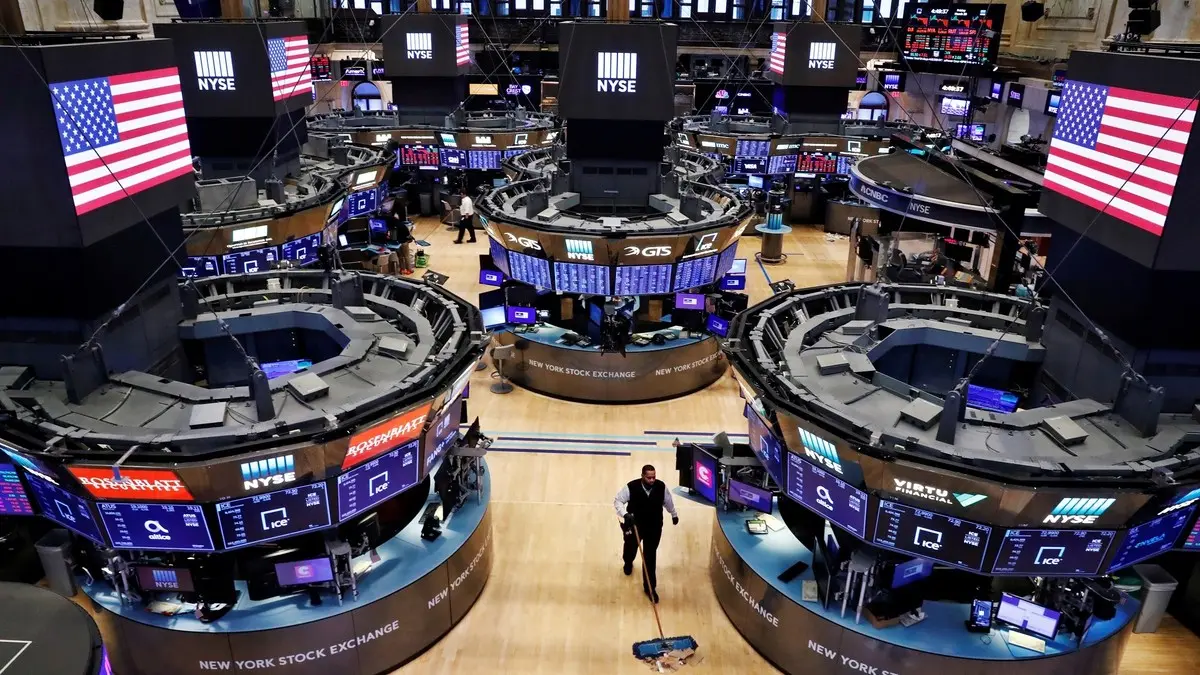
Wall Street moved lower on Wednesday as geopolitical risk returned to focus.
The decline came after the U.S. and Iran exchanged strikes, while President Donald Trump said the interim peace deal signed last month was effectively “over.”
Oil prices jumped, the U.S. dollar strengthened on safe-haven demand, and Treasury yields climbed as investors sold bonds.
Major U.S. Indexes Trade Lower
At 12:23 ET, the S&P 500 fell 0.6% to 7,458.35 points.
The Nasdaq Composite dropped 0.4% to 25,709.12 points.
The Dow Jones Industrial Average posted the steepest decline, falling 1.4% to 52,207.53 points.
Investors Watch Tech Stocks and Fed Minutes
Investors also monitored signs of stabilization in chip stocks and the broader technology sector.
At the same time, markets were waiting for the Federal Reserve’s latest meeting minutes.
The minutes are expected to provide more clues about the outlook for interest rates and monetary policy.
U.S.-Iran Peace Deal Comes Under Pressure
The U.S. and Iran signed an interim peace agreement last month.
The deal was designed to stop fighting, reopen the Strait of Hormuz, and ease sanctions linked to Iranian oil sales.
However, the agreement is now under serious pressure after the latest escalation between the two countries.
U.S. Strikes Iranian Targets
The latest tensions followed reports of attacks on three oil tankers near the Strait of Hormuz.
In response, the U.S. military struck more than 80 targets in Iran on Tuesday.
U.S. Central Command said the strikes targeted Iranian air defense systems, command networks, coastal radar sites, anti-ship missile capabilities, and more than 60 IRGC small boats near the strait.
Iran Responds to U.S. Action
According to CENTCOM, the U.S. strikes were a response to attacks on commercial vessels, including the M/T Al Rekayyat, M/T Wedyan, and M/T Cyprus Prosperity.
Qatar and Saudi Arabia had identified two of the ships earlier on Tuesday.
Iran did not publicly claim responsibility for those attacks. However, Iranian state media later reported that Iran targeted 85 military installations in Kuwait and Bahrain.
State media also said an American drone had been shot down.
Trump Warns of More Action Against Iran
Trump escalated his comments during a NATO summit in Ankara, Türkiye.
When asked about the ceasefire, he said he believed the agreement was no longer useful and suggested that dealing with Tehran had become a waste of time.
He also warned that the U.S. could strike Iran again.
Trump said the U.S. had hit Iran hard the previous night and could do so again if needed.
U.S. May Reimpose Naval Blockade
Trump also said the U.S. may bring back a naval blockade on Iran’s ports and coastline.
That blockade had been removed as part of the interim peace agreement.
He also suggested that Iran had not yet been hit at the highest level, pointing to infrastructure such as bridges and power plants.
Trump added that the U.S. had struck Kharg Island, a key terminal for Iranian oil exports, while saying he had ordered forces not to target the oil directly.
U.S. Revokes Iranian Oil License
The U.S. also revoked a general license that had allowed the production and sale of Iranian oil.
Washington described the move as a response to attacks on commercial ships.
The decision added further pressure to oil markets and raised concerns about tighter supply.
Iran Threatens Strait of Hormuz Closure
Iranian Parliament Speaker Mohammad Bagher Ghalibaf accused the U.S. of violating the interim peace deal.
Iran’s Press TV, citing an informed source, also reported that Tehran could close the Strait of Hormuz if the U.S. carries out more attacks.
The Strait of Hormuz is one of the world’s most important energy shipping routes.
Oil Prices Surge on Supply Fears
Oil prices rallied sharply as traders priced in renewed supply risks.
Brent crude futures for September delivery were last up 7.4% to $79.63 per barrel.
Earlier in the week, oil had been trading closer to pre-war levels.
The sharp rebound showed how quickly geopolitical tensions can return to the center of market attention.
Analysts Warn Tensions Are Back in Focus
Robert Edwards, chief investment officer at Edwards Asset Management, said Iran tensions had returned to the market’s main focus.
He noted that the reaction followed the usual pattern during geopolitical shocks: higher oil prices, higher bond yields, and lower stock prices.
However, he also said the market moves were not as extreme as they were when the war first began.
Stock Pullback Could Cool Speculation
Edwards added that a near-term stock market correction could be healthy.
In his view, a pullback may reduce speculative pressure in semiconductor and memory chip stocks.
He also suggested that a correction could create a more attractive setup ahead of the next earnings season.
Fed Minutes in Focus
Away from the Middle East, investors are waiting for minutes from the Federal Reserve’s June policy meeting.
Markets will study the minutes for signs of how policymakers view inflation, economic resilience, and future interest-rate decisions.
Investors also want to know whether recent economic data and geopolitical developments have changed the Fed’s thinking.
Growth Stocks Remain Under Pressure
Major U.S. indexes also closed lower on Tuesday as investors reduced exposure to growth stocks.
Technology shares came under pressure after Samsung Electronics reported earnings.
Although Samsung beat expectations, the results did not fully ease concerns about artificial intelligence demand and memory chip pricing.
That weighed on the broader semiconductor sector.
Earnings Season Approaches
Investors are also preparing for the start of second-quarter earnings season.
Levi Strauss & Co is expected to report on Wednesday.
PepsiCo is due to report on Thursday, followed by Delta Air Lines on Friday.
These results could help shape market sentiment as investors balance earnings expectations against geopolitical risks.