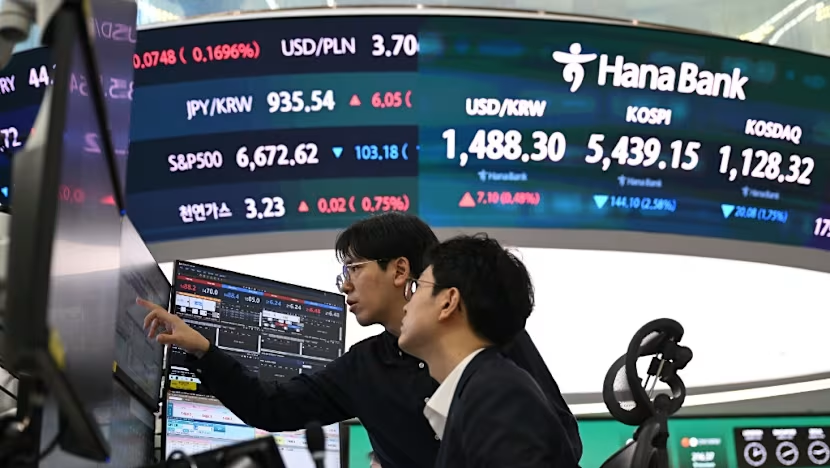
Asian stock markets rallied on Friday after a weaker-than-expected U.S. jobs report strengthened expectations that the Federal Reserve could cut interest rates later this year.
Investors returned to technology and semiconductor shares following a sharp selloff earlier in the week. Easing tensions in the Middle East also supported global risk appetite.
Asian Stocks Recover After Technology Selloff
The rebound followed a volatile week for semiconductor companies worldwide.
Concerns about the scale of artificial intelligence infrastructure spending had triggered heavy profit-taking across the sector. However, investors returned to several leading chipmakers on Friday, judging the recent decline to be excessive.
Questions remain over whether the vast amounts being invested in AI technology will deliver sufficient long-term returns. Nevertheless, lower valuations encouraged selective buying across the semiconductor industry.
U.S. Jobs Report Boosts Rate-Cut Expectations
The Dow Jones Industrial Average closed at a record high ahead of the U.S. Independence Day holiday.
The broader U.S. stock market ended mixed after employment growth slowed sharply in June. Payroll figures from previous months were also revised lower.
The data reinforced expectations that the U.S. labour market is gradually cooling. This could give the Federal Reserve more room to reduce interest rates later in 2026.
During Asian trading, Nasdaq 100 Futures rose 0.9%, while S&P 500 Futures gained 0.4%.
Lower Oil Prices Support Market Sentiment
Oil prices remained under pressure as concerns surrounding the conflict with Iran eased.
U.S. President Donald Trump said during a CNBC interview that tensions had reduced and that he believed Iran was prepared to return to negotiations.
The comments helped improve global market sentiment and reduced demand for traditional safe-haven assets.
Chipmakers Lead the Asian Market Rebound
South Korea’s KOSPI surged 5.8%, recovering much of the ground lost during the previous two sessions.
Despite the rebound, the index remained approximately 6.5% lower for the week.
Japan’s Nikkei 225 climbed 1.5%, while Singapore’s Straits Times Index rose 0.3% after reaching another record high earlier in the session.
Technology stocks attracted renewed demand as investors rebuilt positions following the sharp correction.
Samsung Electronics jumped 6.5%, while SK Hynix gained 4.2%. However, the two companies remained down 10.2% and 15.4%, respectively, over the week.
Semiconductor Recovery Spreads Across Asia
The rebound extended across Asia’s broader semiconductor supply chain.
Japan’s TOPIX advanced 1.2% as technology suppliers and exporters recovered. Kioxia Holdings, Rohm and Sumitomo Chemical were among the strongest performers after suffering heavy losses earlier in the week.
Chinese stocks also regained ground following their steepest two-day decline in several weeks.
The CSI 300 rose 0.6%, while the Shanghai Composite gained 0.4%.
China Services Sector Remains in Expansion
China’s private Caixin and RatingDog services PMI remained above the level that separates growth from contraction in June.
Export orders also increased at their fastest pace in 20 months, providing another positive signal for the Chinese economy.
The data helped strengthen investor confidence after a difficult week for regional stock markets.
Strong Economic Data Improves Risk Appetite
Economic releases across the Asia-Pacific region also supported the market recovery.
Australia’s Composite PMI returned to expansion, suggesting that business conditions were improving.
Japan’s final services PMI was revised higher, pointing to continued strength in domestic demand.
South Korea’s foreign exchange reserves also increased in June, offering a modest sign of financial stability following the week’s market volatility.
Australia, Indonesia and Hong Kong Stocks Rise
Australia’s S&P/ASX 200 climbed 1.4% after stronger services activity indicated improving economic conditions.
Indonesia’s Jakarta Composite Index rose 2.5%, reducing its weekly decline to approximately 0.4%.
Hong Kong’s Hang Seng Index gained 1.3%, extending its weekly advance to around 3.2%. Technology shares remained among the most actively traded stocks in the market.
Asian Inflation Data in Focus
Investors will now turn their attention to Thailand’s inflation report on Monday.
Bank Negara Malaysia is also widely expected to leave interest rates unchanged at its upcoming policy meeting.
ANZ expects inflation to remain broadly stable in China and Taiwan. Inflation in the Philippines is forecast to ease only slightly.
These economic releases could provide further insight into the region’s monetary policy outlook following a week dominated by interest-rate expectations and volatility in technology stocks.