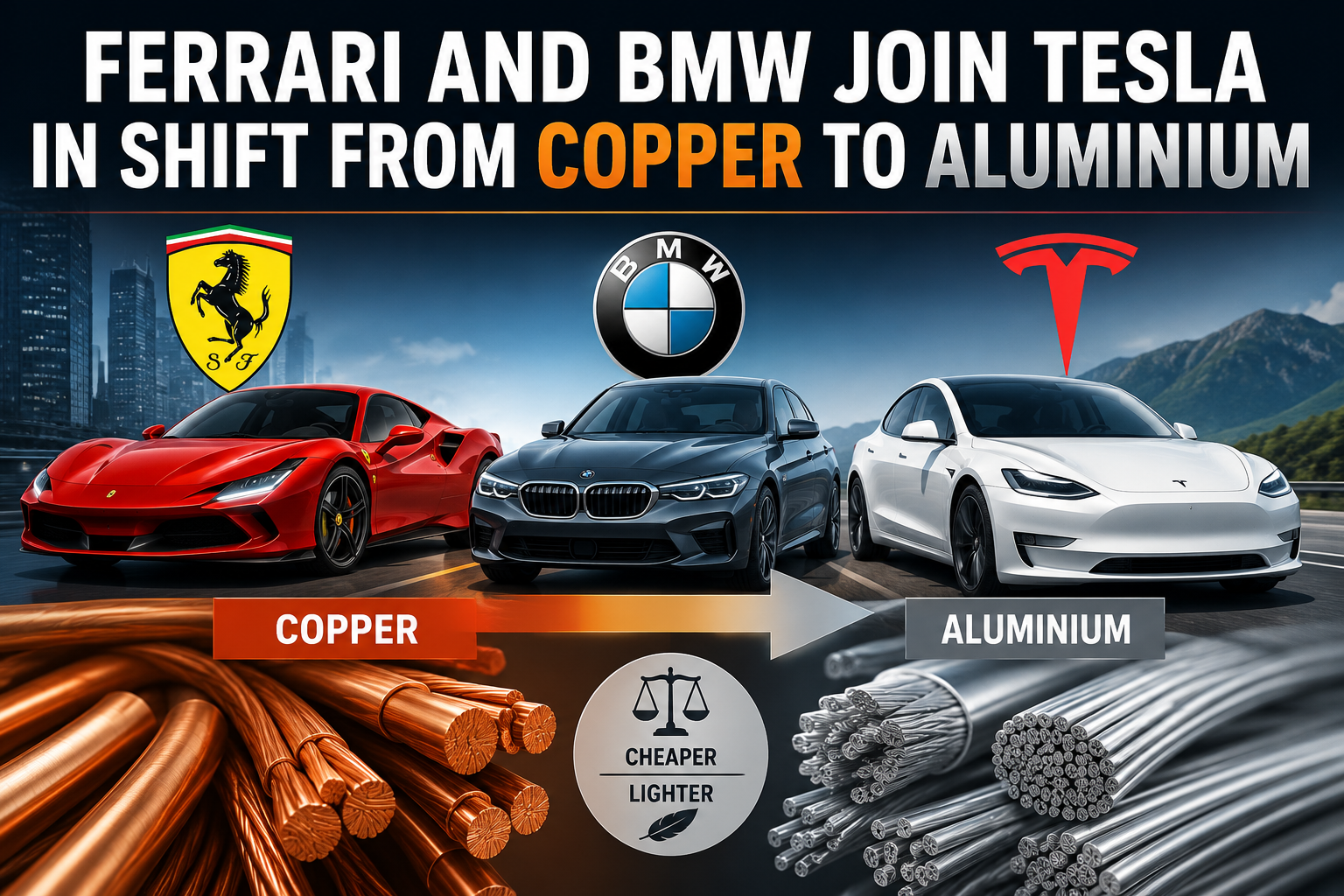
Ferrari and BMW Shift From Copper to Aluminium Wiring
Ferrari and BMW are introducing new vehicles that use lightweight aluminium wiring instead of copper.
The move reflects a wider automotive industry shift toward cheaper materials. Copper has dominated electrical wiring since the invention of the electric battery around two centuries ago.
Tesla and several Chinese electric vehicle manufacturers have already adopted aluminium wiring in some models.
According to JPMorgan, the growing use of aluminium could affect approximately 2% of global copper demand this year.
High Copper Prices Encourage Substitution
More companies could replace copper with aluminium over the coming years.
Copper prices are expected to remain elevated because global supply is struggling to keep pace with demand. The green-energy industry and rapidly expanding data centres are also consuming increasing amounts of the metal.
Companies across the automotive, cable and air-conditioning industries are therefore exploring aluminium alternatives.
Interviews with carmakers, metal producers, consultants and industrial companies suggest that aluminium can provide similar performance in several applications at a much lower cost.
Ferrari and BMW also highlighted aluminium’s lower weight as an important advantage.
Record Copper Prices Strengthen the Case
The substitution of copper with aluminium has occurred in several waves over the past two decades.
However, the argument for switching became stronger after copper prices climbed to a record level of almost $15,000 per metric ton in late January.
Long-term market forecasts also suggest that global copper demand could exceed available supply for more than a decade.
These conditions could encourage manufacturers to use aluminium wherever its performance is considered sufficient.
Ferrari Reduces Vehicle Wiring Weight
Ferrari already uses aluminium in its vehicle bodies, engines and chassis.
The Italian carmaker began using aluminium power cables in its 296 hybrid sports car last year. It later introduced the material into other vehicles, including the Luce, its first fully electric model.
Ferrari communications executive Dario Esposito said the change can reduce total wiring weight by as much as 20%.
The company said performance, rather than cost alone, was the main reason behind the decision.
Nevertheless, aluminium is significantly cheaper than copper. It currently trades at about $3,100 per metric ton, roughly one-quarter of the price of copper.
BMW Expands Aluminium Use Across EVs
BMW first introduced aluminium conductors in its compact 1 Series in 2011.
Since then, the German carmaker has gradually expanded their use across hybrid and electric vehicles.
BMW now uses numerous aluminium cables in both high-voltage and low-voltage systems within its latest eDrive electric vehicle technology.
Stellantis has also started replacing some copper wiring with aluminium, according to an industry source. However, the automaker declined to comment.
Chinese Supplier Reports Rising Demand
Chinese electric vehicle component supplier JONVER has experienced strong growth in aluminium wiring sales.
The products now account for approximately 30% of the company’s sales, compared with around 20% in 2023.
Norwegian aluminium producer Hydro has also recorded rising sales of aluminium tubing for heating and air-conditioning systems.
The company expects aluminium to continue gaining market share as more manufacturers search for alternatives to copper.
Price Remains Key to Material Choice
Copper still offers better performance in certain applications. Therefore, many manufacturers are willing to pay more when its superior conductivity is necessary.
However, Xavier Mathieu of French cable manufacturer Nexans said companies often begin switching to aluminium when copper becomes around 3.5 times more expensive.
Copper currently costs more than 4.2 times as much as aluminium.
This price difference has made substitution increasingly attractive across several industries.
Aluminium Has Important Limitations
Despite its lower cost and lighter weight, aluminium has several disadvantages.
Producing the metal requires large amounts of energy, which can result in higher greenhouse gas emissions.
Aluminium is also less electrically efficient than copper. Therefore, manufacturers need a greater volume of aluminium to conduct the same amount of electricity.
Trade restrictions, including U.S. tariffs, can also complicate decisions about which material to use.
Even so, JPMorgan estimates that aluminium could replace around 6% of annual copper demand by 2030, compared with approximately 2% this year.
China Encourages Switch to Aluminium
China, the world’s largest consumer of industrial metals, has actively encouraged companies to increase their use of aluminium.
A government policy document published in March 2025 called for greater substitution of copper across several industries.
Analysts at Chinese consultancy Zhuochuang estimate that aluminium could replace between 25% and 30% of components currently made from copper by 2030.
The forecast covers the power, automotive and household appliance sectors.
Chinese EV Makers Lead Aluminium Adoption
Chinese electric vehicle manufacturers using aluminium wiring include AVATR, XPeng and Xiaomi, according to engineering consultancy Caresoft Global.
Tesla has also pioneered the use of aluminium wiring. The company introduced it in the Model Y in 2019 and later expanded its use in the Cybertruck.
Chinese automakers have closely studied Tesla’s production methods while developing their own electric vehicles.
Lower Weight Helps Improve EV Range
Aluminium is particularly attractive to electric vehicle manufacturers because it weighs less than copper.
Reducing vehicle weight can improve battery efficiency and extend driving range.
Lower material costs are also important in China’s highly competitive electric vehicle market, where aggressive price cuts have placed pressure on profit margins.
There remains significant potential for further adoption. According to Hydro, around 85% of the electrical busbars that connect electric vehicle batteries to other systems are still made from copper.
The combination of rising copper prices, lower aluminium costs and the need for lighter electric vehicles could accelerate the automotive industry’s shift toward aluminium wiring.