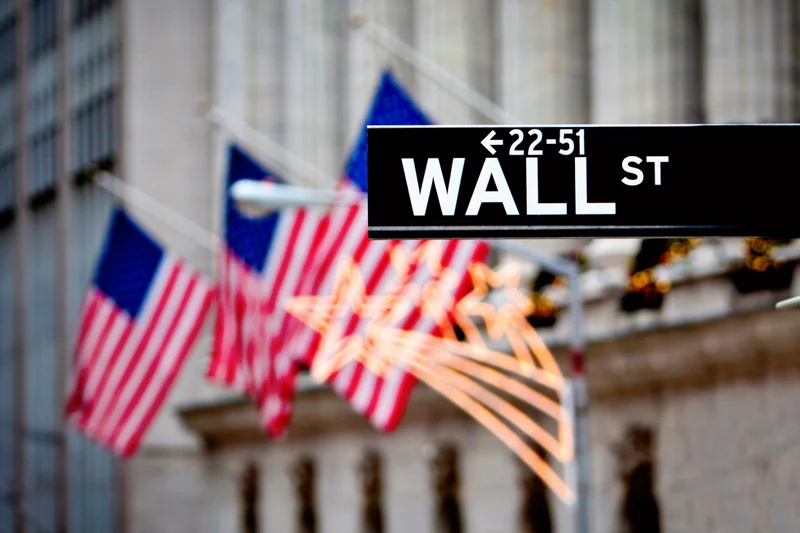
Wall Street turned lower on Wednesday after the Federal Reserve kept interest rates unchanged but signalled that one quarter-point increase could still arrive before the end of the year.
US stocks had traded modestly higher earlier in the session. Investors initially welcomed President Donald Trump’s comments that a preliminary US-Iran peace agreement could soon be signed and reopen the Strait of Hormuz.
Wall Street Falls After Fed Decision
At 2:14 p.m. ET, the S&P 500 fell 0.4% to 7,478.79 points.
The technology-heavy Nasdaq Composite declined 0.3% to 26,287.29, while the Dow Jones Industrial Average slipped 0.1% to 51,939.94.
The market reversal followed the release of the Federal Reserve’s updated interest rate projections.
Federal Reserve Holds Interest Rates Steady
The Federal Open Market Committee left the federal funds rate unchanged between 3.50% and 3.75%.
The decision was widely expected and marked the first policy meeting under new Fed Chair Kevin Warsh.
However, investors focused more closely on the central bank’s updated Summary of Economic Projections, commonly known as the Fed dot plot.
Fed Dot Plot Signals One Rate Hike
Federal Reserve policymakers now expect the federal funds rate to stand at 3.8% at the end of 2026.
That forecast was revised upward from 3.4% in the March projections. The new estimate implies that the Fed could raise rates by 25 basis points before the end of the year.
The more hawkish outlook disappointed investors who had hoped that falling oil prices might create room for lower borrowing costs.
Warsh Faces Inflation and Political Pressure
Warsh’s first policy decision comes at a difficult time for the central bank.
Trump has repeatedly called for lower interest rates. He was also a frequent critic of former Fed Chair Jerome Powell for not easing monetary policy more aggressively.
However, the US labour market remains strong, while the recent rise in oil prices has increased inflationary pressure.
These conditions have limited the Fed’s ability to reduce rates. Some traders had already started pricing in the possibility of rate increases as the conflict in the Middle East continued.
Markets Adjust to Warsh’s Communication Style
James Demmert, chief investment officer at Main Street Research, described the meeting as one of the most important Fed decisions in recent memory.
Investors must now adjust to Warsh’s communication style and assess how he intends to balance inflation risks with political pressure for lower interest rates.
Demmert said Warsh would probably take time to evaluate how inflation responds to the recent decline in oil prices.
Lower Oil Prices Offer Fed Some Relief
Oil prices have fallen sharply this week amid growing optimism surrounding a potential US-Iran peace agreement.
Lower energy prices could ease inflationary pressure and make it easier for the Fed to justify holding interest rates steady.
However, cheaper energy may also support stronger economic activity. Faster growth could eventually increase the need for higher rates if inflation remains persistent.
Demmert said any stock market volatility caused by Warsh’s comments could represent a buying opportunity, as broader market fundamentals remain supportive.
Fed Projections Reveal Policy Divide
The Fed’s updated economic projections offer insight into the internal debate among policymakers.
Before the decision, Bank of America analysts expected the outlook to show higher inflation, lower unemployment and no rate cuts this year.
They also predicted that several policymakers could forecast interest rate increases.
The updated dot plot confirmed that the central bank now sees greater potential for tighter monetary policy.
US Retail Sales Beat Forecasts
Fresh economic data also showed that American consumers remained active despite elevated interest rates.
US retail sales increased by 0.9% in May compared with the previous month, according to the Census Bureau.
Economists had expected a smaller gain of 0.5%.
The stronger figures reinforced the view that the US economy remains resilient and may be able to withstand higher borrowing costs.
Trump Warns Iran Deal Is Not Final
Developments in the Middle East also influenced market sentiment.
Trump warned that the United States could resume military operations against Iran if he rejected the final terms of the proposed agreement.
Washington and Tehran are expected to meet on Friday to sign a memorandum of understanding.
However, Trump stressed that the arrangement had not yet been finalised. He said the US could restart its attacks if Iran failed to comply with Washington’s demands.
Trump Expects Agreement to Be Signed
Despite his warning, Trump said he believed the signing would go ahead.
He acknowledged that negotiations can remain uncertain until the final stage. However, he suggested that Iran wanted to complete the agreement and return to more normal economic conditions.
Trump later said the proposed deal would end the conflict, reopen the Strait of Hormuz and prevent Iran from obtaining a nuclear weapon.
US-Iran Deal Includes 14-Point Framework
Media reports indicate that the memorandum contains 14 main provisions.
The framework reportedly includes a permanent ceasefire, including in Lebanon, and the removal of the US naval blockade covering Iran’s ports and coastline.
The agreement would also reopen the Strait of Hormuz and establish the basis for negotiations over Iran’s nuclear programme.
Those nuclear talks are expected to begin after the formal signing ceremony on Friday.
Iran Could Resume Oil Exports
One key provision could provide immediate waivers for Iranian oil and petrochemical exports.
The agreement may also include the release of frozen Iranian assets and a regional reconstruction programme valued at approximately $300 billion.
In return, Iran would agree not to pursue a nuclear weapon and would neutralise sensitive nuclear material.
Financial relief would reportedly depend on Tehran eliminating its enriched uranium stockpile and abandoning its broader nuclear ambitions.
Oil Prices Halt Recent Decline
Oil prices stabilised after Trump raised doubts about the final agreement.
Brent crude futures for August delivery gained 0.5% to approximately $79.35 per barrel.
The contract had fallen below $80 during the previous session for the first time since March.
The recent decline in crude prices helped ease concerns about an energy-driven inflation shock.
SpaceX Shares Pull Back After IPO Rally
SpaceX stock also moved lower on Wednesday as its historic post-IPO rally began to lose momentum.
Class A shares declined around 2% after recording extraordinary gains during the company’s first four sessions as a publicly traded business.
SpaceX climbed 4.8% on Tuesday to close at $201.80. That price gave the company an implied market capitalisation of approximately $2.65 trillion.
The valuation placed SpaceX around $8 billion above Amazon and briefly brought the company close to Microsoft.
SpaceX Remains 50% Above IPO Price
SpaceX priced its shares at $135 during its initial public offering.
The company raised $75 billion in what became the largest IPO in history.
By Tuesday’s close, SpaceX stock had gained around 50% from its IPO price in only four trading sessions.
The speed of the rally surprised experienced market participants and raised expectations of continued short-term volatility.
Semiconductor Stocks Rebound
Chip stocks recovered after the Philadelphia Semiconductor Index suffered its second-worst session of the year.
ASML, Arm and Marvell were among the strongest percentage gainers on the Nasdaq Composite.
The semiconductor rebound provided some support to the technology sector, although the Fed’s interest rate outlook ultimately pushed the broader market lower.