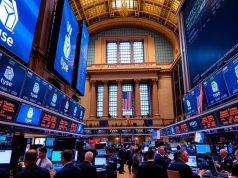
Wall Street moved slightly higher on Wednesday, although gains remained limited as investors prepared for a crucial Federal Reserve interest rate decision.
Markets were also monitoring the expected signing of a preliminary US-Iran peace agreement later in the week.
Wall Street Posts Modest Gains
At 12:22 p.m. ET, the S&P 500 gained 0.1% to reach 7,519.84 points.
The technology-focused Nasdaq Composite rose 0.2% to 26,417.95, while the Dow Jones Industrial Average advanced 0.4% to 52,227.98 after touching a record high earlier in the session.
Cautious trading reflected uncertainty surrounding both US monetary policy and the fragile peace process in the Middle East.
Federal Reserve Decision Takes Centre Stage
The Federal Reserve will conclude its two-day policy meeting on Wednesday.
Markets widely expect the Federal Open Market Committee to keep the federal funds rate unchanged between 3.50% and 3.75%.
The decision will be the first under new Fed Chair Kevin Warsh. The central bank will also release updated economic projections that could provide new clues about inflation, growth and future interest rates.
Warsh Faces a Difficult First Policy Test
The Fed meeting comes during a challenging period for monetary policymakers.
President Donald Trump has repeatedly called for lower interest rates and frequently criticised former Fed Chair Jerome Powell for not easing policy more aggressively.
However, the strong US labour market and the recent energy-driven inflation shock have reduced the central bank’s ability to cut rates.
Before oil prices started declining, some traders had even increased their expectations for possible interest rate hikes.
Investors Focus on Warsh’s Communication
James Demmert, chief investment officer at Main Street Research, described the meeting as one of the most important Fed decisions in recent memory.
Investors must now adjust to Warsh’s communication style and assess how he plans to balance inflation risks against political pressure for lower borrowing costs.
Demmert expects the Fed to leave rates unchanged while monitoring how inflation reacts to the recent decline in oil prices.
Falling Oil Prices Give Fed More Flexibility
Oil prices have fallen sharply this week following encouraging developments surrounding a possible US-Iran peace agreement.
Lower energy costs could reduce inflationary pressure and make it easier for Warsh to justify keeping rates unchanged.
However, cheaper energy may also stimulate economic activity. Stronger growth could eventually create a case for higher interest rates if inflation remains persistent.
Demmert said any stock market volatility caused by Warsh’s comments could represent a buying opportunity because the broader market fundamentals remain supportive.
Fed Projections Could Show No Rate Cuts
The Federal Reserve’s updated Summary of Economic Projections will offer further insight into the debate among policymakers.
Analysts at Bank of America expect the projections to show higher inflation, lower unemployment and no interest rate cuts this year.
They also believe several policymakers could forecast rate increases.
US Retail Sales Beat Expectations
Investors also received stronger-than-expected US retail sales data ahead of the Fed announcement.
Retail sales increased by 0.9% in May compared with the previous month, according to the Census Bureau.
Economists had expected a smaller increase of 0.5%. The figures suggest that consumer spending remains resilient despite high borrowing costs.
Trump Warns Iran Deal Is Not Final
Optimism surrounding the US-Iran agreement weakened slightly after Trump warned that Washington could restart military action if he rejected the final terms.
The United States and Iran are expected to sign a memorandum of understanding on Friday.
However, Trump stressed that the agreement had not yet been completed. He said military operations could resume if Iran failed to comply or if the final arrangement did not satisfy Washington.
Trump Remains Optimistic About Friday Signing
Despite his warning, Trump expressed confidence that the agreement would eventually be signed.
He acknowledged that negotiations can remain unpredictable until the final moment. However, he said Iran appeared willing to complete the deal and return to more normal conditions.
Trump later said the agreement was designed to end the conflict, reopen the Strait of Hormuz and prevent Iran from obtaining a nuclear weapon.
US-Iran Framework Includes 14 Points
Media reports indicate that the proposed agreement contains 14 main provisions.
The framework reportedly includes a permanent ceasefire, including in Lebanon, the removal of the US naval blockade and the reopening of the Strait of Hormuz.
It would also create the foundation for new negotiations over Iran’s nuclear programme following the formal signing ceremony.
Iran Could Receive Financial Relief
The agreement could provide immediate waivers for Iranian oil and petrochemical exports.
Other possible incentives include the release of frozen Iranian assets and a regional reconstruction programme worth approximately $300 billion.
In return, Tehran would agree not to pursue nuclear weapons and would neutralise sensitive nuclear material.
Financial relief would reportedly depend on Iran eliminating its enriched uranium stockpile and abandoning its wider nuclear weapons ambitions.
Oil Prices Stabilise After Trump’s Warning
Oil prices halted their recent decline following Trump’s remarks.
Brent crude futures for August delivery gained 0.8% to approximately $79.61 per barrel.
The global benchmark had fallen below $80 in the previous session for the first time since March. The decline helped ease concerns about energy-driven inflation.
SpaceX Stock Ends Historic Winning Streak
Away from the Middle East, SpaceX shares moved lower on Wednesday as the company’s powerful post-IPO rally lost momentum.
Class A shares fell around 2.1% after the stock recorded extraordinary gains during its first four trading sessions.
SpaceX had climbed 4.8% on Tuesday to close at $201.80, giving the company an implied market capitalisation of approximately $2.65 trillion.
That valuation placed SpaceX around $8 billion above Amazon and briefly brought it close to Microsoft.
SpaceX Remains Up 50% From IPO Price
SpaceX priced its IPO at $135 per share and initially raised $75 billion in the largest public offering in history.
By Tuesday’s close, the stock had risen by approximately 50% from its IPO price in only four sessions.
The extraordinary pace of the rally surprised even experienced market participants and increased expectations of short-term volatility.
Semiconductor Stocks Rebound
Chipmakers also recovered after the Philadelphia Semiconductor Index recorded its second-worst session of the year.
ASML, Arm and Marvell were among the strongest percentage gainers on the Nasdaq Composite.
The rebound offered additional support to the technology sector as investors awaited the Federal Reserve’s policy decision.