Ripple CEO Brad Garlinghouse recently explained why he believes XRP stands apart from other major cryptocurrencies as traditional financial institutions continue increasing their involvement in the digital asset industry.
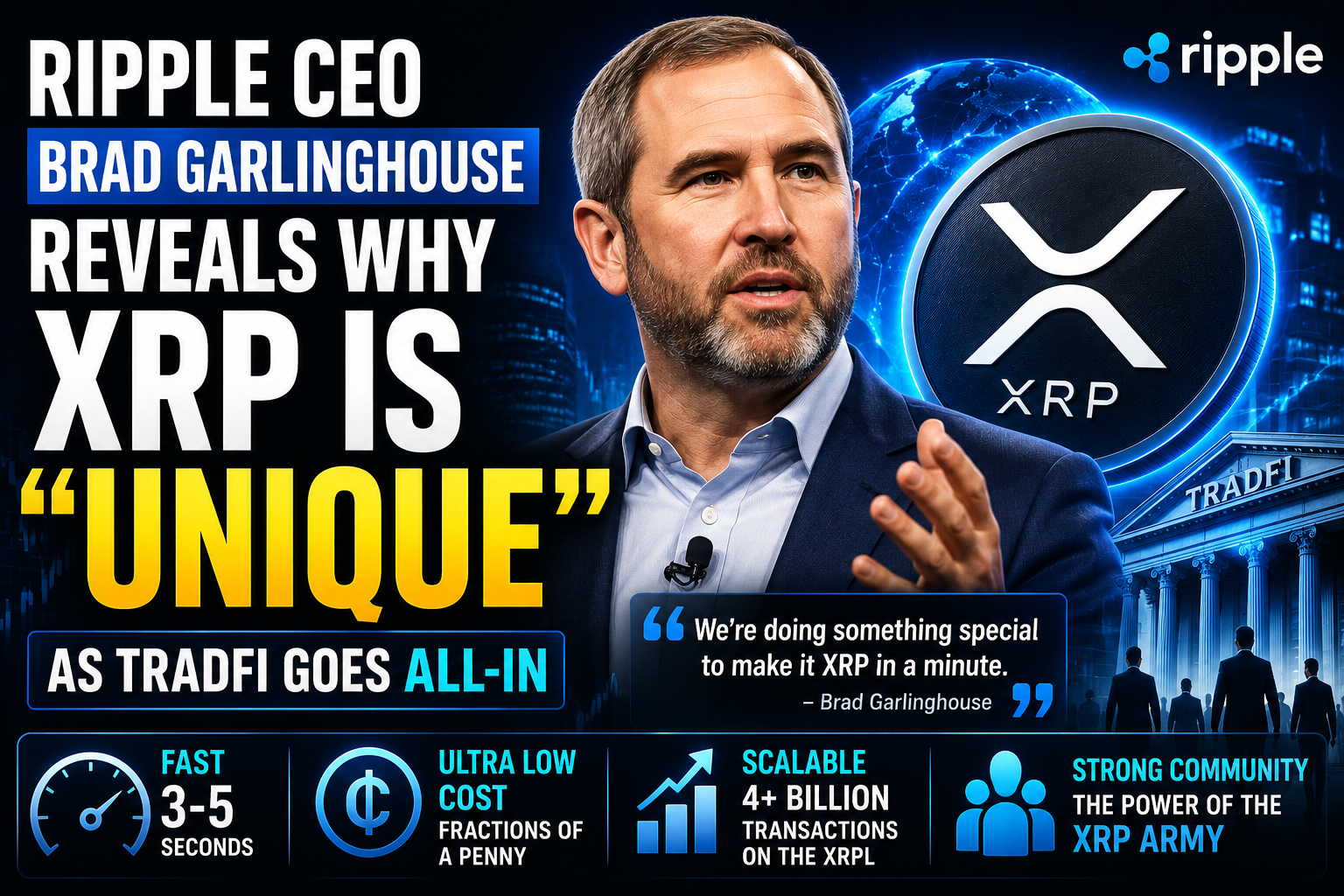
Speaking during Ripple’s “Crypto in a Minute” segment, Garlinghouse highlighted that several early Bitcoin core contributors were also involved in building the XRP Ledger. While Bitcoin evolved into a major store-of-value asset, he explained that XRP was specifically designed to solve global payment inefficiencies.
According to Garlinghouse, XRP’s biggest strengths are its transaction speed, low fees, and scalability. He noted that XRP transactions settle within three to five seconds while costing only fractions of a cent, making the network highly efficient for real-world financial use cases.
The Ripple CEO also pointed out that the XRP Ledger has already processed more than 4 billion transactions, reinforcing its position as one of the most established blockchain payment infrastructures in the crypto market.
Garlinghouse praised the loyalty of the XRP community, often referred to as the “XRP Army,” for continuing to support the project through years of regulatory uncertainty and market volatility. He suggested that the community’s long-term commitment is one of the reasons XRP remains unique within the broader crypto ecosystem.
The discussion comes as institutional interest in blockchain infrastructure and tokenization continues accelerating. During a Binance Square session, Garlinghouse joined Lily Liu and Richard Teng to discuss topics including AI, tokenization, digital payments, and crypto infrastructure.
Garlinghouse stated that the crypto market is moving beyond speculative hype and entering an infrastructure-driven phase, with traditional finance increasingly embracing blockchain technology. He specifically referenced growing institutional participation from firms such as Morgan Stanley as evidence that traditional finance is integrating more deeply into the crypto industry.
He also commented on the progress of the CLARITY Act, describing it as a major step toward regulatory clarity for the crypto market in the United States. The proposed legislation recently advanced through the Senate Banking Committee, signaling continued momentum for crypto regulation.
Meanwhile, XRP maintained relative strength despite broader market weakness that pushed Bitcoin toward the $79,000 level. XRP traded around $1.43, fluctuating between $1.41 and $1.47 over the past 24 hours, while analysts continue monitoring increasing whale wallet activity and institutional demand.