Fed Shifts Focus Back Toward Inflation
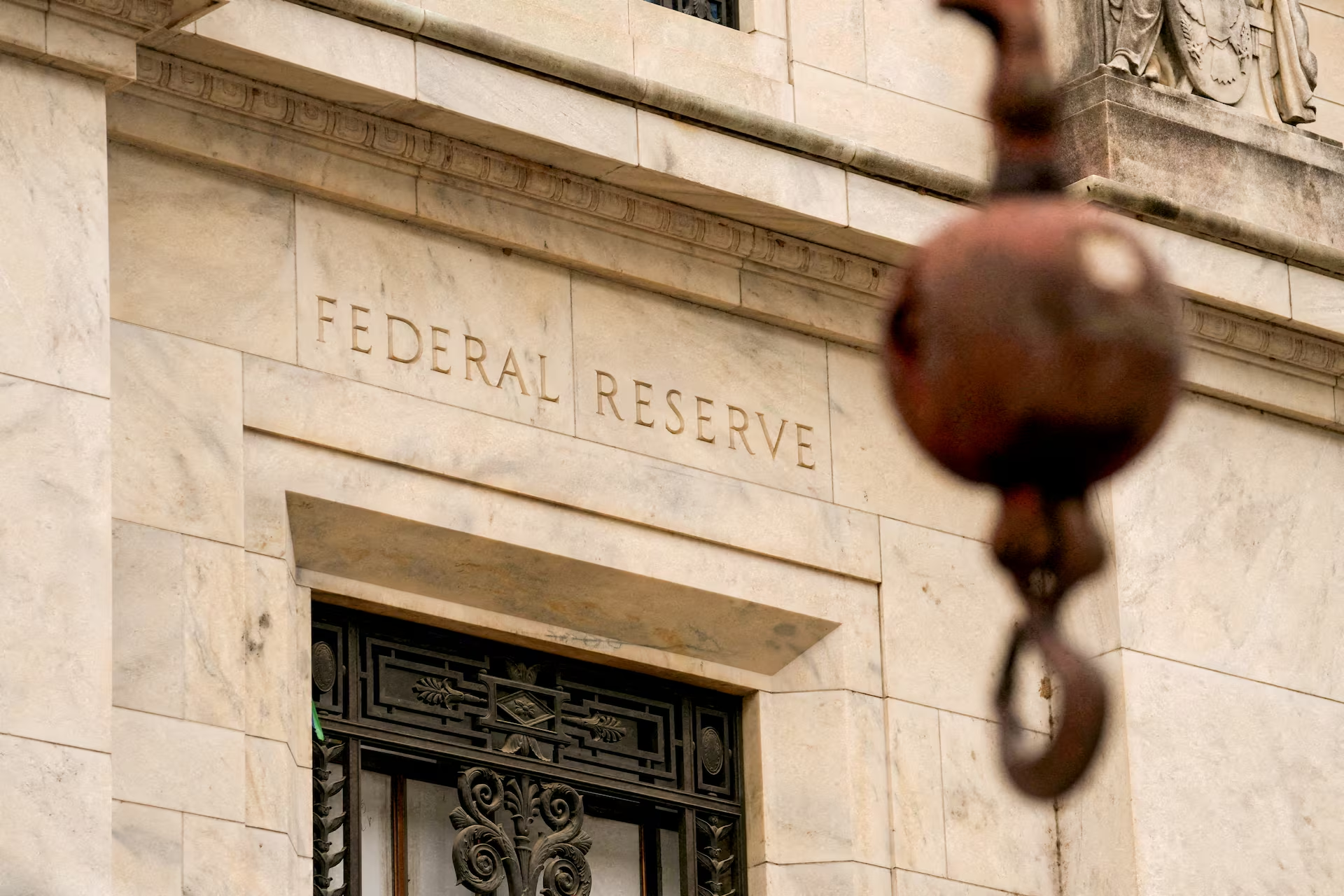
The Federal Reserve, which operates under a dual mandate of maintaining price stability and maximizing employment, is now leaning more toward inflation control after previously prioritizing labor market concerns, according to analysis from UBS Global Research.
Economist Arend Kapteyn noted that while unemployment had recently carried slightly more weight in policy decisions, a stagflationary shock linked to developments in the Middle East is now shifting the balance back toward inflation.
A Changing Balance Between Inflation and Jobs
Kapteyn explained that the Fed’s focus had gradually become more balanced heading into early 2026, with unemployment and inflation carrying nearly equal importance in policy considerations.
However, rising inflation pressures are once again pushing policymakers to prioritize price stability. Final confirmation of this shift is expected to come with the release of the June Summary of Economic Projections.
Understanding the Fed’s Policy Signals
The analysis closely examined changes in the Fed’s “dot plot,” which reflects the projections of the Federal Open Market Committee regarding future interest rates.
By analyzing how these projections respond to updates in inflation and unemployment forecasts, economists were able to estimate how much weight the Fed places on each objective over time.
From Inflation Control to Labor Market Concerns
During the post-pandemic period, the Fed’s primary focus was clearly on controlling inflation. A strong labor market allowed policymakers to tighten monetary policy without significantly risking employment.
As inflation began to ease, attention shifted toward protecting the labor market. This was reflected in a growing emphasis on unemployment in policy decisions, while the importance of inflation gradually declined.
A Balanced Fed Entering 2026
By early 2026, the Fed appeared to reach a near balance between its two mandates. The relative importance of unemployment slightly exceeded that of inflation, indicating a neutral stance rather than a clearly hawkish or dovish approach.
Data trends show that from mid-2024 to early 2026, the weight placed on unemployment rose significantly, while the emphasis on inflation declined to similar levels, with both factors eventually converging.
How Economists Measure Fed Priorities
The methodology used in the analysis is straightforward. If inflation expectations rise but interest rate projections remain unchanged, it suggests the Fed is placing less importance on inflation and adopting a more dovish stance.
Conversely, if higher inflation forecasts lead to increased rate projections, it signals a stronger focus on inflation and a more hawkish policy approach.
Stagflation Poses a New Challenge
The current economic environment presents a more complex challenge for the Fed compared to the post-pandemic period. A stagflation scenario—where inflation and unemployment rise simultaneously—forces policymakers to make difficult trade-offs.
Unlike the 2022–2023 tightening cycle, when strong economic growth provided flexibility, the Fed may now face a direct conflict between stabilizing prices and supporting employment.
June Projections to Provide Key Signals
The upcoming June Summary of Economic Projections will serve as a critical indicator of how the Fed plans to navigate this trade-off. Markets will closely watch how the FOMC adjusts its forecasts to determine whether inflation control will take clear precedence once again.