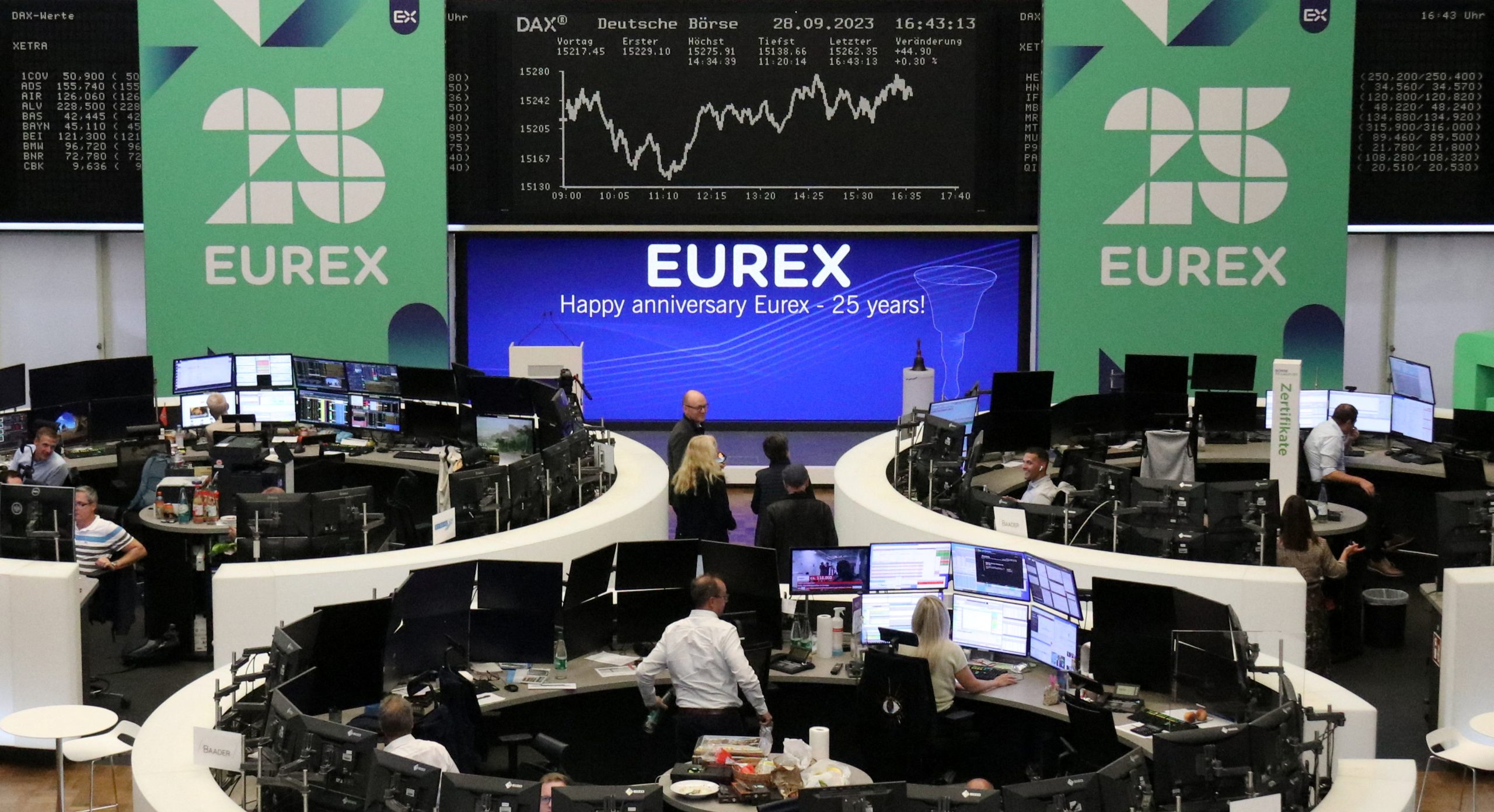
European Stocks Hold Steady Despite Oil Surge
European stock markets traded near flat levels on Tuesday, showing limited movement despite a sharp rise in global oil prices. Investor sentiment was supported by reports suggesting that U.S. President Donald Trump may be willing to end the Iran war even if the Strait of Hormuz remains largely closed.
Major European Indexes Show Modest Gains
By early trading hours, the pan-European Stoxx 600 edged up 0.1%. Germany’s DAX rose 0.2%, while the UK’s FTSE 100 gained 0.1%. France’s CAC 40 remained largely unchanged, reflecting cautious market positioning.
Trump Considers Ending Iran War Without Reopening Hormuz
According to a report by the Wall Street Journal, Trump is open to concluding the ongoing military campaign against Iran, even as Tehran maintains control over the Strait of Hormuz.
This critical shipping route accounts for roughly 20% of global oil flows, and its prolonged disruption has driven a sharp increase in energy prices while raising concerns about a potential global recession.
Oil Prices Surge Above $110 per Barrel
Brent crude, the global oil benchmark, climbed above $110 per barrel, compared to around $70 before the conflict began. The surge highlights the significant impact of supply disruptions caused by the ongoing tensions in the Middle East.
Strategic Shift Toward De-Escalation
The report indicated that reopening the Strait of Hormuz could extend the conflict beyond the initially planned four-to-six week timeline. As a result, the U.S. may focus on weakening Iran’s naval and missile capabilities before gradually reducing military activity.
Washington is also expected to pursue diplomatic efforts, potentially involving European and Gulf allies, to reopen the strategic passage if needed.
Inflation Data in Focus for European Markets
Markets are now awaiting key Eurozone inflation data for March, which could provide further insight into the economic impact of rising energy prices.
Europe remains highly dependent on energy imports from the Gulf region, particularly natural gas from Qatar, where production facilities have reportedly been targeted during the conflict.
ECB Signals Possible Rate Hikes
Officials at the European Central Bank have indicated that interest rate hikes could be considered if energy-driven inflation pressures intensify. ECB President Christine Lagarde has suggested that policymakers may act even if inflation proves to be temporary.
Economists expect headline inflation in the Eurozone to rise to 2.6% in March, up from 1.9% in February, exceeding the ECB’s 2% target.
Bond Yields Edge Higher on Rate Expectations
Expectations of potential rate hikes have led to an increase in European government bond yields, although they remained relatively stable ahead of the inflation data release. Bond yields typically move inversely to prices.