Asian Stocks Rebound as Iran Strike Delay Eases Pressure
Asian stock markets moved higher on Friday after U.S. President Donald Trump postponed planned strikes on Iran’s energy infrastructure. The delay offered temporary relief to investors, although concerns over a prolonged conflict continued to weigh on sentiment.
Mixed Signals Keep Markets on Edge
Regional markets remained under pressure after taking cues from Wall Street, which declined sharply on Thursday amid uncertainty surrounding the Iran conflict. Tehran’s rejection of direct negotiations with Washington further added to investor caution.
However, U.S. futures provided some support, with S&P 500 futures rising 0.6% following Trump’s announcement of a delayed strike deadline and hints of progress in diplomatic talks.
South Korea’s KOSPI Hit by Chip Sector Weakness
South Korea’s KOSPI index recovered from an intraday drop of nearly 3% to trade down just 0.5%. Despite the rebound, the index is still on track for a steep weekly loss of around 6%, making it one of the worst performers in the region.
Major chipmakers Samsung Electronics and SK Hynix stabilized after earlier losses of more than 4%. Still, both companies are expected to post weekly declines of 7% to 10%.
AI Developments Weigh on Chip Stocks
The weakness in semiconductor stocks was partly driven by developments from Google, which recently introduced a new compression algorithm called TurboQuant. The technology could significantly reduce memory requirements for AI applications, potentially impacting long-term demand for memory chips.
Google plans to showcase this innovation at an upcoming conference in April.
Regional Markets Show Mixed Performance
Across Asia, markets showed a mixed but stabilizing trend:
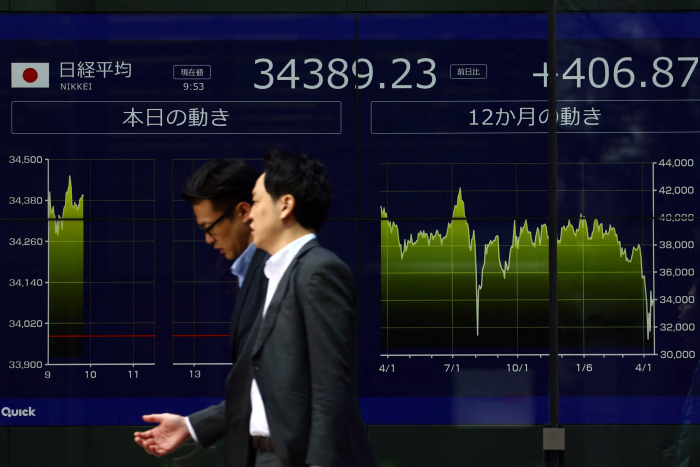
- Japan’s Nikkei 225 and TOPIX indices remained largely flat, heading for modest weekly gains.
- China’s Shanghai Composite and CSI 300 indices rose 0.7% but were still down for the week.
- Hong Kong’s Hang Seng gained 0.2%, though it remained in negative territory weekly.
- Australia’s ASX 200 slipped slightly but held onto weekly gains, supported by energy stocks.
- Singapore’s Straits Times index rose 0.7% and was flat for the week.
- India’s Nifty 50 declined 1.4% in catch-up trading after a holiday, remaining broadly unchanged for the week.
Volatility Driven by Geopolitical Uncertainty
Asian markets experienced sharp swings throughout the week due to conflicting signals about the U.S.-Israel conflict with Iran. While U.S. officials pointed to progress in negotiations, Iran denied any direct talks, though it acknowledged reviewing a ceasefire proposal.
Conflict Enters Fifth Week
Trump confirmed a 10-day extension of the deadline for potential strikes, suggesting some diplomatic progress. However, ongoing hostilities in the region indicate that tensions remain high.
With the conflict entering its fifth consecutive week, markets continue to react to every new development, keeping volatility elevated.
Outlook Remains Cautious
Although markets found some short-term support from the delay in military action, uncertainty surrounding the duration and outcome of the conflict continues to limit investor confidence.