Iran War Begins to Impact Global Economy
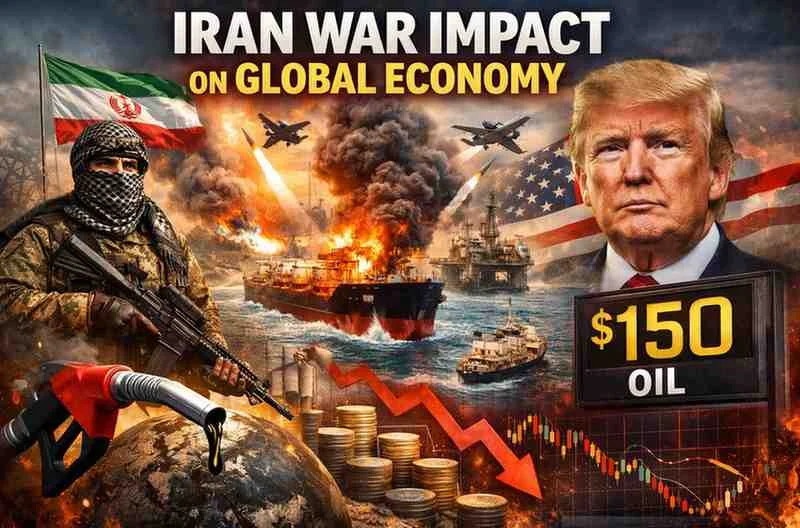
The ongoing Iran war is already placing pressure on major economies worldwide, according to the latest business surveys. Rising energy prices and growing uncertainty are slowing economic activity while pushing inflation expectations higher across global markets.
Early survey data from purchasing managers in the United States, Europe, and Japan provides one of the clearest views so far of the economic consequences of the nearly four-week conflict, which has disrupted a significant portion of global energy supply.
Energy Shock Drives Inflation and Slows Growth
The sharp increase in oil, gas, and energy-related costs is creating a double burden for the global economy. Higher energy prices are fueling inflation while simultaneously weakening economic growth, creating a challenging environment for policymakers.
This situation is also forcing governments and central banks, including those led by U.S. President Donald Trump, to reconsider their economic strategies as they attempt to contain rising price pressures.
Eurozone Growth Stalls as Costs Rise
Across the eurozone, economic activity has nearly stalled. Businesses reported longer delivery times and rising input costs, many of which are expected to be passed on to consumers.
S&P Global’s flash eurozone composite PMI dropped to 50.5 in March, a 10-month low and below market expectations. While still above the 50 mark that signals expansion, the data reflects a sharp slowdown compared to February’s 51.9 reading.
At the same time, both input and output prices in the manufacturing sector increased significantly. Business confidence weakened notably in France, while Germany’s private sector growth slowed to a three-month low.
Economists warn that the region may be facing stagflation risks, a combination of stagnant growth and rising inflation that poses serious challenges for economic stability.
US Economy Shows Similar Signs of Weakness
The United States is also experiencing similar pressures. S&P Global’s survey highlighted growing inflation concerns driven by higher energy costs, alongside weakening business sentiment.
The U.S. Composite PMI Output Index fell to 51.4 in March, its lowest level since April of the previous year. This marks the second consecutive monthly decline, with the slowdown primarily driven by the services sector.
Other Major Economies Also Under Pressure
Other Group of Seven economies are facing comparable challenges. In the United Kingdom, business activity expanded at the slowest pace in six months, while manufacturing input costs surged at their fastest rate in decades.
Japan also saw slower growth, with its composite PMI falling to 52.5 from 53.9, marking the weakest expansion in three months.
Outside the G7, India experienced a notable slowdown as well. With heavy reliance on imported energy, rising costs pushed private-sector growth to a three-year low, while companies struggled with shrinking profit margins.
Global Outlook Remains Uncertain
Despite these developments, economists are not yet forecasting a full global recession. However, the ongoing disruption of the Strait of Hormuz, a critical route for roughly 20% of global oil supply, continues to deepen the energy shock.
The economic outlook remains highly dependent on how long the conflict lasts and how energy prices evolve in the coming months.
Long-Term Risks Are Building
There is increasing concern that the economic impact of the war could be prolonged, particularly due to damage to energy infrastructure in the Gulf region following retaliatory strikes.
The Organisation for Economic Co-operation and Development (OECD) has warned that while it is too early to fully measure the impact, the global economy faces significant downside risks if the situation continues to escalate.