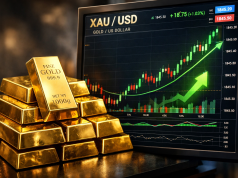
Gold prices dropped to a one-month low on Wednesday, extending losses for a sixth consecutive session. The precious metal continues to face pressure from a stronger U.S. dollar and increasing expectations that interest rates will remain elevated for a longer period.
Investors are now focused on the Federal Reserve’s latest interest rate decision, as well as any remarks from Chair Jerome Powell, particularly regarding the ongoing Iran conflict and its potential economic implications.
As of 12:55 ET (16:55 GMT), spot gold fell 2.4% to $4,887.90 per ounce, marking its lowest level in a month. Meanwhile, gold futures declined 2.3% to $4,890.99 per ounce.
Weak Safe-Haven Demand Despite Middle East Tensions
Escalating tensions in the Middle East have provided only limited support for gold prices. The metal struggled to remain above the $5,000 level this week, even as the United States and Israel intensified strikes on Iran, triggering retaliatory responses.
The conflict showed little sign of easing after an Israeli airstrike reportedly killed Iran’s security chief, Ali Larijani. At the same time, oil prices stayed above $100 per barrel following an attack on a major gas field shared by Iran and Qatar.
Market analysts noted that gold attempted to hold within a narrow range but failed to break above the $5,200 resistance level last week. This has shifted momentum in favor of sellers, raising the risk of further downside unless buyers step in.
Demand for gold as a safe-haven asset also remains subdued. Many investors appear cautious following the metal’s sharp decline from record highs reached earlier this year.
Strong Dollar and Interest Rate Outlook Weigh on Gold
A surge in demand for the U.S. dollar, particularly at the onset of the Iran conflict, has added further downward pressure on gold prices. In addition, expectations that the Federal Reserve will keep interest rates higher for longer continue to act as a key headwind.
Higher interest rates increase the opportunity cost of holding non-yielding assets like gold, reducing its appeal to investors. Unless this dynamic changes, gold may struggle to regain upward momentum.
Inflation Concerns Rise as Oil Prices Surge
Markets are increasingly concerned about the inflationary impact of the ongoing conflict. Oil prices have climbed to near four-year highs due to supply disruptions, especially around the Strait of Hormuz, a critical global shipping route.
Rising energy costs could push central banks toward a more hawkish stance. The Reserve Bank of Australia has already raised interest rates and warned about inflation risks linked to the conflict.
Focus Shifts to Fed Decision and Global Central Banks
Attention is now centered on the Federal Reserve’s policy decision, with other major central banks—including the Bank of Japan, European Central Bank, Swiss National Bank, and Bank of England—scheduled to announce their decisions later this week.
While the Fed is widely expected to leave rates unchanged, investors are looking for guidance on future policy, particularly whether inflation driven by geopolitical tensions could delay potential rate cuts.
Market expectations suggest that any rate cuts by the Fed may be postponed until at least September, adding further pressure on gold prices.
Economic Data Reinforces Inflation Pressures
Recent U.S. economic data has strengthened concerns about persistent inflation. The Producer Price Index (PPI) rose 0.7% month-over-month in February, exceeding expectations of 0.3%. On an annual basis, PPI increased 3.4%, marking the highest level in a year.
Core PPI, which excludes volatile components, also came in above forecasts, rising 0.5% monthly and 3.5% annually. These figures indicate that inflationary pressures remain elevated, supporting the case for prolonged higher interest rates.
Conclusion
In the near term, gold prices remain caught between geopolitical uncertainty and macroeconomic pressures. While ongoing conflict would typically boost safe-haven demand, a strong U.S. dollar, firm economic data, and expectations of higher interest rates are limiting upside potential.